
Think of a structure’s elastic behaviour as a ball resting on a hilly landscape. Every dip in that landscape is a shape the structure is happy to hold on its own, and every ridge between two dips is the energy barrier that keeps it there. A bistable structure, such as a hair clip or a shallow arch pushed inside out, is a ball sitting in one of two valleys. To change its shape, you push the ball over the ridge and let it fall into the neighbouring valley.
But there is a second way. Instead of pushing the ball over the ridge, you can reshape the hillside underneath it until the valley it is sitting in ceases to exist. The ball has nowhere to go but downhill.
This distinction matters because the usual routes to shape-changing, morphing structures have drawbacks. Materials that expand, contract or bend in response to heat or moisture tie the speed of shape change to the intrinsic speed of the material, such as thermal diffusion. Shape changes can take minutes or hours, and holding the new shape often means keeping the stimulus switched on. Multistable structures fix the latter energy problem, since both shapes are self-equilibrated, but something still has to supply the push across the energy barrier to initiate shape change, and doing this reliably in a larger-scale structure is not easy.
Our recently published paper in the International Journal of Solids and Structures asks a different question:
Where should active material be placed inside a structure so that heating or cooling destroys one of its stable states?
We call this strategy active stiffness tailoring. As a proof of concept, we demonstrated this strategy on a shallow arch 3D printed from two commercial photopolymers. The two polymers respond very differently to temperature, such that over the tested working range of 30 °C to 60 °C, the ratio of their stiffnesses reduces from roughly 355:1 to roughly 14:1—a 25-fold change. Crucially, it is this change in ratio that drives the mechanics, and not the absolute stiffness of the components. Scaling both materials by the same factor rescales the energy landscape but leaves its shape, and therefore the stability of the arch remains untouched. But if the ratio is changed, the strain energy redistributes between the stiff and compliant regions, changing the energy landscape itself.
This gives us a design variable to optimise: the boundary between the two materials through the thickness of the arch. We optimised this interface to optimise the relative proportion of the two material through the thickness in order to maximise the strain energy released at the point where the arch loses stability and transitions into the second state. A larger energy release means a more decisive snap and a design less likely to be derailed by manufacturing scatter.
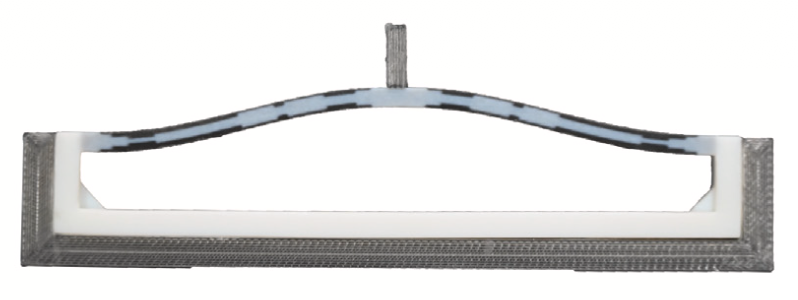
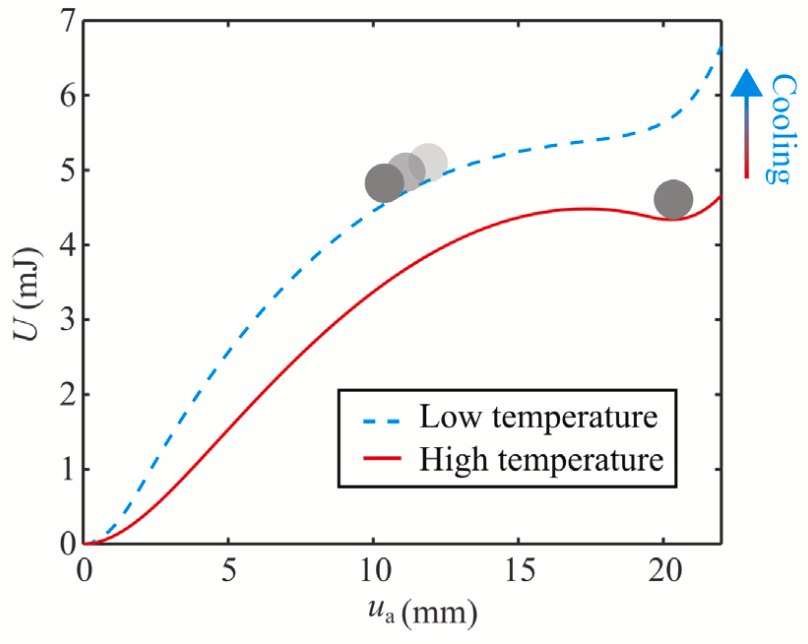
Two designs were optimised, and they behave in opposite thermal directions. One is bistable when hot and becomes monostable on cooling (snaps upon cooling), and the other is bistable when cold and becomes monostable on heating (snaps when heated). The material layouts that achieve this are not ones you would have guessed by eye: the optimiser places active material where its softening with temperature most severely degrades the bending stiffness that sustains the everted shape, and keeps passive material where it is needed to preserve bistability before actuation.
We then tested the snap-upon-heating design in a water bath to test and demonstrate the phenomenon experimentally. While the shape transition occurred as expected, the measured transition temperature exceeded our predicted temperature by nearly 11 °C. Frame recoil, uncertainty in the material data and thermal expansion are all possible explanations for this discrepancy.
The result we find most interesting is about timescales. Heating the water bath took minutes. The snap itself took less than a second. Once the critical stiffness ratio of the two materials is crossed, the rate of shape change is independent of how fast the polymer responds itself and rather is set by how much elastic energy is released into motion. The stimulus and the response have been decoupled, which is exactly what conventional shape-memory actuation cannot offer.
More broadly, this is another example of instabilities being used for design rather than being avoided as a failure mode. In this case, elastic nonlinearity does the job that sensors, actuators and control systems often do together. Where the structure is stable, how much energy it will release and where it ends up can all be programmed into the material layout at the printer, and then triggered later by an ambient temperature change. No motors, no wiring, no control loop. There is also no reason to assume that the stimulus has to be heat — light, moisture, electric and magnetic fields would all serve as potential ambient actuation sources, provided they change stiffness enough to reshape the energy landscape.