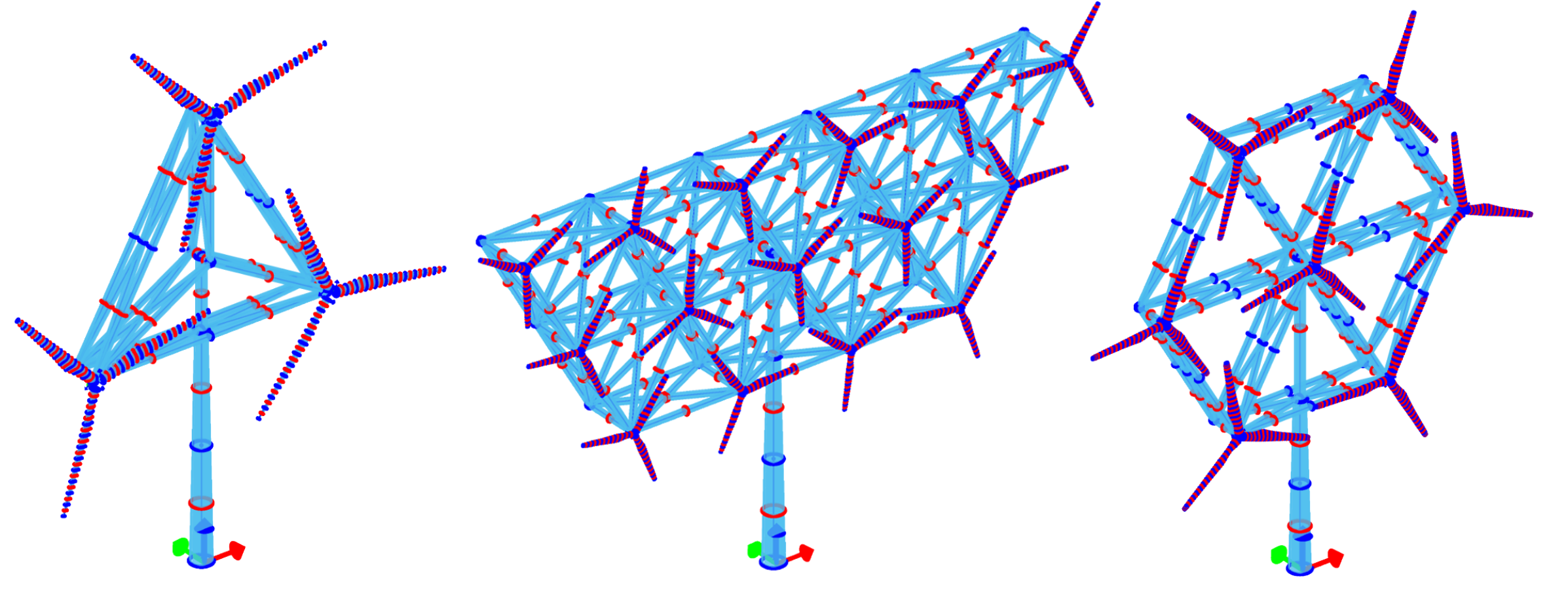
Wind energy is expected to be one of the central pillars of a low-carbon electricity system, and for the past few decades the industry has pursued a single, simple strategy to push costs down: build bigger. Each new turbine generation carries a larger rotor than the last, because — up to a point — a longer blade sweeps more area and captures more energy. But the trend cannot continue indefinitely. As blades grow, the mass of blades, generator and nacelle climb faster than the power they produce, and the practical headaches of manufacturing and transporting large components begin to factor. Eventually the cost of going bigger outweighs the extra energy, and the levelised cost of energy (LCoE) — the price of electricity averaged over the lifetime of the turbine — stops falling.
One way around this ceiling is to stop thinking of a turbine as a single rotor. A multi-rotor wind turbine (MRWT) replaces one very large rotor with a coplanar array of many smaller rotors mounted on a shared support structure. The installation occupies a similar footprint and produces the same total power, but the individual blades are short enough to be considerably easier and cheaper to build and transport. Smaller rotors also mean less material overall and the system can keep producing energy even if a rotor fails.
This is the promise, at least. The difficulty is that nobody can yet say with confidence how large these savings really are. The theoretical argument most often cited in support of multi-rotors — a “square-cube law” of scaling — is not borne out by simulation data, and there are few physical installations or detailed design studies to check against. Most existing studies take shortcuts: they reuse rotors designed for conventional single-rotor machines, simplify or ignore important ways the structure can fail, or tend to conclude that increasing rotor count indefinitely always lowers costs — a result that is unlikely to hold in practice.
In a recent paper presented at the Torque 2026 conference, we set out to close that gap with a more honest design process. The work uses an in-house aeroelastic optimisation tool, ATOM, to design a multi-rotor turbine from first principles. “Aeroelastic” simply means the calculation accounts for both the aerodynamic loads imposed by the wind and the way the structure deforms in response; “optimisation” means the software automatically searches for the design that minimises cost. Importantly, the rotors are not borrowed from single-rotor turbines — they are drawn from an open library of rotors (blog post here) we optimised specifically for the multi-rotor context in earlier work.
Designing a multi-rotor turbine means answering two intertwined questions at once: how many rotors to use, and how to arrange and size the support structure that holds them. We tackle this with a “tiered” approach. For each candidate number of rotors, the software lays out the arrangements that are geometrically feasible — square grids, hexagons, pyramid-like stacks — and then designs the lightest support structure that can sustain loads in each case, checking every member against strength, buckling and fatigue failure. The competing arrangements are ranked by cost of energy to choose the best one for that rotor count. As a demonstration, optimising the support structure of a seven-rotor, 3 MW turbine reduced structural mass by nearly 70%.
The ultimate aim of this work is not to hand industry a ready-to-build blueprint, but to make a fair comparison possible. Because we now optimise both the rotors and the structure that carries them — rather than scaling up off-the-shelf parts — the eventual head-to-head comparison against an equivalent single-rotor turbine should be more representative than previous attempts. This conference paper is a deliberately preliminary step: it demonstrates the framework on individual cases, and the next stage is to sweep across a wide range of rotor numbers to locate the genuine sweet spot for a given power rating. Only then can we offer a credible answer to the question if multi-rotor turbines actually make wind energy cheaper.