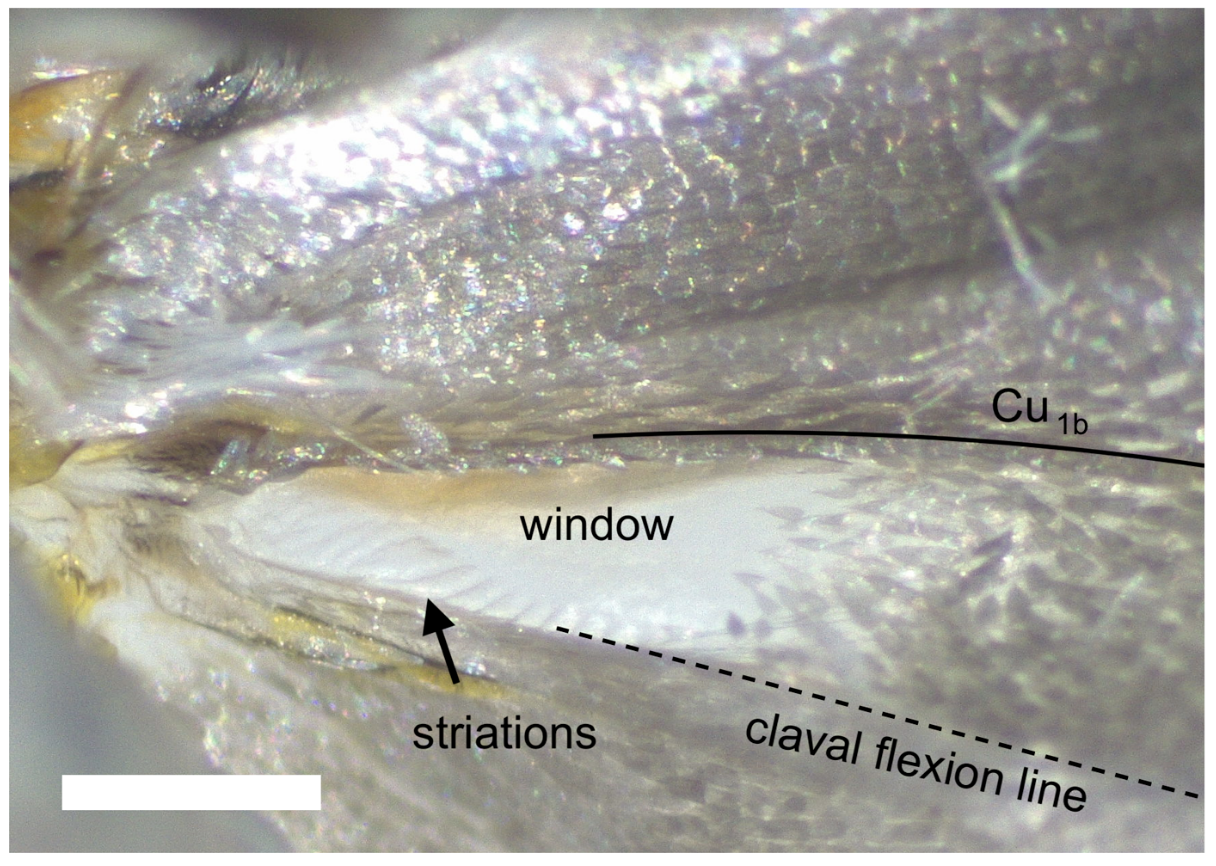
Moths are not usually thought of as noisy animals, but some species produce rapid bursts of ultrasonic clicks that interact with the echolocation systems of hunting bats. In ermine moths (Yponomeuta), these sounds originate from a small structure on the hindwing known as a tymbal. The mechanics behind how this tiny feature generates sound are surprisingly rich and provide an interesting example of how biological structures exploit mechanical instabilities.
The tymbal consists of a narrow band of ridges located along a natural fold in the wing. As the moth flaps, this region deforms under aerodynamic and inertial loads. Our work shows that the ridges do not simply bend smoothly. Instead, they undergo sequential snap-through buckling: each ridge flips between two stable shapes one after another. Every snap produces a short mechanical impulse, and the series of snaps during a wingbeat results in a burst of ultrasonic clicks.
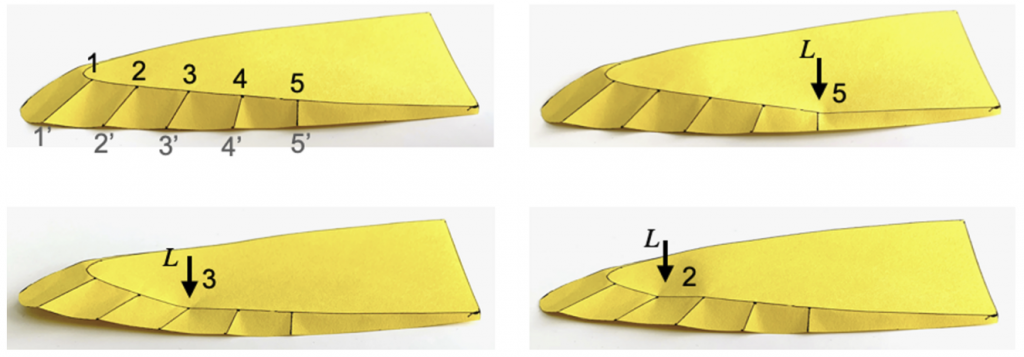
To understand this process, we studied the geometry and motion of the wing and then constructed a simplified creased-shell analogue, inspired by the mechanics of origami. The model captures how a thin shell with discrete crease-like features can buckle in a controlled sequence. In the moth, the resulting vibrations propagate into a nearby thin region of the wing, which acts as a lightweight radiating surface that emits sound.
From a mechanics perspective, this is interesting because buckling is usually considered a structural failure. Here, however, it is deliberately built into the morphology and used as a functional mechanism. The ermine moth effectively couples the wing-beat motion during flight into a repeatable sequence of mechanical snap events that generate sound (and because the moth is deaf, it is none the wiser for it).
Beyond the biological insight, this system highlights how thin shells with patterned creases can be designed to trigger controlled sequences of instabilities. Such ideas may be useful in the design of lightweight acoustic devices, responsive structures, or engineered systems that harness snap-through behaviour rather than avoiding it.