Tag: Aircraft

  • Wingtip Vortices and Fluidic Winglets

    This is the second guest post by Jason D’souza, a recent MSc Graduate in Aerospace Vehicle Design from the University of Cranfield in the UK. Winglets are aerodynamic devices that feature on many modern commercial aircraft, but do have certain drawbacks. In this post, Jason considers a slightly different, on-demand system, known as a fluidic winglet and demonstrates its interesting properties using CFD analyses.

    Turmoil in The Sky

    The environmental impact of aircraft carbon footprint is of rising importance to all operators as consumer demand for air travel continues to grow. The aviation industry holds a small contribution to global emissions, but unequivocally, it is one of the fastest growing contributors to emissions. Since the 1970s, when the price of aviation fuel began to spiral upward, airlines and aircraft manufacturers have explored many ways to reduce fuel consumption by improving the operating efficiency of their aircraft. Fuel economy concerns have been particularly important for operators of commercial aircraft, which typically fly many hours per day in competitive markets. Hence, there are also good economic incentives for reducing emissions, since reduced emissions are naturally related to reduced fuel consumption and savings in fuel expenditure for air carriers.  A great potential source for fuel savings is reducing parasitic drag of the airframe, such as inherent wingtip vortices.

    Introduction to Wingtip Vortices

    Wingtip vortices are schematically illustrated in Figure 1. If a wing is producing lift, a pressure differential exists between the upper and lower surfaces, i.e. for positive lift, the static pressure on the upper surface will be less than on the lower surface. At the tips and trailing edges of the wing, the existence of this pressure differential creates a vortex where the high-pressure air below the wing spills onto the low-pressure area above the wing to form a swirling tunnel of turbulent air along (top of Figure 1) and behind the wing (bottom of Figure 1). The vortex is strongest when the angle of attack is high, such as during take-off and landing, because the pressure differential at high angles of attack is greatest during these phases.
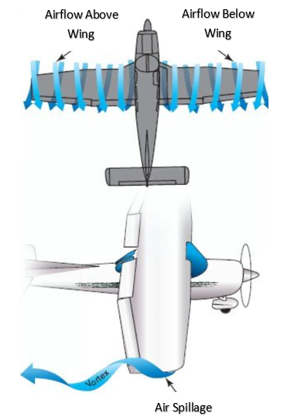
    Figure 1: Wingtip Vortices [2].

    Why are wingtip vortices detrimental to aircraft aerodynamics?

    To create a specific lift coefficient with the airfoil section, a certain angle of attack must exist between the airfoil chord line and the relative wind; see Figure 2. However, as the total lift force is developed perpendicular to the wing chord line, it is angled slightly backwards. There are two problems occurring here; firstly, some of the total lift force is now deflected backwards leading to the creation of lift-induced drag, illustrated in Figure 2; and secondly, there is a smaller component of lift pointing upwards to counterbalance the weight of the aircraft. Both of these effects are to the detriment of the lift-to-drag ratio, a key efficiency parameter in aircraft design. Thus, as a result of this decrease in vertical lift, the wing must be given an angle of attack greater than the current section angle in order to generate more lift to account for the inclination of the total lift force. However, any increase in the angle of attack also increases the lift-induced drag. Wingtip vortices exacerbate this lift-induced drag by causing the total lift force to point even further backward. A number of possible solutions exist for mitigating the effect of vortex-induced drag, but conventionally, wingtip retrofits, commonly known as winglets, are used to mitigate the problem.
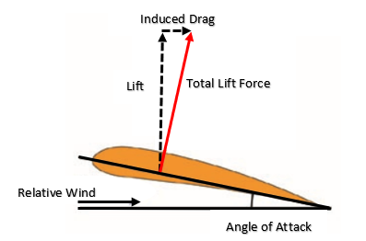
    Figure 2: Lift-Induced drag.

    How do winglets help to improve the situation and what are some of the drawbacks?

    One of the visible actions taken by commercial airframe manufacturers to reduce wingtip vortices is the modification of an aircraft’s wingtip by installing, as shown in Figure 3, near-vertical “winglets”. Experience shows that these tip devices reduce block fuel consumption (total fuel burn from engine start at the beginning of a flight to engine shutdown at the end of the flight) of the modified aircraft by 3% – 5%, depending on trip length [1].
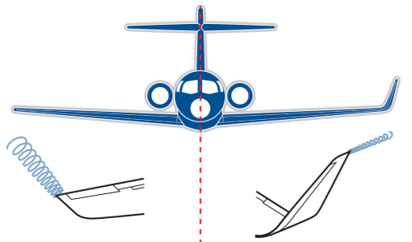
    Figure 3: Vortex intensity with and without winglets [3].

    Winglets are airfoil-shaped structures that also produce lift but are orientated inwards towards the fuselage relative to the rest of the wing. The presence of winglets changes the effect that wingtip vortices have on lift and drag. The winglets cause the relative wind to bend inwards towards the fuselage, creating a forward vector of lift in the direction of flight counteracting some of the induced drag, as illustrated in Figure 4.
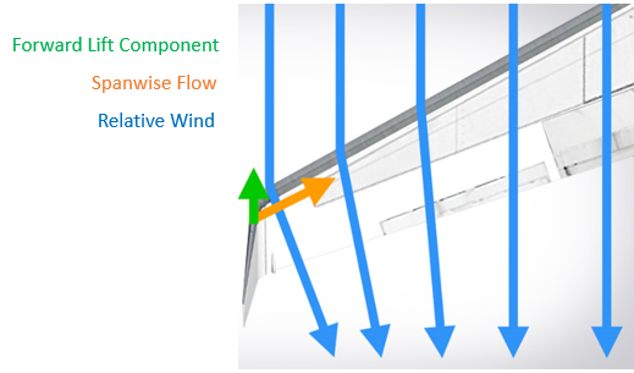
    Figure 4: Creation of forward lift force to partially alleviate induced drag [4].

    However, winglets do not operate effectively under all conditions throughout the flight envelope and incur an added mass penalty. So, the question is whether winglets conserve more fuel by reducing drag than the extra fuel required to carry their mass? An inherent problem with winglets is their susceptibility to flutter and increased bending stresses in the winglet fold area. In fact, under some flight conditions an equal area, flat span extension can be a more effective and less risky design solution. Lastly, winglets are always present in flight, as they are fixed devices attached to the tips of wings, and because they are fixed surfaces, they provide their best lift-induced drag reduction for a single design point. Hence, a more on-demand and active, rather than passive, type of control device could be of benefit. One example is the use of a “Fluidic Winglet”.

    What is a fluidic winglet and how does it work?

    A fluidic winglet is a system architecture that can provide a controlled stream of air ejected outwards in the vicinity of the wingtip, as shown in Figure 5, to create an aerodynamic force strong enough to disrupt the vortex formation. This system architecture could potentially produce the same benefits as a winglet without a visible increase in wingspan.

    Figure 5: Wing with fluidic winglet.

    The pressurised air for the fluidic winglet could be taken from: 

    1. The jet engine 
    2. The aircraft surface 
    3. The leading edge of the wing
    4. An internal pressurised air tank

    RAM drag (a common source of system-induced drag caused by taking in air, typically for cooling purposes) and weight penalties introduced from the above systems must be considered when evaluating the system. If air is taken from the aircraft surface, then a Laminar Flow Control (LFC), a Hybrid Laminar Flow Control (HLFC) system, or a duct located at the wing leading edge stagnation pressure line could be appropriate. However, this would not result in high jet momenta and will be limited to lower mass flow rates [5]. The LFC and HLFC systems are active boundary layer control techniques, shown in Figure 6, that help to maintain the laminar flow state by means of suction onto the wing surface during flow states that would otherwise be transitional or turbulent.
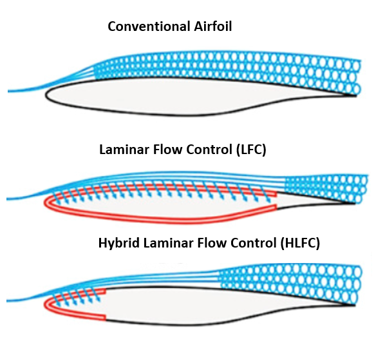
    Figure 6: Laminarisation of flow using LFC and HLFC systems [6].

    If the air used to operate the fluidic winglet is taken from a separate pressurised tank inside the fuselage, the fluidic system could look something like depicted in Figure 7. Once the pilot signal is received, a solenoid valve allows the air to be released from the tank where it is regulated to provide the required exit velocity. The air then flows into the vortex dissipation device where the air is distributed to the discharge nozzles. If the exit pressure past the pressure regulating valve (PRV) exceeds the design limit, a shut-off valve ahead of the PRV will not allow fluid to pass above a certain set pressure as a fail-safe.
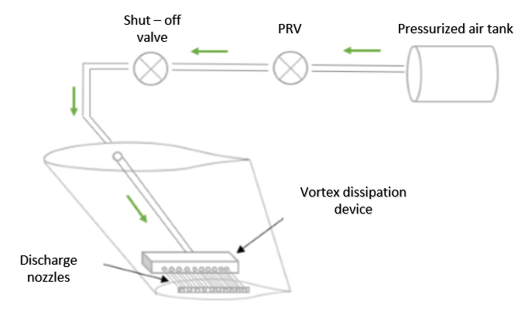
    Figure 7: Potential fluidic system architecture.

    Analysis – What potential benefits of the fluidic winglet can be expected over conventional alternatives?

    In order to ascertain the potential benefits of the fluidic winglet, the lift coefficient (CL), drag coefficient (CD) and lift-to-drag ratio (CL/CD) of three models are investigated using ANSYS Fluent, and the results are extracted and summarised in Figure 8. The models designed are:

    1. A clean wing (CW) with no winglet attached: designed from a NASA HSNLF (1)-0213 airfoil with a leading-edge sweep angle of 33° and a taper ratio of 0.4.
    2. A wing with a raked winglet (WRW): designed from a NACA 0012 airfoil with 10% of wing semi-span and a taper ratio of 0.2 and with a sweep angle greater than that of the wing of about 57°.
    3. A wing with the fluidic winglet (WFW): this will not require a wingtip extension, and hence, there is no physical increase in the wing’s span. The fluidic winglet instead consists of a rectangular high-aspect ratio slot.

    Note: The models do not have an aerodynamic twist consideration.

    The boundary conditions that constitute the flow variables are: a freestream velocity of 50 m/s and an injection velocity three times the freestream (150 m/s) with a jet sweep angle equivalent to that of the wing sweep (i.e. the jet is co-linear with the wing). These models will be tested at high angles of attack of 7.5°, 10° and 12.5° to simulate the effect of the fluidic winglet on the vortex when it is strongest.
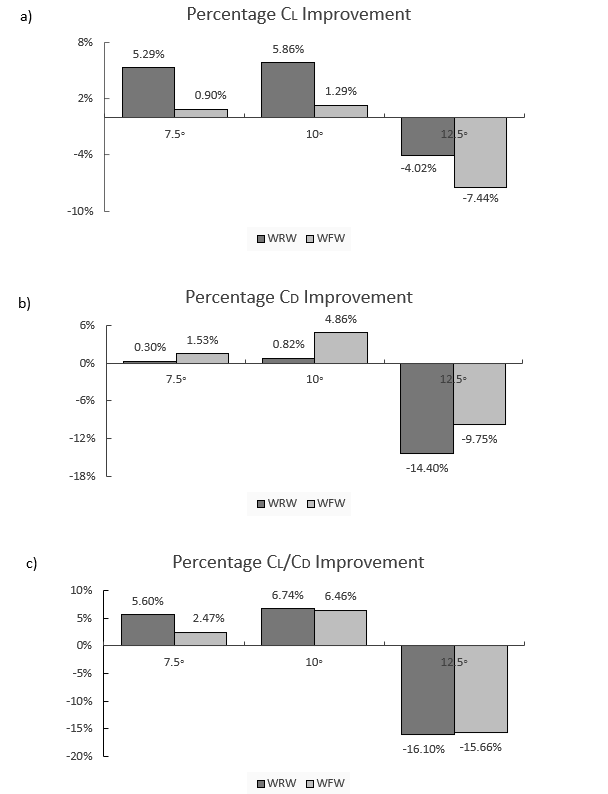
    Figure 8: a) Lift coefficient improvement with addition of raked and fluidic winglet. b) Drag coefficient improvement with addition of raked and fluidic winglet. c) Lift-to-drag ratio improvement with addition of raked and fluidic winglet.

    As illustrated in Figure 8c), the results indicate that having a tapered wingtip extension (i.e. a raked wingtip, WRW) provides improved aerodynamic efficiency (CL/CD) of 7% for an angle of attack of 10°, and generally better levels of drag reduction are expected at lower (7.5° and 10°) angles of attack than higher (12.5°) angles. As shown in Figure 8a), the WRW improves the lift coefficient much more than the fluidic wingtip (WFW). This is due to the increase in wing area added by the physical wingtip. However, this additional surface area causes a parasitic component of drag, which is why the WFW outperforms the WRW design in terms of drag coefficient, as shown in Figure 8b). Further, in Figure 8c) it appears that the WRW’s performance is reduced by 16% at an angle of attack of 12.5°, which occurs due to local wingtip stall. There are two reasons for this stall occurrence; firstly, the dissimilarity between the main wing airfoil and the raked winglet airfoil and secondly, the WRW is not twisted. The WRW should employ twist to avoid local stalling at such high angles of attack.

    Similarly, the application of the fluidic WFW at high angles of attack leads to improvements to the wing’s aerodynamic efficiency. As shown in Figure 8c), at 7.5° angle of attack, the lift-to-drag ratio is increased by 2.5%, and at 10°, the lift-to-drag ratio is increased by 6.5%. However, for the 12.5° angle of attack, when the 50 m/s freestream air collides with the 150 m/s jet, stalling occurs locally, thus spoiling the lift and increasing drag. This stall condition occurs due to a local increase in the Reynolds number in the region where the freestream and jet efflux meet.

    Nonetheless, because the fluidic winglet has no additional surface exposed, there is no increase in parasitic drag. This fact contributes to acceptable drag reductions as shown in Figure 8b). Hence, the overall enhancement of the lift-to-drag ratio between the WRW and the WFW is very similar emphasizing the capability of the WFW. The WRW is more effective at improving the lift, whereas the WFW is better at reducing drag. Furthermore, the WFW can be activated at any specific angle of attack, and has the potential to deliver better levels of drag reduction at more than a single design point during the flight envelope. Other benefits not only include potential improved fuel economy, but also improved payload-range capability, improved take-off performance, and less take-off noise.

    How is the fluidic winglet able to improve the lift-to-drag ratio?

    The WFW is able to improve aerodynamic efficiency by altering the chordwise lift distribution along the wingspan. It is generally well known that an elliptical lift distribution in the spanwise direction is optimal for reducing induced drag for a specific wing area and lift. First, as shown in Figure 9, the WFW (right figure) makes the lift distribution more elliptical than the clean wing (left figure). Furthermore, it is observed that, at high angles of attack, the sectional chordwise pressure distribution on the upper and lower surface of the WFW changes favourably from root to tip.
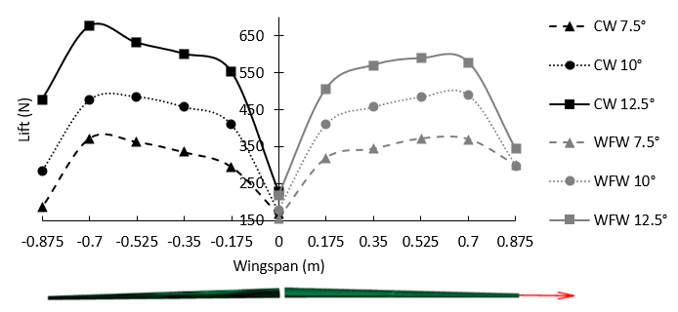
    Figure 9: Spanwise lift distribution over CW (Left) and WFW (Right).

    The spanwise variation in the sectional lift force, as shown in Figure 9, for the CW is observed to increase until the 80% wing semi-span location, at which point it drops off dramatically. This drop off in lift force towards the wingtip (100% wing semi-span position) is due to the creation of wingtip vortices that disrupt effective lift generation over the wing. It is clear that the aerodynamic lift force is considerably increased by the WFW towards the wingtip for the 7.5° and 10° conditions, thereby demonstrating the effectiveness of the jet efflux to increase the aerodynamic loading at the wingtips for the angles of attack tested herein. The only exception is the 12.5° angle of attack condition, where the addition of the fluidic jet efflux creates a local stall condition, as previously discussed above.

    Additional thoughts – How could fluidic winglets be implemented?

    It is important to evaluate aircraft inventory and identify the most suitable aircraft candidates for fluidic winglet modification. The process could be summarised under four main tasks:

    1. Examine the feasibility of modifying aircraft with fluidic winglets, to include a cost-effectiveness analysis of the modification in net present value (NPV) terms.
    2. Determine the market price of aviation fuel at which incorporating the fluidic winglets would be beneficial for each platform.
    3. Consider impact to aircraft maintenance and flight operations (including ground operations).
    4. Investment strategies to minimize the operator’s capital investment and maximize investment return.

    These tasks call for a quantitative assessment of the costs and benefits of fluidic winglet modifications on a variety of platforms. In a comprehensive analysis, one would need to include the non-recurring engineering costs of wing analysis and fluidic system design, as well as the costs of materials, manpower, and out-of-service time to accomplish the modification, financial implications, training costs, potential impacts on maintenance docks, costs associated with software and technical manual revisions, and any impacts on maintenance, operations, or mission accomplishment.

    In each case, the aircraft structure needs to be studied and determined to be appropriate; engineering design must be analysed in detail; modifications will need to be prototyped, tested, and certified; modification kits to be developed and flight manuals revised as required. Past commercial experience with aircraft that have installed conventional winglets has shown that there have been no significant impacts on aircraft maintenance, flight operations, or ground operations (gate space, taxiways, hangars, etc.) [1].

    Conclusion

    It is clear that aerodynamic improvements, including fluidic winglets, can make significant contributions to the efficiency of aircraft. In each case, however, the appropriateness of such structural/system modifications must be determined fleet by fleet. These decisions are very complex and will depend on many factors, including the design of the aircraft’s structures, systems design, design margin within those structures, the condition of the structures, mission profiles, utilisation rates, fuel consumption rates, fuel prices, and the remaining life of the aircraft. There are also other ways to reduce fuel consumption, many of which have already been adopted by commercial airlines. Nonetheless, the best solution is decided by economics rather than aerodynamics.

    The design of the fluidic winglet combines several disciplines such as structures, manufacturing and assembly, systems, aerodynamic and flight dynamics. The selection of the most appropriate system air resource and subsequent system design will depend upon the jet efflux requirements of the fluidic winglet. The benefits of the concept are highly dependent upon the jet parameters like the jet momentum coefficient, jet dihedral, jet sweep, jet thickness and jet area as well as the boundary conditions. Higher jet momenta and smaller jet cross-sectional areas show promise to move the vortex centre further away from the wingtip to increase the effective wingspan. Jet sweep angles higher than the wing sweep angle are not suspected to provide improved results.
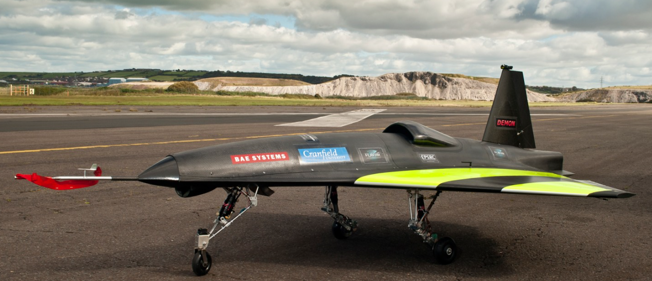
    Figure 10: Flaviir demon project – a collaboration between BAE Systems and Cranfield University [7].

    Since 2010, BAE Systems has set out to develop key technologies and skills with long-term collaboration from academia, industry and the UK government to create the combat air system of the future so that the UK can deliver more advanced capabilities through shared investment and revolutionise aircraft design. The first ever exhibit of fluidic flight control (i.e. no flaps, elevators or ailerons) begins with the FLAVIIR Demon Project (Flapless Air Vehicle Integrated Industrial Research program), a UAV showcasing new technology for the conventional flight control system. There are slots located on the wing’s trailing edge for the blown compressed air taken from the APU (Auxiliary Power Unit) to be curled either upwards (i.e. lowering the wing) or downwards (i.e. lifting the wing) to provide for control of the aircraft. This allows for a more seamlessly integrated design with fewer mechanically moving parts, and hence, a design with reduced edges and gaps that make the aircraft less observable on radar.
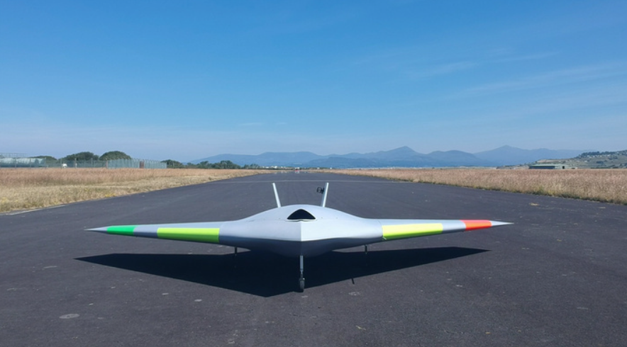
    Figure 11: MAGMA project – a collaboration between BAE Systems and the University of Manchester [8].

    Similarly, in 2017 BAE Systems, in collaboration with the University of Manchester, revealed the first flight of MAGMA, a new UAV iteration showcasing novel control technologies for wing circulation control and fluidic thrust vectoring. The wing circulation control system takes air from the aircraft engine and blows it supersonically through the trailing edge of the wing to provide roll control for the aircraft. The fluidic thrust vectoring systems also uses blown air to deflect the main thrust allowing for the pitch direction of the aircraft to be changed. So far, flight tests have been promising and we are awaiting the first use of such circulation control in flight on gas turbine aircraft.

    References

    [1]National Research Council. ASSESSMENT OF WINGTIP MODIFICATIONS TO INCREASE THE FUEL EFFICIENCY OF AIRCRAFT, accessed 10/01/2020.

    [2] Jeffrey (2008). Wingtip Vortices and Wake Turbulence Explained, accessed 10/01/2020.

    [3] Mike C (2017). WHAT AM I: WINGLETS, accessed 10/01/2020.

    [4] Colin C (2019). This Is How Winglets Work, accessed 10/01/2020.

    [5] Ronald J (1998). Overview of Laminar Flow Control, NASA Technical Paper, accessed 10/01/2020.

    [6] Krishnan K (2017). Review of hybrid laminar flow control systems, accessed 10/01/2020.

    [7] Ben C (2010). DEMON UAV achieves historic first ‘flapless flight’, accessed 10/01/2020.

    [8] Andrea K (2019). MAGMA: The future of flight, BAE Systems, accessed 10/01/2020.

  • Podcast Ep. #29 – Samson Sky is Building the First Truly Useful Flying Car

    Sam Bousfield is the founder and CEO of Samson Sky, a company that is developing the first truly useful flying car. Sam is an architect by training, but a passion for aviation led him to work on a supersonic aircraft with Boeing. Out of this experience came the idea of building a flying car called the Switchblade.

    Harking from an architectural background, Sam approached the problem of designing a flying car slightly differently. Rather than asking the question of how you could make a car fly, Sam and his team focused on the architectural question of how a vehicle that can both fly and drive should be designed. Answering this question led the Samson team to some unique design choices, such as a three-wheel layout and wings that stow and swing out from underneath the vehicle. One of the other challenges in designing a flying car is striking the right compromise between on-road and off-road performance. For example, a car should preferably create downforce, while a plane should create lift. To achieve this Samson Sky has made some very clever design choices in terms of the layout and shaping of the Switchblade, as well as the positioning of the wings and centre of gravity, and the use of lightweight composite materials. In our conversation, Sam and I talk about:

    • why it has taken so long for a functional flying car to be built
    • the main design challenges that need to be overcome
    • the changes that need to be made to the vehicle when switching between flying and driving
    • the way that Sam envisions the Switchblade to be used in practice
    • and much, much more.


    Selected Links from the Episode

  • Podcast Ep. #26 – How AERALIS is Designing a New Family of Military Trainer Aircraft

    On this episode I am speaking to Luca Leone who is the Head of Programme of AERALIS, a British startup designing a new class of military trainer and aerobatic jet aircraft. AERALIS have set out to re-invigorate the UK aircraft manufacturing sector with a military trainer that provides an exceptional pilot training experience.

    AERALIS’ design is purposely modular meaning that a basic and an advanced version of the training aircraft are based on one common platform. This reduces costs in engine and airframe maintenance through training and spares commonality and also facilitates a shorter training period for pilots due to similarities between aircraft types. What’s more, AERALIS are developing a fully tailorable flying training system based on configurable cockpits and advanced simulators. In this way, AERALIS aim to not just be an aircraft manufacturer but a company that designs the total flying training experience. In this episode, Luca and I talk about:

    • the features of the basic and advanced trainer aircraft
    • the characteristics of the modular design
    • the AERALIS training ecosystem
    • and much, much more


    Selected Links from the Episode

  • Podcast Ep. #12 – The Perlan Project: Soaring to the Edge of Space

    This episode features an in-depth look at the Perlan Project. The mission of the Perlan Project is to fly an engineless aircraft to the edge of space, in this case, by taking advantage of an aerodynamic phenomenon known as wave lift. Not only is soaring to 90,000 feet an audacious goal, but on top of that, the Perlan Project is a worldwide collaborative project run entirely by aviation enthusiasts, scientists, engineers and adventurous pilots. No one has ever soared to the edge of space in a glider and so the Perlan engineers are venturing into unchartered aviation territory on their own. On this episode of the Aerospace Engineering Podcast I speak to Project Manager Morgan Sandercock and Flight Test Engineer Alan Lawless about:

    • the genesis and history of the Perlan Project
    • how one goes about designing, manufacturing and testing a glider that is to fly to the edge of space
    • past success stories
    • and the team’s future plans for breaking aviation records.

    In case you personally want to support the Perlan Project as a donor, you can do so on the Perlan Project donor page.


    Selected Links from the Episode

  • Podcast Ep. #5 – Concorde Chief Engineer John Britton on Supersonic Flight

    In this episode I am talking to John Britton. John was the chief engineer of Concorde on the British side of the enterprise from 1994 until Concorde’s demise in 2003. John possesses a wealth of knowledge regarding the engineering behind Concorde, and its heritage in Bristol, UK. Because he was the chief engineer at its demise, he also has a unique insight into why the aircraft is no longer flying today. In this conversation, John and I talk about:

    • how he ended up as the Chief Engineer of Concorde
    • what engineering feats made Concorde special
    • why Concorde is no longer flying today
    • and what he thinks new supersonic companies need to focus on

    This interview was recorded at Aerospace Bristol, which is a new aerospace museum located at Filton Airfield in the South West of the United Kingdom. From the beginnings of powered flight, Filton Airfield was the birthplace of many a flying machine – from aeroplanes and helicopters to missiles and satellites. Aerospace Bristol represents the new heart to the area’s aerospace heritage.


    Selected Links from the Episode


  • Podcast Ep. #4 – Kim-Tobias Kohn on Electric Aviation

    “We need to get going into the future in terms of clean aviation” — Kim-Tobias Kohn

    On this episode of the podcast I speak to Kim-Tobias Kohn who is a lecturer in Aerospace Engineering at the University of the West of England. Beside his main vocation, Kim is also an avid pilot and runs an electric skateboard startup company. Kim has garnered attention in the media and from aerospace societies in the UK for his unique university project of building an electric glider with his undergraduate students. For obvious reasons, building an electric passenger aircraft that can replace current fuel-powered airliners is significantly more challenging than replacing gasoline cars with electric vehicles. However, there is a growing grass-roots initiative developing in the UK that is attempting to solve some of the regulatory and technical challenges to realise this vision of electric aviation.

    So in this episode Kim and I talk about:

    • the unique regulatory framework for experimental aircraft in the UK known as the E-conditions
    • the major technical hurdles that need to be overcome to make electric aviation a reality
    • how the UAV/drone sector is opening doors for larger-scale electric aviation
    • his university project of building an electric glider
    • his dreams for a student-led design, build and fly competition for electric aircraft
    • and much, much more


    Selected Links from the Episode


  • A Vision for Shape-Adaptive Aircraft

    Over the last couple of months, a number of readers of the blog and listeners of the podcast have asked me about my research. Although there is a brief overview on the Research page, the information there probably leaves too many things unsaid to form a clear picture of what we trying to achieve. On the other hand, going into the nitty-gritty details of the mathematical models, computer methods and prototypes that we are developing will probably bore most readers of this blog senseless. In fact, communicating the technical details of research is often counterproductive when creating awareness with colleagues, the general public and funding bodies.

    The power of stories

    A much more effective way of communicating one’s ideas is through stories. For many centuries, stories were the predominant means of understanding life and society. Orators, poets and philosophers used analogies, metaphors and fables as arguments that voiced something important about reality. In this way, literature is not mere wordplay, but an effective means of communicating a complex topic in a manner that sticks, often with recourse to emotion. There is even evidence to suggest that stories have evolutionary utility, by being a means to relay important information such as a lucrative hunting spot. This hypothesis would suggest that a proclivity for stories is hardwired into our psyche. Some people, like Jonathan Gottschall, even argue that we live our entire lives by projecting a web of stories over everything we perceive through our senses.

    In many ways, the great achievement of the Enlightenment, and Western thought in general, is a devotion to rationality: I don’t want to hear the story, give me the numbers instead. In his biography of Steve Jobs, Walter Isaacson argues that rational thought is not an innate human characteristic as such, but rather needs to be learned. Engineers—at least the good ones—should have plenty of this training. And perhaps this training is why we generally have a hard time communicating our ideas through stories—sticking rather to the technical details, which, generally speaking, tend to be a lot less inspiring.

    Taking inspiration from nature: shape-adaptation

    So what I will attempt to do in this post is to relay some of the technical details of our research through a vision of the future—a story of science-fiction if you will. It is a vision of shape-adaptive aircraft that can radically re-configure their shape as the operating conditions around them change.

    Engineering systems are typically designed to meet multiple specifications stemming from (i) different functions that the system is meant to fulfill and (ii) the broad spectrum of environments it is operating in.

    In terms of functionality, the most efficient approach is combining as many functions into one system as possible—so-called multi-functionality. For example, the wings of early aircraft such as the Wright Flyer, had two mechanisms for resisting aerodynamic loads and providing lift. The strut-and-wire-braced box truss provided bending rigidity and torsional stiffness against excessive wing bending and wing twisting, while the fabric wing skins provided the aerodynamic profile. The structural and aerodynamic functions were separated into two systems, and neither contributed to the other. In modern, stressed-skin designs, the externally visible wing skin serves both as an aerodynamic profile and also provides structural support.

    Wright brothers patent plans 1908

    When the operating conditions around an aircraft change, the situation is a bit more complicated. In isolation, different conditions can push the design in opposite directions, meaning that some form of design compromise is needed. The disadvantage of a compromise is that the aircraft will perform sub-optimally in most, if not all, of the individual operating conditions.

    A solution to this conundrum is adaptation, also known as morphing, which would allow structures to change geometry and/or material properties in response to changing conditions. As with many good ideas we can take inspiration from nature. For example, birds can adapt the camber and angle of attack of their wings to react to different flight conditions. On modern aircraft wings, leading-edge slats and trailing-edge flaps, which are used to increase the lift-generating capabilities of wings at slow airspeeds, crucial for landing and takeoff, are manifestations of such adaptation. Even though these devices are effective and reliable, they rely on ancillary devices, such as heavy hydraulic or electric actuators, to facilitate the wing shape adaptation. By flexing and relaxing their wing muscles, birds have the ability to adapt between many different wing configurations, and due to the information-processing capability of the nervous system, this happens quickly and on the fly.

    Voilure A319

    Hence, the challenge for engineers is how to embed shape-adaptive technologies in a multi-functional manner. And ideally, we would want both the actuation (think muscles), sensors (think nerves) and information processing (think brain) to be integral to the materials or structure. Only in this way will it be possible to design seamless and aerodynamically efficient aircraft that have the ability of sentient organisms to adapt to a wide array of changing environments.

    An historic aside

    The biomimetic inspiration for morphing and adaptive technologies has been around since the dawn of powered flight. This is no surprise given that many of the early aircraft pioneers took their inspiration from nature—dissecting bird wings and observing birds in flight to borrow ideas for steering and control. For example, the Wright Flyer used flexible wingtips that could be warped using pulleys and cables. Even though this technique became known as wing warping, it is essentially a basic form of wing morphing.

    WrightBrothers1899Kite


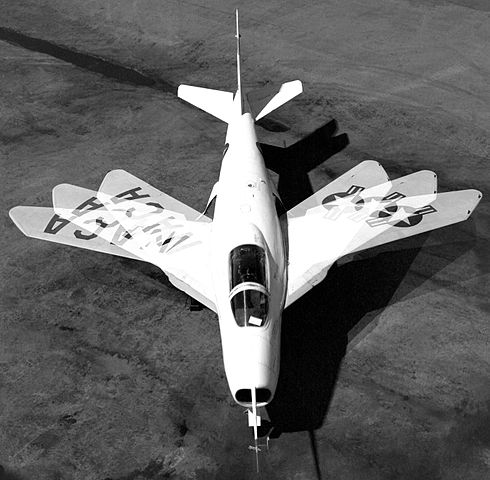
    In the 1910-1920s many patents about variable camber wings, telescopic wings and variable angle-of-attack wings were filed, but none of these concepts made it into production. This can partly be explained by the shift from a more compliant timber and fabric construction to a stiffer metallic design. This allowed for greater flying speeds and bigger aircraft, but increased the energetic threshold required for shape adaptation. Interest in morphing aircraft intensified in the post-WWII era, when the technological race between the USA and the USSR provided the impetus for many novel ideas. One example, the Bell X-5, featured variable wing sweep in flight. Wing sweep reduces the effective airspeed across the lifting surface and can therefore be used to prevent supersonic shocks—a source of parasitic drag. The faster you want to fly, the greater the required sweep, and hence this adaptive feature allowed the X-5 to fly more efficiently at subsonic and supersonic speeds. The same concept was successfully implemented in the MiG-23, Grumman F-14 and Rockwell B-1B. Apart from moving slats, flaps and control surfaces present on most aircraft today, the most prominent modern example of morphing is probably the drooping nose of the Concorde, which was used to find a compromise for better cockpit visibility during landing and streamlining at cruise.

    These early morphing ideas revolve predominantly around mechanically operated devices. That is, multiple components are joined by a mechanical hinge and the different components are then moved relative to each other by an actuator. Starting from the 1990s, new developments in materials science catalysed a shift from mechanical devices to novel materials. For example, during the late 1990s NASA Langley and DARPA led the Morphing Project and Smart Wing programme, which led to wing prototypes with gapless and hingeless leading- and trailing-edge control surfaces. NASA also released its now renowned artist impression of a morphing aircraft set in the year 2030, with wings that are capable of sweeping back and forth, changing shape and with compliant feather-like control surfaces for extreme manoeuvres.

    Over the last 20 years, lots and lots of different materials have been used for a range of morphing technologies and concepts. Many of these technologies, ranging from flexible elastomers and honeycomb-type auxetic materials, to deployable structures and shape-memory metals, are summarised in the excellent review paper by Thill et al. from 2008. One particular concept, the FlexSys Mission Adaptive Compliant Wing (MACW), which has a moveable internal structure covered by a flexible skin and is capable of morphing the trailing edge through an angle of 20°, has been undergoing extended flight tests. One of these tests on the Scaled Composites SpaceShipOne suggests that the MACW could lead to 15% in fuel savings due to an improved laminar flow profile and minimal flow separation.

    A shift in perspective: Well-behaved non-linearity

    To most engineers, non-linearity is something to avoid. In a linear system, cause and effect are proportional—if I apply a force of 100 N to a beam and it bends by 1 mm, then I can expect it to bend by 2 mm for a force of 200 N and 4 mm for a force of 400 N. What is more, for a more complex situation with many interacting parts, a linear system is always a simple addition of its parts. This means a multi-part system can be broken apart, its constituents analysed individually, and the behaviour of the whole system deduced from an aggregation of the constituents. This linear decomposition is not possible for a non-linear system, which means that (i) non-linear systems are more complicated and costly to analyse, and (ii) the non-linearity can lead to unwanted and counter-intuitive effects.

    One example of structural non-linearity is an instability. In aerospace engineering, minimising mass is the main design driver for more efficiency. No matter if you are trying to hold an aircraft aloft or shooting a rocket into space, the lighter your machine, the easier your task. This drive for lightweighting leads to thinner and thinner structures, where instabilities (like buckling) play a greater and greater role. In general, buckling is the tendency of thin-walled structures (struts and plates) loaded in compression to spontaneously bow out-of-plane (bend) at a critical value of compression. The buckling load varies with the cube of the strut’s or plate’s thickness, and while minimising thickness is very effective for reducing mass, it means that the susceptibility to buckling shoots up very quickly. Buckling is a non-linear event because the structure fundamentally changes its deformation mode—from one involving only compression, to one involving bending. Because there was no bending component pre-buckling, the bent post-buckling state cannot be a simple aggregation of pre-buckled states, and hence the phenomenon must be non-linear.

    Buckled column

    In traditional engineering design, buckling is considered as an unwanted “failure” mode to be treated no differently than material fracture, fatigue or plastic deformation. This traditional view is for good reason because buckling can cause a structure to lose its stiffness, and in the worst case, collapse. However, seen in a different light, the change in deformation mode brought on by buckling, can also be viewed as an opportunity for well-behaved shape-adaptation.

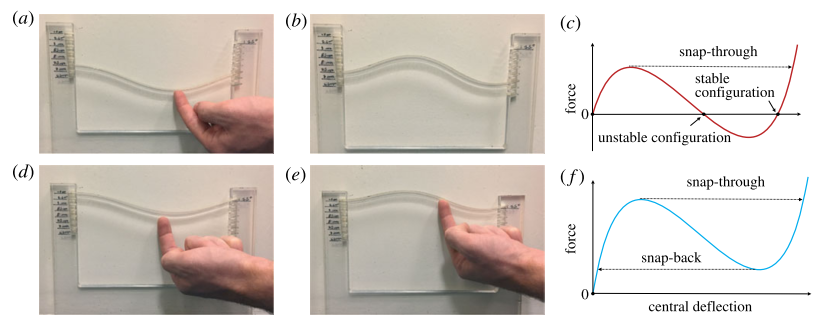
    This concept can be illustrated using an example that will be familiar to most people who have sat through an introductory mechanics course as an undergrad—the Euler strut pictured above. Take a thin strut and pin the two ends so that they cannot move perpendicular to the strut axis. Then apply a compressive load by moving the two ends closer together. For an idealised strut with no geometric imperfections and with the load perfectly aligned with the strut axis, the strut will remain flat and simply compress. At a critical value of the applied load, the strut will suddenly bow out-of-plane, i.e. bend into one of two mirror-symmetric sinusoidal shapes. By applying a load perpendicular to the strut axis, the structure can now be snapped from one sinusoidal shape to another. This is indeed a pronounced snap, whereby the strut needs to be actively pushed in the direction of the other shape, but once a critical point is reached (a so-called tipping point), the strut suddenly and automatically transitions to the other shape without any further expenditure of energy. And once the load is removed, the structure will happily stay in this second configuration.

    Limit point instability

    This is known as as bi-stable structure because there are two distinct configurations, which are both stable under no applied transverse load. These bi-stable systems are attractive for shape-adaptation, because to facilitate the shape change, energy only has to be expended to reach the snapping point, and thereafter the structure will happily settle into the second configuration.

    Of course, this system is rather simple and these two sinusoidal shapes are not directly useful for the large spectrum of shape-adaptations we would want to achieve for real aircraft structures. However, even for this simple example, the design space is relatively large because the two strut ends can be moved or rotated relative to each other such that the initial shape of the strut is no longer flat but curved. In this manner, a wide array of different configuration pairs is attainable. Furthermore, by varying the degree of compression the post-buckled strut can be designed so that one of the two configurations is unstable if the snapping load is removed. This means that the structure can be snapped from an initially curved shape into another, and when the transverse load is removed, the strut will automatically snap back to its previous shape. This is generally known as a monostable snapping device.

    Multistability and snap-through. (a) The application of a transverse load causes snap through into the inverted stable shape (b). (c) The applied load increases until it reaches a critical value. At this point, the beam snaps through a region of instability, where applied load decreases, reaching a second stable branch. Upon load removal, the structures settles in the secondary stable state. Similarly, a monostable buckled structure snaps from its first (d) to its second inverted configuration (e) when a transverse load is applied, but, as shown in (f), load removal causes snap back to the original unloaded equilibrium (d). Reproduced from Arena et al. (2017) Adaptive compliant structures for flow regulation. Proc.R.Soc.A 473: 20170334

    Hence, from these general concepts illustrated via a small toy model, it follows that it is possible to take advantage of concepts such as bi-stability and snap-through instabilities to induced repeatable and well-behaved shape changes.

    An example: a shape-adaptive air inlet

    The multi-stable behaviour described above can, for example, be used to design an adaptive air inlet for engine cooling on car bonnets or jet engine covers. In this situation, you generally want the air inlet to be open at low velocities to maximise the air flow into the engine. At higher velocities, however, enough air is impinging onto the hot parts of the engine that these additional cooling ducts can be closed to reduce the induced drag.

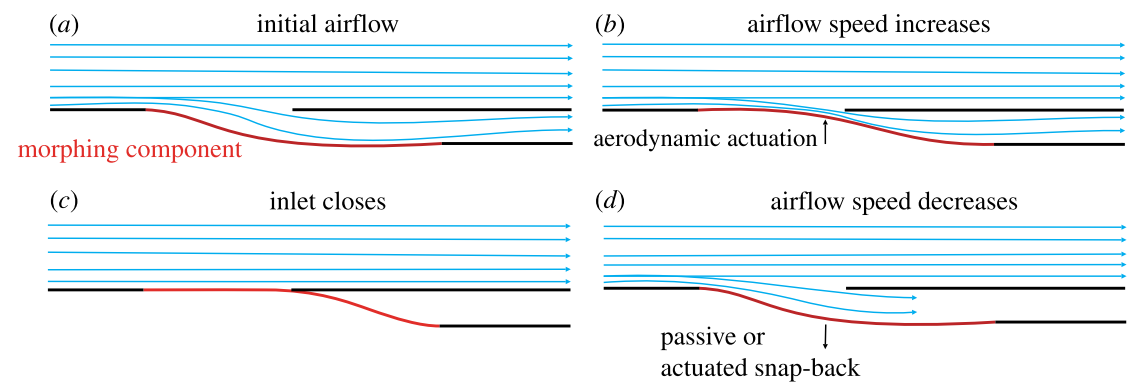
    Consider, for example, the schematic air inlet in the figure below and assume that it is designed to be fully open at low air speeds. Considering the tradeoff between cooling performance and drag described above, at a critical air speed we would like the air inlet to automatically snap-shut for drag reduction. Furthermore, once the air-speed increases, the air inlet should open-up again to facilitate cooling. Ideally, this mechanism is to be designed autonomously without recourse to additional sensors or actuators. In fact, the fluid flow over the inlet creates a pressure field which can be used to actuate the adaptive air inlet, and the amount of compression of the inlet, i.e. the post-buckled state, plays the role of an integral sensing and control system.

    Reproduced from Arena et al. (2017) Adaptive compliant structures for flow regulation. Proc.R.Soc.A 473: 20170334

    An increase of fluid velocity into the inlet generates an area of low static pressure over the adaptive component. This pressure field is equivalent to a transverse load described above and causes the adaptive component to be sucked upwards. At a critical velocity, the low static pressure field exceeds the tipping point and the inlet snaps shut. If the device is designed to be bistable, then an additional actuation device is required to open the inlet up again. However, if the inlet is a monostable snapping device, then it will automatically open again once the airspeed is reduced and falls beneath a certain threshold. In this manner, a non-linear snapping air inlet can be used to automatically open and close a cooling duct purely by interacting with the fluid around it.

    In our lab we have built and successfully tested such an adaptive air inlet in a wind tunnel. The two options of bistable and monostable snapping behaviour are clearly visible in the video below. Our current research is looking into the question of whether this behaviour can be extended from bistability to multi-stability. This would allow us to introduce an intermediate stage between the fully open and closed states for reduced air flow into the duct.

    The question of control

    The shape-adaptive air inlet is an example of a passive morphing device. Passive control refers to the ability of a system to react and adapt to external stimuli without having additional sensory, information processing or actuating devices. For example, no pressure sensors were attached to the air inlet to provide a signal to an external actuator to close the duct. Instead, the sensing, actuating and control functions were entirely embedded within the non-linear mechanics of the air inlet. The pressure field provided the actuation, the tipping point acted as an on/off switch, and the inherent stability of the second configuration acted as control. Such passive control systems are attractive from a minimal design perspective, and nature has found uses for passive control in the ruffling of birds’ feathers and adaptive shark scales for boundary layer control.

    However, most shape-adaptive systems in nature are of the active type, where sensors (nerves) provide information to a central information processing unit (brain), which then provides an action signal to actuators (muscles). The beauty of biological organisms, may they be birds or even “smart” plants like the Venus flytrap, is that the entire control system of sensing, information processing and actuating is very efficiently contained within the organism. For example, the modern control systems of hydraulic lines and actuators that drive slats, flaps and control surfaces on an aircraft seem clumsy compared to the integral and lightweight solutions that evolution has crafted.

    Dionaea muscipula closing trap animation

    Of course, nature has undergone 4 billion years of evolution to arrive at these solutions, and so it is no wonder that our systems are comparatively ad hoc. But what seems crucial is that the three functions of sensing, information processing and actuation need to be scaled down, distributed more evenly and integrated tightly within the surrounding structure. Consider the musculoskeletal system of your arms, which can be understood as a tightly layered system. You have bones to provide structure, muscles layered on top for actuation, nerves running through muscles as lines of communication, and a further layer of skin to contain everything and provide sensory means to probe your surroundings (touch and heat).

    Focusing on this concept of a layered structure, only in the last 1-2 decades have we gained the manufacturing expertise to produce such structures and materials with fidelity. Classic manufacturing techniques are subtractive in nature. Take a big billet of metal and cut everything away which is not your desired object. Contrast this to the modern additive manufacturing techniques of 3-D printing and laminated composite materials. Here, you create an object by layering material bit by bit, creating the whole unit from the bottom up. In the case of 3-D printing, a nozzle ejects material in pre-defined paths, whereas advanced composite laminates are manufactured by stacking layers of fibre-reinforced plastic on top of each other. Both these manufacturing techniques have the unique possibility of combining different material systems on the go, and even inserting additional components throughout the manufacturing process.

    For example, consider an analogue to your arm renditioned as multiple material layers. Take a couple layers of carbon fibre composite to provide structure, layer on top of that a layer of magnetostrictive or piezo-electric material as a muscle and a layer of modern thin-film integrated circuitry. Hold everything together by a soft, impact resistant layer studded with sensors, and voilá, there goes your cyborg arm. Of course, this is a dramatic over-simplification of a potential solution, and to date, entirely science fiction. But the utility of this thought experiment is to plant a flag somewhere ambitious, which can then serve as a motivating goal. We might not arrive at this precise reality in the future, but the technology that will be developed just by embarking on this journey will certainly be novel and exciting.

    Conclusion

    So here you have it: a vision for the future of shape-adaptive aircraft featuring smart and multi-functional materials/structures. Advances in material science, manufacturing technology and compliant integrated circuitry now allow us to embed intelligence into engineering structures. This means structures will no longer just resist loads but have other integrated functions like sensing, information processing and actuation embedded within them. Furthermore, appreciable shape changes imply a degree of non-linearity and the shift from avoiding non-linearity to exploiting it for novel functionality opens up an entirely new frontier for innovation.

    Acknowledgements

    As with most modern research, there is a group of engineers working on these ideas, and I am just one member of this group at the Bristol Composites Institute. The people involved in this project are Alberto Pirrera, Paul Weaver, Gaetano Arena, Raf Theunissen and Alex Brinkmeyer. The work on the adaptive air inlet was funded by the Engineering and Physical Sciences Research Council (EPSRC).

    Further Reading

  • Podcast Ep. #3 – Airbus Senior Expert Ian Lane on the A350, Innovation in Aerospace, and Diversity in Engineering

    “You could say: What could we possibly do next? You look back at history and say: All the shelves must be full now! We must have the capabilities to do everything we need. And yet, we still go on…It’s your generation that is going to Mars. So please, can you get on with it and do it, because I want to enjoy it from the augmented reality that other engineers are going to produce.” — Ian Lane

    This episode features Ian Lane, Senior Expert in Composite Analysis for Airbus UK. Ian has more than 40 years of experience in the aerospace industry and his career has taken him from British Hovercraft to British Aerospace, Westland Helicopters and finally to his current role at Airbus. On top of this broad aerospace background, Ian’s specialty are modern composite airframes and he was the lead stress engineer on the Airbus A400M and Airbus A350. Ian is also a Visiting Professor in Aerospace Engineering at the University of Bristol, and a great example of an industry leader who knows how to inspire the next generation of young engineers. Indeed, Ian is actively involved with the Airbus Fly Your Ideas campaign, and a regular attendee at many international research conferences.

    In this episode Ian and I discuss:

    • his career progression from apprentice to Senior Expert at Airbus
    • the incredible safety record of the aerospace industry
    • why the demise of Concorde wasn’t a step backwards
    • how Airbus fosters innovation and out-of-the-box thinking
    • why inclusion and diversity in engineering are so important
    • and much, much more


    Selected Links from the Episode


  • Podcast Ep. #2 – Prof. Paul Weaver on Shape, Stiffness and Smart Aerospace Structures

    “There’s been a lot of good press from the science community on self-assembly of atoms. Well, I guess what I’m looking for is self-assembly and disassembly of large-scale structures…There is all sorts of exciting things we can do when [engineering] structures re-configure themselves.” — Prof. Paul Weaver

    This episode features Prof. Paul Weaver, who holds a Bernal Chair in Composite Structures at the University of Limerick in Ireland, and is the Professor in Lightweight Structures at the University of Bristol in the United Kingdom. Lightweight design plays a crucial role in the aerospace industry, and Paul has worked on some fascinating concepts for more efficient aircraft structures. Paul’s research has influenced analysis procedures and product design at NASA, Airbus, GKN Aerospace, Augusta Westland Helicopters, Vestas (and many more), and in this episode we cover some of his past accomplishments and his vision for the future.

    Central to this vision is artificial metamorphosis, which is a term that Paul coined to describe structures that re-configure by dis-assembly and re-assembly to adapt and optimise on the fly. Although Paul thinks that this vision of engineering structures is still 50 years into the future, he is well known for his work on a related technology: topological shape-morphing. The simplest example of a morphing structure is a leading edge slat, which is used on all commercial aircraft today to prevent stall at take off and landing. Paul, on the other hand, envisions morphing structures that are more integral, that is without joints and which do not rely on heavy actuators to function. Apart from artificial metamorphosis, Paul and I discuss

    • his teenage dreams of becoming a material scientist
    • his work with Mike Ashby at Cambridge University on material and shape factors
    • interesting coupling effects in composite materials that can be used for elastic tailoring
    • his work with Augusta Westland helicopters on novel rotor blades
    • why NASA contacted him about his research on buckling of rocket shells
    • and much, much more


    Selected Links from the Episode


  • Control and Stability of Aircraft

    One of the key factors in the Wright brothers’ achievement of building the first heavier-than-air aircraft was their insight that a functional airplane would require a mastery of three disciplines:

    1. Lift
    2. Propulsion
    3. Control

    Whereas the first two had been studied to some success by earlier pioneers such as Sir George Cayley, Otto Lilienthal, Octave Chanute, Samuel Langley and others, the question of control seemed to have fallen by the wayside in the early days of aviation. Even though the Wright brothers build their own little wind tunnel to experiment with different airfoil shapes (mastering lift) and also built their own lightweight engine (improving propulsion) for the Wright flyer, a bigger innovation was the control system they installed on the aircraft.

    1902 Wright glider turns
    The Wright Flyer: Wilbur makes a turn using wing-warping and the movable rudder, October 24, 1902. By Attributed to Wilbur Wright (1867–1912) and/or Orville Wright (1871–1948). [Public domain], via Wikimedia Commons.
    Fundamentally, an aircraft manoeuvres about its centre of gravity and there are three unique axes about which the aircraft can rotate:

    1. The longitudinal axis from nose to tail, also called the axis of roll, i.e. rolling one wing up and one wing down.
    2. The lateral axis from wing tip to wing tip, also called the axis of pitch, i.e. nose up or nose down.
    3. The normal axis from the top of the cabin to the bottom of landing gear, also called the axis of yaw, i.e. nose rotates left or right.

    Yaw Axis Corrected
    Aircraft Principal Axes (http://creativecommons.org/licenses/by-sa/3.0)], via Wikimedia Commons
    In a conventional aircraft we have a horizontal elevator attached to the tail to control the pitch. Second, a vertical tail plane features a rudder (much like on a boat) that controls the yawing. Finally, ailerons fitted to the wings can be used to roll the aircraft from side to side. In each case, a change in attitude of the aircraft is accomplished by changing the lift over one of these control surfaces.
    For example:

    1. Moving the elevator down increases the effective camber across the horizontal tail plane, thereby increasing the aerodynamic lift at the rear of the aircraft and causing a nose-downward moment about the aircraft’s centre of gravity. Alternatively, an upward movement of the elevator induces a nose-up movement.
    2. In the case of the rudder, deflecting the rudder to one side increases the lift in the opposite direction and hence rotates the aircraft nose in the direction of the rudder deflection.
    3. In the case of ailerons, one side is being depressed while the other is raised to produce increased lift on one side and decreased lift on the other, thereby rolling the aircraft.

    ControlSurfaces
    Aircraft Control Surfaces By Piotr Jaworski (http://www.gnu.org/copyleft/fdl.html) via Wikimedia Commons
    In the early 20th century the notion of using an elevator and rudder to control pitching and yawing were appreciated by aircraft pioneers. However, the idea of banking an aircraft to control its direction was relatively new. This is fundamentally what the Wright brothers understood. Looking at the Wright Flyer from 1903 we can clearly see a horizontal elevator at the front and a vertical rudder at the back to control pitch and yaw. But the big innovation was the wing warping mechanism which was used to control the sideways rolling of the aircraft. Check out the video below to see the elevator, rudder and wing warping mechanisms in action.


    Today, many other control systems are being used in addition to, or instead of, the conventional system outlined above. Some of these are:

    1. Elevons – combined ailerons and elevators.
    2. Tailerons – two differentially moving tailplanes.
    3. Leading edge slats and trailing edge flaps – mostly for increased lift at takeoff and landing.

    But ultimately the action of operation is fundamentally the same, the lift over a certain portion of the aircraft is changed, causing a moment about the centre of gravity.

    Special Aileron Conditions
    Two special conditions arise in the operation of the ailerons.

    The first is known as adverse yaw. As the ailerons are deflected, one up and one down, the aileron pointing down induces more aerodynamic drag than the aileron pointing up. This induced drag is a function of the amount of lift created by the airfoil. In simplistic terms, an increase in lift causes more pronounced vortex shedding activity, and therefore a high-pressure area behind the wing, which acts as a net retarding force on the aircraft. As the downward pointing airfoil produces more lift, induced drag is correspondingly greater. This increased drag on the downward aileron (upward wing) yaws the aircraft towards this wing, which must be counterbalanced by the rudder. Aerodynamicists can counteract the adverse yawing effect by requiring that the downward pointing aileron deflects less than the upward pointing one. Alternatively, Frise ailerons are used, which employ ailerons with excessively rounded leading edges to increase the drag on the upward pointing aileron and thereby help to counteract the induced drag on the downward pointing aileron of the other wing. The problem with Frise ailerons is that they can lead to dangerous flutter vibrations, and therefore differential aileron movement is typically preferred.

    The second effect is known as aileron reversal, which occurs under two different scenarios.

    • At very low speeds with high angles of attack, e.g. during takeoff or landing, the downward deflection of an aileron can stall a wing, or at the least reduce the lift across the wing, by increasing the effective angle of attack past sustainable levels (boundary layer separation). In this case, the downward aileron produces the opposite of the intended effect.
    • At very high airspeeds, the upward or downward deflection of an aileron may produce large torsional moments about the wing, such that the entire wing twists. For example, a downward aileron will twist the trailing edge up and leading edge down, thereby decreasing the angle of attack and consequently also the lift over that wing rather than increasing it. In this case, the structural designer needs to ensure that the torsional rigidity of the wing is sufficient to minimise deflections under the torsional loads, or that the speed at which this effect occurs is outside the design envelope of the aircraft.

    Stability
    What do we mean by the stability of an aircraft? Fundamentally we have to discern between the stability of the aircraft to external impetus, with and without the pilot responding to the perturbation. Here we will limit ourselves to the inherent stability of the aircraft. Hence the aircraft is said to be stable if it returns back to its original equilibrium state after a small perturbing displacement, without the pilot intervening. Thus, the aircraft’s response arises purely from the inherent design. At level flight we tend to refer to this as static stability. In effect the airplane is statically stable when it returns to the original steady flight condition after a small disturbance; statically unstable when it continues to move away from the original steady flight condition upon a disturbance; and neutrally stable when it remains steady in a new condition upon a disturbance. The second, and more pernicious type of stability is dynamic stability. The airplane may converge continuously back to the original steady flight state; it may overcorrect and then converge to the original configuration in a oscillatory manner; or it can diverge completely and behave uncontrollably, in which case the pilot is well-advised to intervene. Static instability naturally implies dynamic instability, but static stability does not generally guarantee dynamic stability.

    Aircraft static longitudinal stability
    Three cases for static stability: following a pitch disturbance, aircraft can be either unstable, neutral, or stable. By Olivier Cleynen via Wikimedia Commons.
    Longitudinal/Directional stability
    By longitudinal stability we refer to the stability of the aircraft around the pitching axis. The characteristics of the aircraft in this respect are influenced by three factors:

    1. The position of the centre of gravity (CG). As a rule of thumb, the further forward (towards the nose) the CG, the more stable the aircraft with respect to pitching. However, far-forward CG positions make the aircraft difficult to control, and in fact the aircraft becomes increasingly nose heavy at lower airspeeds, e.g. during landing. The further back the CG is moved the less statically stable the aircraft becomes. There is a critical point at which the aircraft becomes neutrally stable and any further backwards movement of the CG leads to uncontrollable divergence during flight.
    2. The position of the centre of pressure (CP). The centre of pressure is the point at which the aerodynamic lift forces are assumed to act if discretised onto a single point. Thus, if the CP does not coincide with the CG, pitching moments will naturally be induced about the CG. The difficulty is that the CP is not static, but can move during flight depending on the angle of incidence of the wings.
    3. The design of the tailplane and particularly the elevator. As described previously, the role of the elevator is to control the pitching rotations of the aircraft. Thus, the elevator can be used to counter any undesirable pitching rotations. During the design of the tailplane and aircraft on a whole it is crucial that the engineers take advantage of the inherent passive restoring capabilities of the elevator. For example, assume that the angle of incidence of the wings increases (nose moves up) during flight as a result of a sudden gust, which gives rise to increased wing lift and a change in the position of the CP. Therefore, the aircraft experiences an incremental change in the pitching moment about the CG given by

    [latex](\text{Incremental increase in lift}) \times (\text{new distance of CP from CG})[/latex]

    At the same time, the elevator angle of attack also increases due to the nose up/tail down perturbation. Hence, the designer has to make sure that the incremental lift of the elevator multiplied by its distance from the CG is greater than the effect of the wings, i.e.

    [latex](\text{Incremental increase in lift} \times \text{new distance of CP from CG})_{elevator} > (\text{Incremental increase in lift} \times \text{new distance of CP from CG})_{wings}[/latex]

    As a result the interplay between CP and CG, tailplane design greatly influences the degree of static pitching stability of an aircraft. In general, due to the general tear-drop shape of an aircraft fuselage, the CP of an aircraft is typically ahead of it’s CG. Thus, the lift forces acting on the aircraft will always contribute some form of destabilising moment about the CG. It is mainly the job of the vertical tailplane (the fin) to provide directional stability, and without the fin most aircraft would be incredibly difficult to fly if not outright unstable.

    Lateral Stability
    By lateral stability we are referring to the stability of the aircraft when rolling one wing down/one wing up, and vice versa. As an aircraft rolls and the wings are no longer perpendicular to the direction of gravitational acceleration, the lift force, which acts perpendicular to the surface of the wings, is also no longer parallel with gravity. Hence, rolling an aircraft creates both a vertical lift component in the direction of gravity and a horizontal side load component, thereby causing the aircraft to sideslip. If these sideslip loads contribute towards returning the aircraft to its original configuration, then the aircraft is laterally stable. Two of the more popular methods of achieving this are:

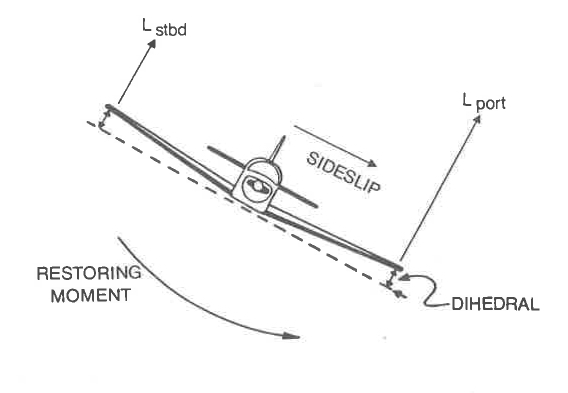
    1. Upward-inclined wings, which take advantage of the dihedral effect. As an aircraft is disturbed laterally, the rolling action to one side results in a greater angle of incidence on the downward-facing wing than the upward-facing one. This occurs because the forward and downward motion of the wing is equivalent to a net increase in angle of attack, whereas the forward and upward motion of the other wing is equivalent to a net decrease. Therefore, the lift acting on the downward wing is greater than on the upward wing. This means that as the aircraft starts to roll sideways, the lateral difference in the two lift components produces a moment imbalance that tends to restore the aircraft back to its original configuration. This is in effect a passive controlling mechanism that does not need to be initiated by the pilot or any electronic stabilising control system onboard. The opposite destabilising effect can be produced by downward pointing anhedral wings, but conversely this design improves manoeuvrability.

      The Dihedral Effect. Figure from (1)
      The Dihedral Effect with Sideslip. Figure from (1).
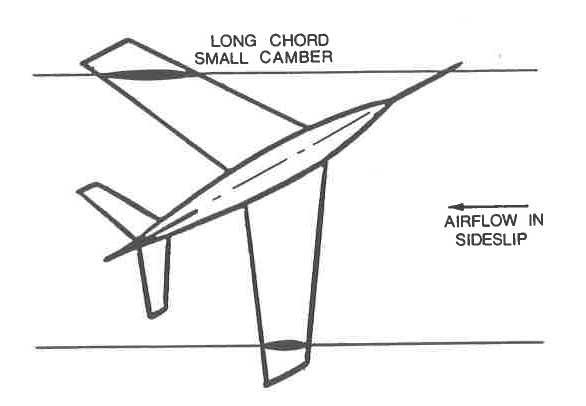
    2. Swept back wings. As the aircraft sideslips, the downward-pointing wing has a shorter effective chord length in the direction of the airflow than the upward-pointing wing. The shorter chord length increases the effective camber (curvature) of the lower wing and therefore leads to more lift on the lower wing than on the upper. This results in the same restoring moment discussed for dihedral wings above.

      The Sweepback Effect of Shortened Chord. Figure from (1).
      The Sweepback Effect of Shortened Chord. Figure from (1).

    It is worth mentioning that the anhedral and backward wept wings can be combined to reach a compromise between stability and manoeuvrability. For example, an aircraft may be over-designed with heavily swept wings, with some of the stability then removed by an anhedral design to improve the manoeuvrability.

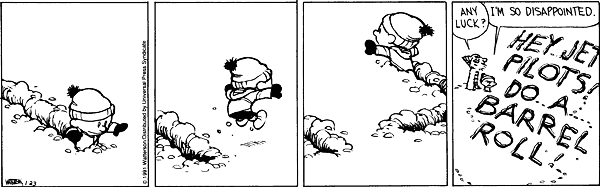
    From Calcin and Hobbes Daily (http://calvinhobbesdaily.tumblr.com/image/137916137184)
    From Calvin and Hobbes Daily (http://calvinhobbesdaily.tumblr.com/image/137916137184)

    Interaction of Longitudnal/Directional and Lateral Stability
    As described above, movement of the aircraft in one plane is often coupled to movement in another. The yawing of an aircraft causes one wing to move forwards and the other backwards, and thus alters the relative velocities of the airflow over the wings, thereby resulting in differences in the lift produced by the two wings. The result is that yawing is coupled to rolling. These interaction and coupling effects can lead to secondary types of instability.

    For example, in spiral instability the directional stability of yawing and lateral stability of rolling interact. When we discussed lateral stability, we noted that the sideslip induced by a rolling disturbance produces a restoring moment against rolling. However, due to directional stability it also produces a yawing effect that increases the bank. The relative magnitude of the lateral and directional restoring effects define what will happen in a given scenario. Most aircraft are designed with greater directional stability, and therefore a small disturbance in the rolling direction tends to lead to greater banking. If not counterbalanced by the pilot or electronic control system, the aircraft could enter an ever-increasing diving turn.

    Another example is the dutch roll, an intricate back-and-forth between yawing and rolling. If a swept wing is perturbed by a yawing disturbance, the now slightly more forward-pointing wing generates more lift, exactly for the same argument as in the sideswipe case of shorter effective chord and larger effective area to the airflow. As a result, the aircraft rolls to the side of the slightly more backward-pointing wing. However, the same forward-pointing wing with higher lift also creates more induced drag, which tends to yaw the aircraft back in the opposite direction. Under the right circumstances this sequence of events can perpetuate to create an uncomfortable wobbling motion. In most aircrafts today, dampers in the automatic control system are installed to prevent this oscillatory instability.

    In this post I have only described a small number of control challenges that engineers face when designing aircraft. Most aircraft today are controlled by highly sophisticated computer programmes that make loss of control or stability highly unlikely. Free unassisted “Flying-by-wire”, as it is called, is getting rarer and mostly limited to start and landing manoeuvres. In fact, it is more likely that the interface between human and machine is what will cause most system failures in the future.

    References

    (1) Richard Bowyer (1992). Aerodynamics for the Professional Pilot. Airlife Publishing Ltd., Shrewsbury, UK.