Materials and Structures for Net Zero
My research focuses on supporting the transition to a net zero economy through the development of sustainable and lightweight structures.
My aspirational goal is to devise novel structural architectures that combine advanced materials, computational design, and automated manufacturing.
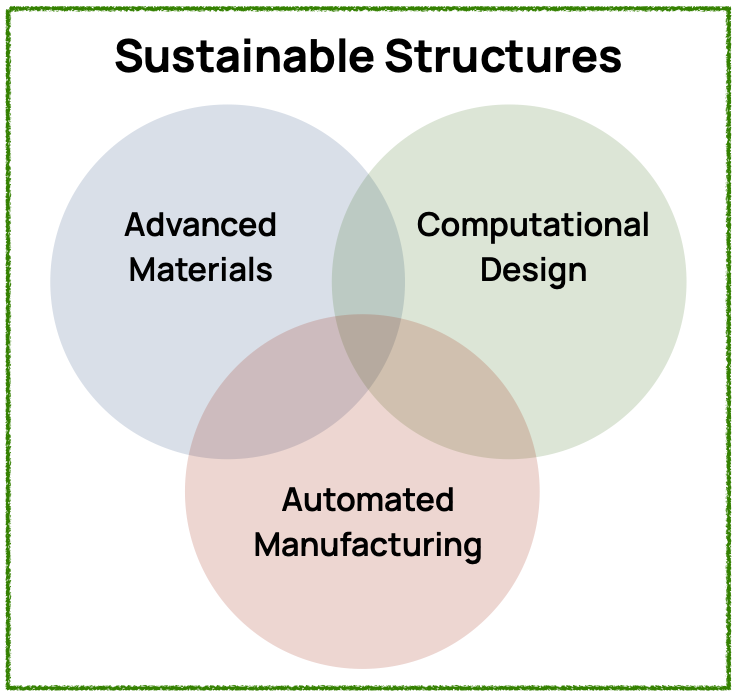
Current research activities are built on the following three pillars:
| Design of Sustainable Structures | Computational Methods | Active Structures |
|---|---|---|
| Mechanics of lightweight structures | Numerical continuation and bifurcations | Morphing structures |
| Recycled composite materials | Finite element methods for shells | Soft active matter |
| Automated Tape Laying/Fibre Placement | Nonlinear optimisation under uncertainty | Biomechanics of growth |
| Structures in extreme environments | Data-driven methods | 4D printing |
The research questions pursued by my research group are both of fundamental and of applied nature. Examples of the former include uncovering the mechanics of localisations in cylindrical shells or an understanding of how moths produce ultrasonic clicks through wing-membrane deformations. Examples of the latter include the design of gust-alleviation devices for wings or an exploration of tow-steered composites for launch vehicle structures.
Research Projects
A curated list of significant research projects is shown below:
2025 – 2029 : Gradient Shells: Tailoring Geometric and Material Anisotropy for Structural Efficiency, Adaptivity and Sustainability — UKRI Future Leaders Fellowship
2025 – 2030 : BladeUp: Secure Upscale Of Wind Turbine Blade Production Capacity — EPSRC Prosperity Partnership
2023 – 2024 : Commercial viability of novel design software for next-generation lightweight structures — RAofEng Proof of Concept Award
2022 – 2023 : Bioinspired manufacturing of non-Euclidean morphologies — BBSRC EngBio Breakthrough Award
2019 : Philip Leverhulme Prize — The Leverhulme Trust
2018 – 2023 : Robust computational methods and design paradigms for spatially chaotic structures — RAofEng Fellowship