Wil Benton is the Venture & Ecosystem Director for the ATI Boeing Accelerator in London, UK. The Aerospace Technology Institute (ATI) is a UK organisation that creates the technology strategy for the UK aerospace sector and funds world-class research and development. The ATI recently launched a startup accelerator to accelerate the growth of new companies in industry 4.0 and sustainable development, with the aim of bolstering the growth and competitiveness of the UK aerospace industry. The programme is designed to help startups establish commercial relationships with global aerospace companies, like Boeing and GKN Aerospace, and to raise follow-on funding and engage with the wider UK aerospace sector. The first cohort of companies was recently announced and and you can check out a video of the selection day below.
Wil’s background is originally in the tech industry as a founder of Chew, a live streaming platform for DJ’s, as well as an angel investor and startup advisor for the startup accelerator Ignite. In this episode, Wil and I speak about:
his career background and route into the aerospace industry
the goal and operational principle of the ATI Boeing Accelerator
some of the aerospace startups in the first cohort of the accelerator
and Wil’s passion for entrepreneurship and STEM engagement
Paul Williams is the Executive Director of the British startup Black Arrow Space Technologies. Black Arrow is developing a sea-borne launch capability based on their current expertise in developing composite propellant tanks for satellites. The launching of rockets from ships has a previous history in America, and as an island nation, the concept is clearly suited for a UK launch provider. Paul and I talk about the heritage of the Black Arrow name, the advantages of a sea-borne launch approach, and the importance of audacious technical challenges in galvanising and inspiring the next generation of engineering talent.
In fact, Black Arrow is currently supporting and working with a number of ambassadors from the Women in Science and Engineering (WISE) campaign. One of these ambassadors is Liv Scott-Golding, a 3rd year Physics undergraduate student at the University of Bristol, who is also joining us on this episode. Liv has been involved with Black Arrow from the start, and with contagious enthusiasm, tells us about her passion for the space industry and her interactions with Black Arrow as a WISE ambassador.
Dr Steve Bullock is an engineering researcher in air-to-air refuelling and cooperative control of UAVs, as well as the Programme Director of the Aerospace Engineering programme at the University of Bristol. As the programme director of a leading European aerospace engineering programme, Steve has a unique vantage point on how the higher education landscape is changing, and specifically, how technology trends such as aviation sustainability and digitisation are changing the requirements for an engineering university education in the 21st century.
As a TeachFirst ambassador and presenter of the Cosmic Shed podcast, Steve has a clear passion for education in general and is actively exploring different ways of disseminating technical information to a broad audience. In this episode of the podcast Steve and I talk about,
his path into aerospace engineering and how he found his passion for teaching
his PhD work on air-to-air refuelling and cooperative control
what he considers to be some of the key challenges in engineering university education
how the Aerospace Engineering department in Bristol is planning for the future
Tom Szirtes is the founder and director of Mbryonic, a London-based digital design studio. Mbryonic specialises in creating virtual reality (VR), augmented reality (AR) and mixed reality (MR) experiences that help organisations communicate, educate and entertain more effectively. Apart from the traditional applications in gaming and education, VR is now increasingly important for industrial design and engineering in general. For example, Mbryonic recently partnered with All Nippon Airways to provide customers an immersive virtual tour of All Nippon’s new business class in the Boeing 777 cabin. Mbryonic has also partnered with Acumen to create ‘The Adient Ascent VR’; a modular aircraft seating system that allows airlines to configure their cabins through a touch screen interface and then experience what it’s actually like to be in the cabin through a VR headset. Apart from discussing these two projects, Tom and I talk about:
the fundamentals of and differences between virtual reality, augmented reality and mixed reality
some of the advantages of VR that will transform the aerospace business landscape
and how engineers can benefit from using the technology
The following is a guest post by Jason D’souza, a recent MSc Graduate in Aerospace Vehicle Design from the University of Cranfield in the UK. Jason is a long-term reader of the blog and reached out to me about the idea of a guest post on electric aviation. As I have covered the prospects of electrification on my podcast, and believe that electrification will have profound effects on the aviation industry just like the jet engine did post-WWII, I thought this would be a great opportunity to get a young engineer with fresh ideas to write about this exciting area. And, of course, if you have any questions or want to discuss the topic matter, please feel free to reach out to Jason directly.
Introduction – The Need for Electric Propulsion
In the automotive industry,
electrification is developing at a fast rate. In the UK, both electric and
hybrid cars are becoming a common sight on roads and electric charging ports
are ever-more common in car parks. Electric vehicles offer a better solution
towards a cleaner, greener environment than their diesel/petrol counterparts, as
well as reducing noise pollution for those living in busy residential areas.
So, when will air travel and air freight follow this electric journey?
Certainly, aircraft emissions degrade air quality and have an increasing effect on global warming as most emissions occur at high altitudes. According to the European Union [1], aviation accounts for approximately three percent of the EU’s total greenhouse gas emissions, and more than two percent of global emissions. Although air travel currently accounts for only a small portion of global emissions, air travel is recognized as one of the fastest growing contributors, as elucidated in a recent study in the Atmospheric Chemistry and Physics journal. But by what mechanisms is aviation actually effecting the climate?
Aircraft engines do not only
produce plenty of CO2, but also exhaust nitrous oxides, NOX,
fine particulate matter, PM25, and ozone, O3. CO2 emissions
are the most significant contributor to climate change and have the same effect
regardless of altitude emission. However, at higher altitudes, NOX emissions
are particularly effective in forming O3, thereby causing a greater
global warming effect than would be the case at lower altitudes.
To put this into perspective, if you’ve ever played with a Carbon Footprint Calculator and plugged in a return trip from London to New York, this trip balloons your carbon footprint by more than 2000 pounds of CO2, nearly equivalent to the level of emissions incurred by heating an average European household for an entire year [2]. Reducing the CO2 impact of aircraft should be addressed as early as possible, as future regulations may impart even stricter regulations on environmental targets that will only be achieved by the use of the latest, and hence most expensive, technologies.
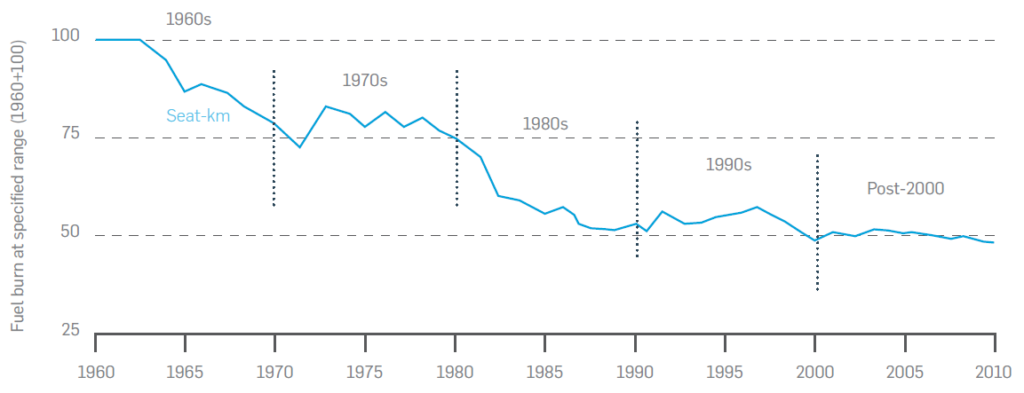
Average fuel burn for new jet aircraft, 1960-2010. Large reductions in fuel burn are seen from 1960 up to 1990s. Since then, further reductions have been modest, despite the development costs of new aircraft continuing to rise [3].
Hence, there is a clear incentive
for cleaner, greener air mobility: the reduction of CO2, NOX,
PM25 and O3 emissions, reduced noise and better fuel consumption.
Currently, we have reached a plateau in terms of improving aircraft fuel
efficiency and reducing emissions. By introducing electric battery-powered
aircraft, an opportunity exists to reduce potentially harmful emissions even
further and to make air travel quieter in urban areas. But is electric flight
actually possible given the technological challenges?
Electric Innovations: Past, Present and Future
Many industry giants are researching
and developing new prototypes and concepts for electrification. Commercially,
the Airbus A350 and Boeing 787 increasingly use battery power for several of
their on-board systems to form an approach described as the ‘More-Electric
Aircraft’ (MEA). At the same time, both Airbus and Boeing are actively
developing methods to progress towards full electric propulsion. The strategy
is to begin with a hybrid option first, with energy still provided by
hydrocarbon fuels, and then progress to an all-electric system with batteries
to provide energy for propulsion.
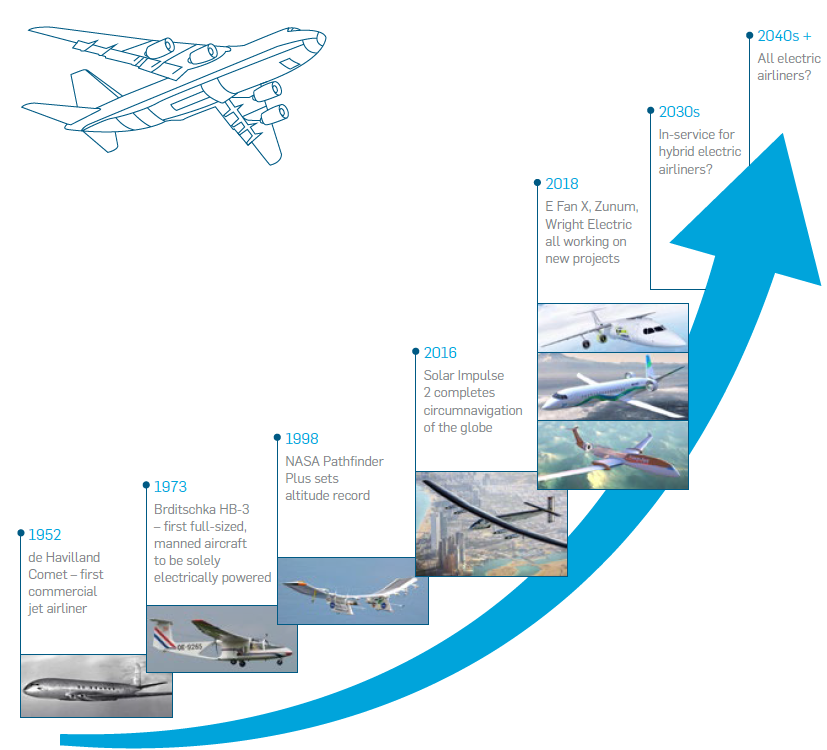
History of Electric Aircraft [4].
In technical terms, the main challenge that hybrid or electric aircraft, such as the Airbus E-Fan X, Zunum Aero and Wright Electric, are faced with is power-to-weight ratio or specific power. To make an all-electric system a reality, a battery with greater energy density than currently available, with a longer service life and improved reliability is needed. However, historic trends and current understanding of aircraft development cycles suggest that battery technology will not reach the required technical level and production rates until the 2030s to support even current aircraft scales.
Potential Propulsion System Architectures
In the short term, we will
probably witness a ‘More Electric-Hybrid’ commercially sized aircraft rather
than an ‘All-Electric’ alternative. This ‘More Electric-Hybrid’ version could
deliver real benefits through reduced emissions and allow for the development
of motors and power electronics for the transition to fully electric operation.
Let’s examine, on a system level, what a hybrid powered solution might look
like.
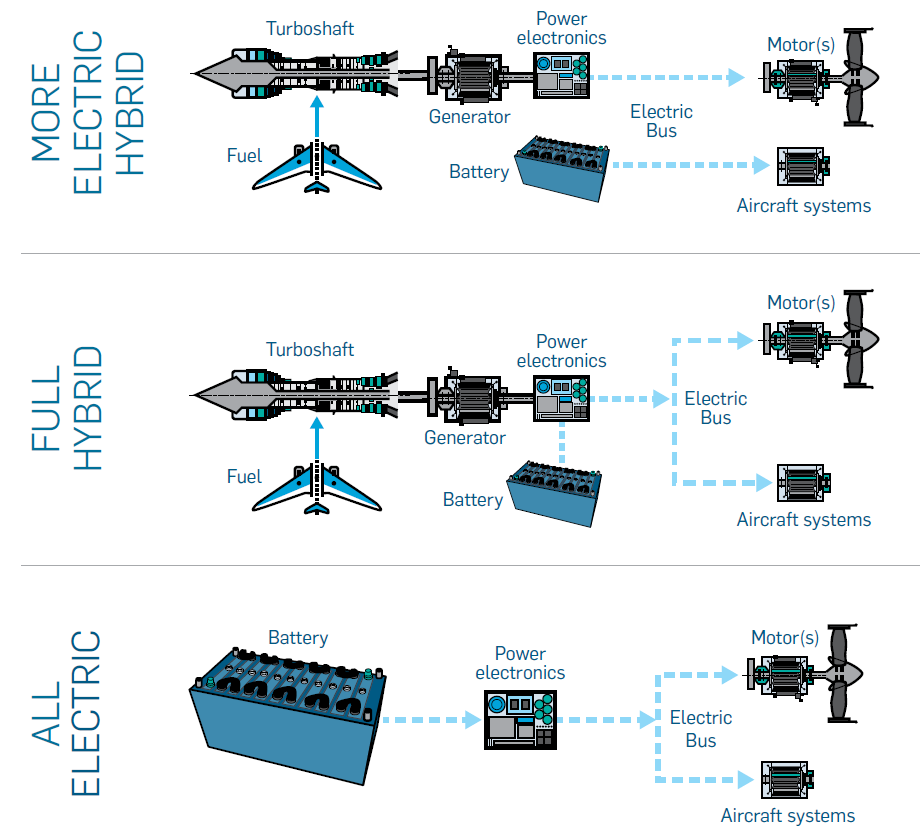
Three potential system architectures are shown with a progression from ‘More Electric – Hybrid’ to ‘Full – Hybrid’ to ‘All – Electric’. There are varying development needs for each system component and a large integration challenge for the complete systems. While other proposals for hybrid systems exist, those presented here are considered the most feasible at present [5].
Using an existing gas turbine
with traditional jet fuel (kerosene) mixed with biofuels to drive an electric
generator creates a simple and well-understood solution. However, new power
electronics systems are likely to be required to control and transfer the electrical
energy to electric motors to provide the requisite thrust.
If only batteries are used to
power the remaining systems on the aircraft, then the architecture is known as
a ‘More Electric-Hybrid’ solution. However, the power available from the
generator and batteries can also be combined to power all aircraft systems to
form a ‘Fully-Hybrid’ solution with each energy supply augmenting the other in
different ratios during various flight phases. But, if kerosene is still the source
of energy, then where does the reduction in emissions come from?
The aircraft’s flight is
affected by the varying thrust requirements needed for take-off, climb, cruise,
and altitude changes. Current jet engines are designed to operate in all
conditions but do not always function optimally and efficiently in all flight
segments. In a hybrid solution, the gas turbine can be isolated from changes in
operational conditions and continuously run at an optimized speed to power an
electric generator, which then drives the power electronics that provide
electrical energy.
The main danger in this
scenario is relying on unproven power distribution systems and electric motors.
Indeed, one of the stated objectives of the Airbus E-Fan X program is to
address this uncertainty with regards to electric power systems. Further advancements
can be made by switching the kerosene-powered gas turbine and generator to
battery power, thereby forming an ‘All-Electric’ system. In this case, the
power electronics used for the hybrid solution will need to be adapted, but the
propulsive element could remain the same.
Electric Motor Development
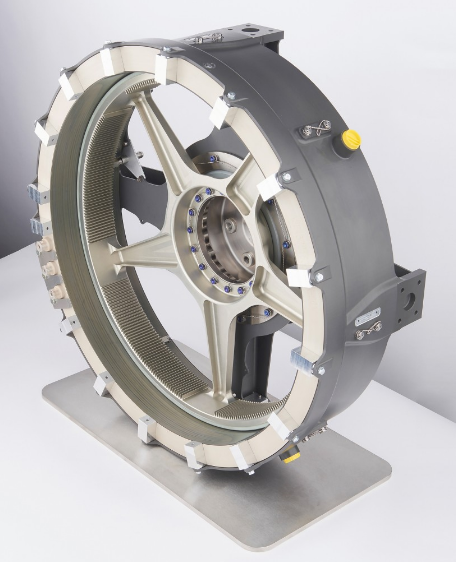
To date, Siemens has developed
a 50 kg electric motor SP260D that delivers 260 kW power output—five times more
than comparable hybrid electric propulsion systems of equal weight. However, this
is still a long way away from the power required for a commercial aircraft to
fly at acceptable speeds (2-50 MW). Nonetheless, Siemens has established its
electric propulsion systems business through the development of the eAircraft
program, now acquired by Rolls Royce.
So, with improved technology,
can enough power be generated? Currently, the answer to this question isn’t
clear, keeping in mind changes to the overall aircraft weight, safety considerations
for electrical systems, wiring routes, electrical interference, and thermal
environment created by batteries.
A High Aspect-Ratio Wing Design
Aircraft wings are designed to withstand aerodynamic loads and carry jet fuel distributed across the span. For an electric aircraft, would there be any benefit of carrying batteries within the wings instead?
High aspect ratio wing [7].
One positive side-effect of
electrification would be that the wing’s mass remains constant during flight (unless
using lithium air batteries), creating novel opportunities for aeroelastic
tailoring and aerodynamic optimization by allowing wings to become longer and
thinner (better lift-to-drag ratio). A current challenge of designing long and
slender wings for conventionally fueled is the onset of ‘aeroelastic flutter’,
an unstable interaction between airflow and the wing’s elasticity that causes a
buildup of oscillations and potential wing failure. With strategically placed
batteries, thinner and longer wings could emerge as a viable design that doesn’t
succumb to flutter, thereby improving aerodynamics and paving the way for
radically different aircraft configurations.
The Need to Reduce Aircraft Mass
What happens to the weight of
the airframe in a move towards hybrid or full electrification? In a hybrid
system, the full propulsion and electrical system, combined with all the
technical operation equipment inside the aircraft, will probably increase the
mass of the airframe. Furthermore, as the aircraft is no longer shedding mass
via fuel burn during flight, the landing weight of aircraft is likely to be
higher than it is today. To compensate for these effects, reductions in the
airframe mass are probably required to facilitate a fully electric system. Indeed,
designing lighter airframes is a huge challenge, putting great requirements on
future research on materials science to determine the full capabilities of next-generation
metallic alloys and fiber-reinforced plastics.
Funding Resources
The best solutions often come
from coordinated efforts to ensure a collaborative, knowledge-sharing approach
that leads to conformity in standards. The UK is a major player in Aerospace
Research & Development and is involved in extensive research networks, partnerships,
and bids to numerous funding bodies working on developing the technology for the
future of air travel.
Lastly, the largest European research program developing innovative technologies aimed at aircraft emission and noise reductions, known as the Clean Sky Initiative, has a €4 billion budget and has backed several projects like Airbus’ BLADE and Safran’s Contra Rotating Open Rotor engine.
Regulation
There is a need for new
regulations addressing emerging technologies, platforms and systems related to
electrification. Firstly, as new technologies are created in the field of
electric aviation, each technology will need regulatory backing to determine
the airworthiness of the technology. This is critical to establish broad
regulatory acceptance for enabling technologies like high-power batteries,
voltage distribution systems and boundary layer ingestion.
Subsequently, regulation will be critical to enable new platforms. Regulation and certification procedures for radically new architectures such as distributed fans will be required to enable the full potential of Electrical Propulsion. As a first step, both the Federal Aviation Administration (FAA) and the European Aviation Safety Agency (EASA) are currently opening doors for electrical propulsion. For example, a key change in FAA Part 23 and EASA CS23 came into effect in 2017, allowing larger classes of general aviation aircraft to legally fly non-traditionalengine types. This not only opens revenue potential for developers in general aviation, but this platform category is a key stepping stone to even larger architectures. There is, however, a long journey ahead and regulation must keep a-pace with the technological evolution of electric aircraft.
In April 2018, these new regulations provided the opportunity for Siemens to test the Magnus eFusion at Matkópuszta airfield in Hungary, using a Siemens SP55D electric motor and a FlyEco diesel engine to allow for silent take-off and landing with an extended range. The full electrical propulsion system is developed by the Siemens eAircraft program. Furthermore, a Los Angeles-based company Ampaire recently demonstrated its electric hybrid propulsion system at Camarillo Airport in California with its maiden flight test in June 2019. Their technology was adapted to the Cessna 337 Skymaster and is already considered by some as the largest hybrid-electric aircraft to have ever flown.
There’s Turbulence Ahead
Certainly, the biggest
challenge is integration. For example, when designers and engineers have new
technologies ready for flight, how does the industry support in-service
operation? As an aviation company, how will business models need to adapt over
the next twenty years? When is the best time to start thinking about how to
integrate these new business models with the shift in aircraft architecture? Even
though some of these changes are still years away, it pays to contemplate the
disruptive nature of these changes now, and to consider strategies of how the
industry can ready itself to face up to these coming challenges.
Additional Thoughts
Keeping in mind the
potentially great opportunity aircraft electrification presents, Maintenance
and Servicing Organizations (MRO’s) should be reconsidering their operations to
address questions like what kind of physical infrastructure will be needed going
forward? Topics for consideration range from how many spare batteries will need
to be stored at airports and the most optimal location of recharging points, to
how long it will take for the batteries to be charged or changed in between
flights. The latter will be a considerable consideration for airlines, as an
electric aircraft will not be earning money when it is recharging.
With regards to traffic
control, what happens in the case of diversions and re-routing? Will regional
electric aircraft take priority over long-range gas-powered aircraft? Or could
quieter aircraft lead to additional airports in closer vicinity to cities, such
that regional and long-range aircraft won’t share the same airspace? Finally, a
major challenge will be instilling confidence in passengers about the safety of
this new technology.
Conclusion – Where Do We Stand?
The continuing growth of the
aviation sector has buoyed production rates and has led Airbus and Boeing to
establish themselves as the key players in the aviation market. This duopoly
has only been reinforced by recent mergers and acquisitions of smaller
operations (Bombardier and Embraer). The shift to electrification poses a risk
to incumbents, as this new paradigm in propulsion levels the playing field for
new entrants entering the market.
At the same time, both
incumbents and new players will face key technical barriers, such as improving
the current energy storage capacity per unit weight of batteries, as well as light
and efficient electrical generators, motors and power electronics able to
convert, condition and switch to high voltage power.
On the regulatory side,
airworthiness authorities will have to find approaches to certify novel
aircraft architectures as for over fifty years commercial aircraft have not
deviated from the gas turbine powered architecture. The Advisory Council for
Aeronautics Research (ACARE) has brought about a united sense of purpose across
the European aviation sector to shift towards greener solutions and has set
challenging goals, such as achieving seventy-five percent CO2
emission reductions per passenger.
These challenges mean that we
will probably witness a ‘More Electric-Hybrid’ commercially sized aircraft in
the near future rather than an all-electric alternative. This could, however,
still deliver real benefits through reduced emissions and allow for the
development of motors and power electronics for the switch to fully electric
operation in the far-reaching future.
The deHavilland Comet was the first commercial jet aircraft and ushered in the “Jet Age” on 2nd May 1952 by taking fare-paying passengers from London to Johannesburg. The aircraft featured several new technologies to allow it to operate economically and to enhance the flying experience for passengers. For several months the aircraft led the world by halving journey times and offering comfort levels which could not be matched on other piston-engined aircraft. However, two accidents in 1954 grounded the Comet fleet and the subsequent investigation has ensured that the deHavilland Comet disaster remains a notorious example of metal fatigue failure.
This high-profile incident encouraged much work in the field of fatigue, and has led to a much better understanding of the science of fatigue and the use of fracture mechanics to evaluate the life of components and structures. In fact, with modern understanding of metal fatigue, it is unlikely that the deHavilland engineers would have made the same design choices they did in the 1950s. So, knowing that our understanding of fatigue has evolved by leaps and bounds since the 1950s, why not use modern analysis methods to see if we would do anything differently today?
Paul Withey is the Professor of Casting at the University of Birmingham School of Metallurgy. Before his professorial role in academia, Paul worked at Rolls Royce for more than 20 years, culminating in his position as the Engineering Associate Fellow in Casting Technology. He now leads a lab looking at nickel-based superalloys and their growth.
I recently invited Paul to give a public lecture on the Comet disaster at the University of Bristol. Paul’s expertise in metal casting and fatigue means that he has been a guest on many documentaries on the deHavilland Comet disaster. The talk embedded below provides a fascinating account of the history of the Comet aircraft—from concept to entry into service. It then reviews the accident investigation at the Royal Aicraft Establishment in Farnborough, and uses modern fatigue analysis to propose a likely chain of events that led to the aircraft’s failure. Spoiler alert: No, it wasn’t the square windows…
Sam Bousfield is the founder and CEO of Samson Sky, a company that is developing the first truly useful flying car. Sam is an architect by training, but a passion for aviation led him to work on a supersonic aircraft with Boeing. Out of this experience came the idea of building a flying car called the Switchblade.
Harking from an architectural background, Sam approached the problem of designing a flying car slightly differently. Rather than asking the question of how you could make a car fly, Sam and his team focused on the architectural question of how a vehicle that can both fly and drive should be designed. Answering this question led the Samson team to some unique design choices, such as a three-wheel layout and wings that stow and swing out from underneath the vehicle. One of the other challenges in designing a flying car is striking the right compromise between on-road and off-road performance. For example, a car should preferably create downforce, while a plane should create lift. To achieve this Samson Sky has made some very clever design choices in terms of the layout and shaping of the Switchblade, as well as the positioning of the wings and centre of gravity, and the use of lightweight composite materials. In our conversation, Sam and I talk about:
why it has taken so long for a functional flying car to be built
the main design challenges that need to be overcome
the changes that need to be made to the vehicle when switching between flying and driving
the way that Sam envisions the Switchblade to be used in practice
Aleksey Matyushev is the co-founder and CEO of Natilus, a startup headquartered in San Francisco. Natilus has set out to reduce global air freight costs through the use of large autonomous drones, and has moved quickly over the last couple of years to develop a sea-plane prototype to serve as a technology demonstrator.
The engineers at Natilus are now moving ahead at full steam to design a land-based freighter drone based on a blended-wing body. As the name suggests, a blended aircraft has no clear demarcation line between wings and fuselage. Advantages of this approach are efficient lift generation aided by the wide airfoil-shaped body, allowing the entire aircraft to generate lift. This means that a blended wing body has better lift-to-drag ratios than a conventional aircraft, resulting in improved fuel efficiency. One particular challenge, however, is that a blended wing body does not feature a vertical and horizontal tail, and this makes controlling the aircraft particularly challenging. In this episode of the Aerospace Engineering Podcast, Aleksey and I talk about:
his educational journey to becoming an expert aerodynamicist
the technical details of the freighter drone Natilus is designing
Natilus’ business model
and near-term developments that are in the pipeline
On this episode I am speaking to Luca Leone who is the Head of Programme of AERALIS, a British startup designing a new class of military trainer and aerobatic jet aircraft. AERALIS have set out to re-invigorate the UK aircraft manufacturing sector with a military trainer that provides an exceptional pilot training experience.
AERALIS’ design is purposely modular meaning that a basic and an advanced version of the training aircraft are based on one common platform. This reduces costs in engine and airframe maintenance through training and spares commonality and also facilitates a shorter training period for pilots due to similarities between aircraft types. What’s more, AERALIS are developing a fully tailorable flying training system based on configurable cockpits and advanced simulators. In this way, AERALIS aim to not just be an aircraft manufacturer but a company that designs the total flying training experience. In this episode, Luca and I talk about:
the features of the basic and advanced trainer aircraft
Michael Darcy is the Chief Commercial Officer of the British eVTOL (electric vertical-takeoff-and-landing) company Vertical Aerospace. Vertical Aerospace has set out to change the way we fly short-haul distances and to reduce the time required for end-to-end journeys. Their vision is to develop an intercity air taxi service that gives customers the freedom to fly from local neighbourhood directly to the final destination.
To achieve this, Vertical has assembled a world-class team with veteran engineers from Airbus, Boeing, Rolls Royce and leading Formula 1 teams to design a fully certified eVTOL aircraft starting from first principles. Since their founding in 2016, Vertical Aerospace has already built the UK’s first full-scale eVTOL aircraft, and is iterating quickly to build the next generation of larger aircraft. One aspect that really stands out in this conversation is that Vertical Aerospace focuses strongly on quickly iterating through the design, manufacture and test cycle to improve their design in the most efficient way. In this episode, Michael and I discuss:
Vertical’s particular approach to designing eVTOL aircraft
how Vertical Aerospace see the electric aviation sector developing
and which hurdles need to be overcome by the industry to build certifiable aircraft