Tag: Aerospace Engineering

  • How Quickly Do Bubbles Rise in a Pint of Beer?

    The material we covered in the last two posts (skin friction and pressure drag) allows us to consider a fun little problem:

    How quickly do the small bubbles of gas rise in a pint of beer?

    To answer this question we will use the concept of aerodynamic drag introduced in the last two posts – namely,

    • skin friction drag – frictional forces acting tangential to the flow that arise because of the inherent stickiness (viscosity) of the fluid.
    • pressure drag – the difference between the fluid pressure upstream and downstream of the body, which typically occurs because of boundary layer separation and the induced turbulent wake behind the body.

    The most important thing to remember is that both skin friction drag and profile drag are influenced by the shape of the boundary layer.

    What is this boundary layer?

    As a fluid flows over a body it sticks to the body’s external surface due to the inherent viscosity of the fluid, and therefore a thin region exists close to the surface where the velocity of the fluid increases from zero to the mainstream velocity. This thin region of the flow is known as the boundary layer and the velocity profile in this region is U-shaped as shown in the figure below.
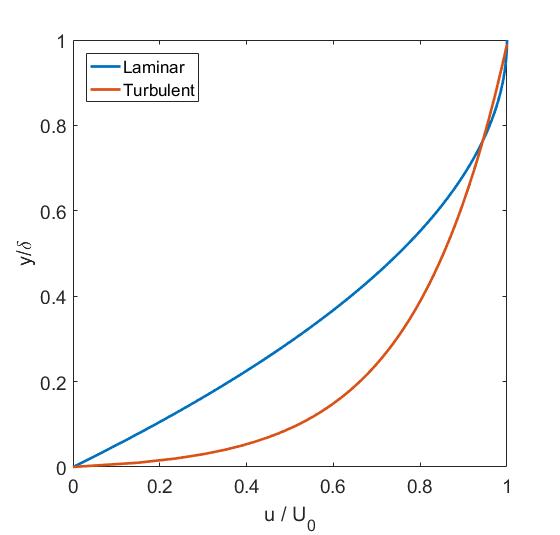
    Velocity profile of laminar versus turbulent boundary layer
    Velocity profile of laminar versus turbulent boundary layer

    As shown in the figure above, the flow in the boundary layer can either be laminar, meaning it flows in stratified layers with no to very little mixing between the layers, or turbulent, meaning there is significant mixing of the flow perpendicular to the surface. Due to the higher degree of momentum transfer between fluid layers in a turbulent boundary layer, the velocity of the flow increases more quickly away from the surface than in a laminar boundary layer. The magnitude of skin friction drag at the surface of the body (y = 0 in the figure above) is given by

    τw=μdudyw\tau_w = \mu \frac{\mathrm{d}u}{\mathrm{d}y}_w

    where du/dy\mathrm{d}u/\mathrm{d}y is the so-called velocity gradient, or how quickly the fluid increases its velocity as we move away from the surface. As this velocity gradient at the surface (y = 0 in the figure above) is much steeper for turbulent flow, this type of flow leads to more skin friction drag than laminar flow does.

    Skin friction drag is the dominant form of drag for objects whose surface area is aligned with the flow direction. Such shapes are called streamlined and include aircraft wings at cruise, fish and low-drag sports cars. For these streamlined bodies it is beneficial to maintain laminar flow over as much of the body as possible in order to minimise aerodynamic drag.

    Conversely, pressure drag is the difference between the fluid pressure in front of (upstream) and behind (downstream) the moving body. Right at the tip of any moving body, the fluid comes to a standstill relative to the body (i.e. it sticks to the leading point) and as a result obtains its stagnation pressure.

    The stagnation pressure is the pressure of a fluid at rest and, for thermodynamic reasons, this is the highest possible pressure the fluid can obtain under a set of pre-defined conditions. This is why from Bernoulli’s law we know that fluid pressure decreases/increases as the fluid accelerates/decelerates, respectively.

    At the trailing edge of the body (i.e. immediately behind it) the pressure of the fluid is naturally lower than this stagnation pressure because the fluid is either flowing smoothly at some finite velocity, hence lower pressure, or is greatly disturbed by large-scale eddies. These large-scale eddies occur due to a phenomenon called boundary layer separation.
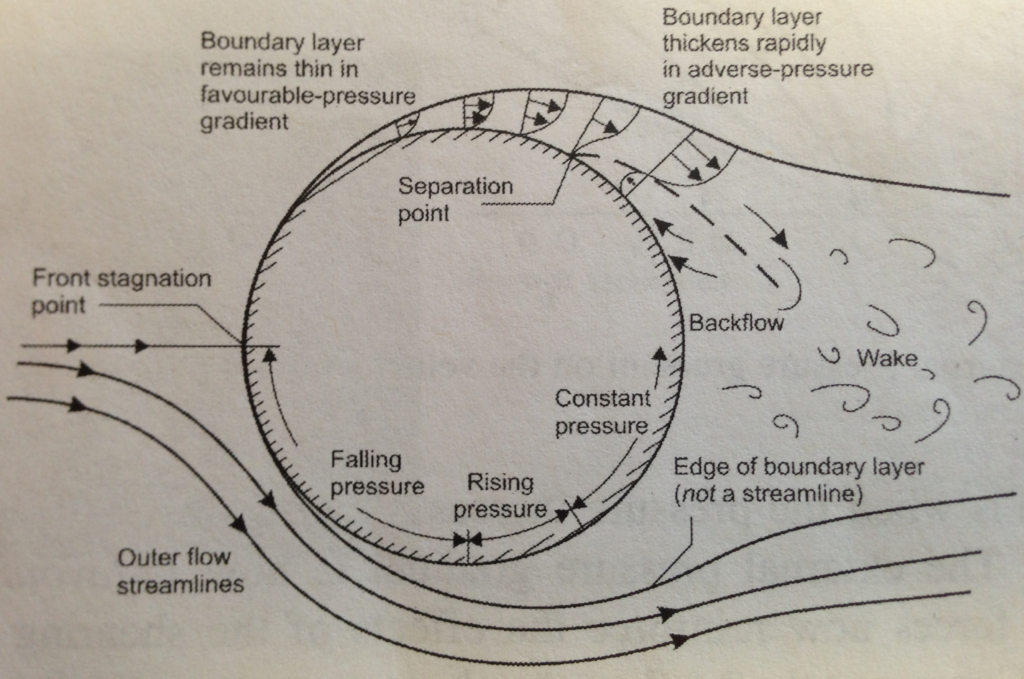
    Boundary layer separation over cylinder
    Boundary layer separation over a cylinder


    Why does the boundary layer separate?

    Any body of finite thickness will force the fluid to flow in curved streamlines around it. Towards the leading edge this causes the flow to speed up in order to balance the centripetal forces created by the curved streamlines. This creates a region of falling fluid pressure, also called a favourable pressure gradient. Further along the body, the streamlines straighten out and the opposite phenomenon occurs – the fluid flows into a region of rising pressure, also known as an adverse pressure gradient. This adverse pressure gradient decelerates the flow and causes the slowest parts of the boundary layer, i.e. those parts closest to the surface, to reverse direction. At this point, the boundary layer “separates” from the body and the combination of flow in two directions induces a wake of turbulent vortices; in essence a region of low-pressure fluid.

    The reason why this is detrimental for drag is because we now have a lower pressure region behind the body than in front of it, and this pressure difference results in a force that pushes against the direction of travel. The magnitude of this drag force greatly depends on the location of the boundary layer separation point. The further upstream this point, the higher the pressure drag.

    To minimise pressure drag it is beneficial to have a turbulent boundary layer. This is because the higher velocity gradient at the external surface of the body in a turbulent boundary layer means that the fluid has more momentum to “fight” the adverse pressure gradient. This extra momentum pushes the point of separation further downstream. Pressure drag is typically the dominant type of drag for bluff bodies, such as golf balls, whose surface area is predominantly perpendicular to the flow direction.

    So to summarise: laminar flow minimises skin-friction drag, but turbulent flow minimises pressure drag.

    Given this trade-off between skin friction drag and pressure drag, we are of course interested in the total amount of drag, known as the profile drag. The propensity of a specific shape in inducing profile drag is captured in the dimensionless drag coefficient CDC_D

    CD=D1/2ρU02AC_D = \frac{D}{1/2 \rho U_0^2A}

    where DD is the total drag force acting on the body, ρ\rho is the density of the fluid, U0U_0 is the undisturbed mainstream velocity of the flow, and AA represents a characteristic area of the body. For bluff bodies AA is typically the frontal area of the body, whereas for aerofoils and hydrofoils AA is the product of wing span and mean chord. For a flat plate aligned with the flow direction, AA is the total surface area of both sides of the plate.

    The denominator of the drag coefficient represents the dynamic pressure of the fluid (1/2ρU021/2 \rho U_0^2) multiplied by the specific area (AA) and is therefore equal to a force. As a result, the drag coefficient is the ratio of two forces, and because the units of the denominator and numerator cancel, we call this a dimensionless number that remains constant for two dynamically similar flows. This means CDC_D is independent of body size, and depends only on its shape. As discussed in the wind tunnel post, this mathematical property is why we can create smaller scaled versions of real aircraft and test them in a wind tunnel.
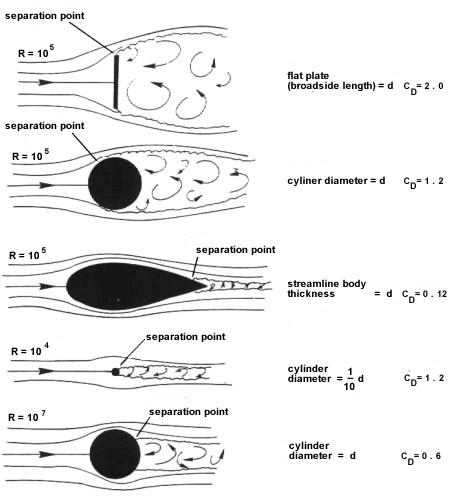
    Skin friction drag versus pressure drag for differently shaped bodies

    Looking at the diagram above we can start to develop an appreciation for the relative magnitude of pressure drag and skin friction drag for different bodies. The “worst” shape for boundary layer separation is a plate perpendicular to the flow as shown in the first diagram. In this case, drag is clearly dominated by pressure drag with negligible skin friction drag. The situation is similar for the cylinder shown in the second diagram, but in this case the overall profile drag is smaller due to the greater degree of streamlining.

    The degree of boundary layer separation, and therefore the wake of eddies behind the cylinder, depends to a large extent on the surface roughness of the body and the Reynolds number of the flow. The Reynolds number is given by

    R=ρU0dμR = \frac{\rho U_0 d}{\mu}

    where U0U_0 is the free-stream velocity and dd is the characteristic dimension of the body. The reason why the Reynolds number influences boundary layer separation is because it is the dominant factor in influencing the nature, laminar or turbulent, of the boundary layer. The transition from laminar to turbulent boundary layer is different for different problems, but as a general rule of thumb a value of R=105R = 10^5 can be used.

    This influence of Reynolds number can be observed by comparing the second diagram to the bottom diagram. The flow over the cylinder in the bottom diagram has increased by a factor of 100 (R=107R = 10^7), thereby increasing the extent of turbulent flow and delaying the onset of boundary layer separation (smaller wake). Hence, the drag coefficient of the bottom cylinder is half the drag coefficient of the cylinder in the second diagram (R=105R = 10^5) even though the diameter has remained unchanged. Remember though that only the drag coefficient has been halved, whereas the overall drag force will naturally be higher for R=107R = 10^7 because the drag force is a function of CDU02C_D U_0^2 and the velocity U0U_0 has increased by a factor of 100.

    Notice also that the streamlined aircraft wing shown in the third diagram has a much lower drag coefficient. This is because the aircraft wing is essentially a “drawn-out” cylinder of the same “thickness” dd as the cylinder in the second diagram, but by streamlining (drawing out) its shape, boundary layer separation occurs much further downstream and the size of the wake is much reduced.

    Terminal velocity of rising beer bubbles

    The terminal velocity is the speed at which the forces accelerating a body equal those decelerating it. For example, the aerodynamic drag acting on a sky diver is proportional to the square of his/her falling velocity. This means that at some point the sky diver reaches a velocity at which the drag force equals the force of gravity, and the sky diver cannot accelerate any further. Hence, the terminal velocity represents the velocity at which the forces accelerating a body are equal to those decelerating it.
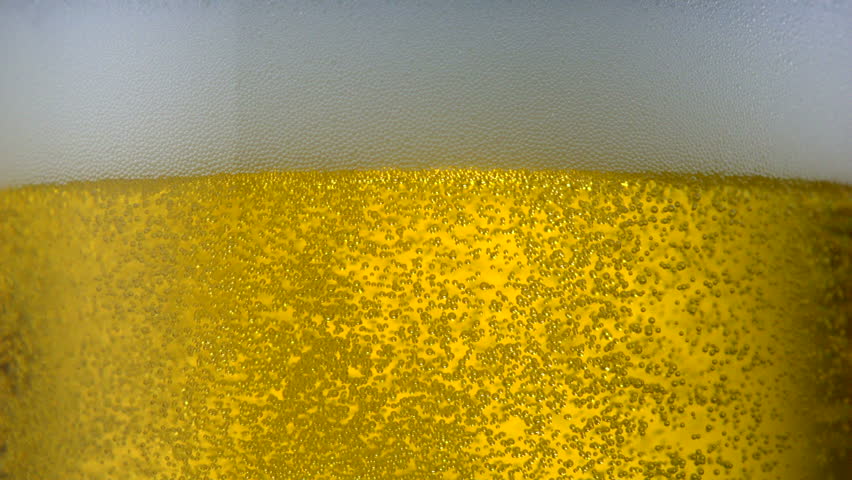
    Beer bubbles rising to the surface. We will model the gas bubbles rising to the top of beer as a sphere moving through a liquid

    The net accelerating force of a bubble of air/gas in a liquid is the buoyancy force, i.e. the difference in density between the liquid and the gas. This buoyancy force FBF_B is given by

    FB=π6d3(ρlρg)gF_B = \frac{\pi}{6} d^3 \left( \rho_l-\rho_g \right)g

    where dd is the diameter of the spherical gas bubble, ρg\rho_g is the density of the gas, ρl\rho_l is the density of the liquid and gg is the gravitational acceleration 9.81m/s29.81 m/s^2. The buoyancy force essentially expresses the force required to displace a sphere volume π6d3\frac{\pi}{6} d^3 given a certain difference in density between the gas and liquid.

    At terminal velocity the buoyancy force is balanced by the total drag acting on the gas bubble. Using the equation for the drag coefficient above we know that the total drag DD is

    D=1/2CDρlUT2(π4d2)D = 1/2 C_D \rho_l U_T^2 \left( \frac{\pi}{4} d^2\right)

    where UTU_T is the terminal velocity and we have replaced AA with the frontal area of the gas bubble π4d2\frac{\pi}{4} d^2, i.e. the area of a circle. Thus, equating DD and FBF_B

    π6d3(ρlρg)g=1/2CDρlUT2(π4d2)\frac{\pi}{6} d^3 \left( \rho_l-\rho_g \right)g = 1/2 C_D \rho_l U_T^2 \left( \frac{\pi}{4} d^2\right)

    and re-arranging for terminal velocity gives us

    UT2=4d(ρlρg)g3CDρlU_T^2 = \frac{4d\left(\rho_l-\rho_g\right)g}{3C_D\rho_l}

    At this point we can calculate the terminal velocity of a spherical gas bubble driven by buoyancy forces for a certain drag coefficient. The problem now is that the drag coefficient of a sphere is not constant; it changes with the flow velocity. Fortunately, the drag coefficient of a sphere plateaus at around 0.5 for Reynolds numbers 10310510^3-10^5 (see diagram below) and it is reasonable to assume that the flow considered here falls within this range. Some good old engineering judgement at work!

    Drag coefficient of a sphere as a function of Reynolds number
    Drag coefficient as a function of Reynolds number. The curve flattens out between 10^3 and 10^5.

    Hence, for our simplified calculation we will assume a drag coefficient of 0.5, a gas bubble 3 mm in diameter, density of the gas equal to 1.2kg/m31.2 kg/m^3 and density of the fluid equal to 989kg/m3989 kg/m^3 (5% volume beer).

    Therefore, the terminal velocity of gas bubbles rising in a beer are somewhere in the range of

    UT2=4×0.003×(9891.2)×9.813×0.5×989=0.0790 ms/s2U_T^2 = \frac{4 \times 0.003 \times \left(989-1.2\right) \times 9.81}{3 \times 0.5 \times 989} = 0.0790 \ m^s/s^2

    and taking the square root

    UT=0.281 m/s=28.1 cm/s(11 inches/s)U_T = 0.281 \ m/s = 28.1 \ cm/s \left( 11 \ inches/s \right)

    Given that the viscosity of the fluid is around μ=0.001Ns/m2\mu = 0.001 Ns/m^2 we can now check that we are in the right Reynolds number range:

    R=ρlUTdμ=989×0.281×0.0030.001=833R = \frac{\rho_l U_T d}{\mu} = \frac{989 \times 0.281 \times 0.003}{0.001} = 833

    which is right at the bottom of R = 10310510^3-10^5!

    So there you have it: Beer bubbles rise at around a foot per second.

    Perhaps the next time you gaze pensively into a glass of beer after a hard day’s work, this little fun-fact will give you something else to think (or smile) about.

    Acknowledgements

    This post is based on a fun little problem that Prof. Gary Lock set his undergraduate students at the University of Bath. Prof. Lock was probably the most entertaining and effective lecturer I had during my undergraduate studies and has influenced my own lecturing style. If I can only pass on a fraction of the passion for engineering and teaching that Prof. Lock instilled in me, I consider my job well done.
  • Rocket Science 101: Operating Principles

    In a previous post we covered the history of rocketry over the last 2000 years. By means of the Tsiolkovsky rocket equation we also established that the thrust produced by a rocket is equal to the mass flow rate of the expelled gases multiplied by their exit velocity. In this way, chemically fuelled rockets are much like traditional jet engines: an oxidising agent and fuel are combusted at high pressure in a combustion chamber and then ejected at high velocity. So the means of producing thrust are similar, but the mechanism varies slightly:

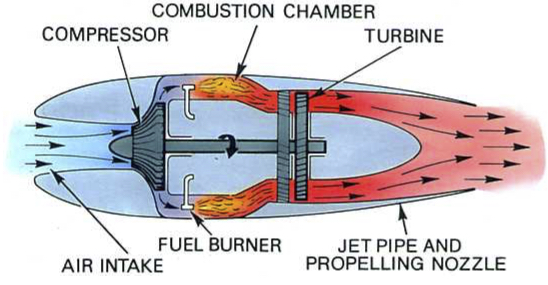
    • Jet engine: A multistage compressor increases the pressure of the air impinging on the engine nacelle. The compressed air is mixed with fuel and then combusted in the combustion chamber. The hot gases are expanded in a turbine and the energy extracted from the turbine is used to power the compressor. The mass flow rate and velocity of the gases leaving the jet engine determine the thrust.
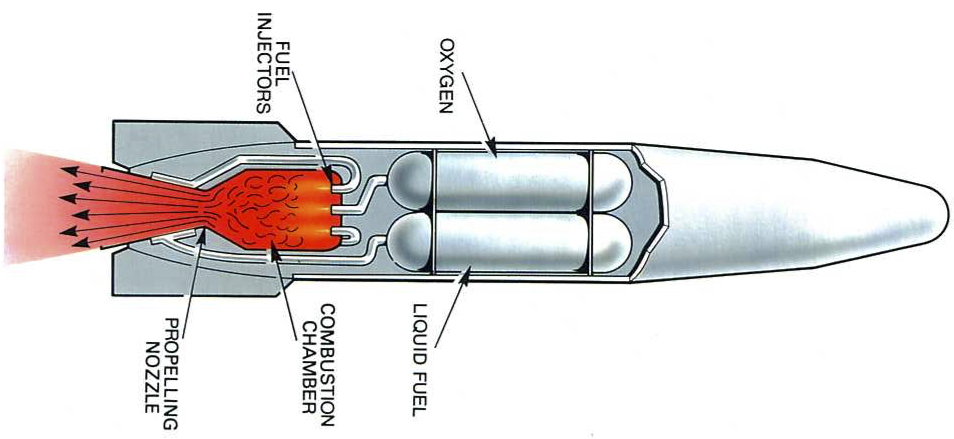
    • Chemical rocket engine: A rocket differs from the standard jet engine in that the oxidiser is also carried on board. This means that rockets work in the absence of atmospheric oxygen, i.e. in space. The rocket propellants can be in solid form ignited directly in the propellant storage tank, or in liquid form pumped into a combustion chamber at high pressure and then ignited. Compared to standard jet engines, rocket engines have much higher specific thrust (thrust per unit weight), but are less fuel efficient.
    A turbojet engine [1]
    A liquid propellant rocket engine [1]

    In this post we will have a closer look at the operating principles and equations that govern rocket design. An introduction to rocket science if you will…

    The fundamental operating principle of rockets can be summarised by Newton’s laws of motion. The three laws:

    1. Objects at rest remain at rest and objects in motion remain at constant velocity unless acted upon by an unbalanced force.
    2. Force equals mass times acceleration (or F=maF=ma).
    3. For every action there is an equal and opposite reaction.

    are known to every high school physics student. But how exactly to they relate to the motion of rockets?

    Let us start with the two qualitative equations (the first and third laws), and then return to the more quantitative second law.

    Well, the first law simply states that to change the velocity of the rocket, from rest or a finite non-zero velocity, we require the action of an unbalanced force. Hence, the thrust produced by the rocket engines must be greater than the forces slowing the rocket down (friction) or pulling it back to earth (gravity). Fundamentally, Newton’s first law applies to the expulsion of the propellants. The internal pressure of the combustion inside the rocket must be greater than the outside atmospheric pressure in order for the gases to escape through the rocket nozzle.

    A more interesting implication of Newton’s first law is the concept escape velocity. As the force of gravity reduces with the square of the distance from the centre of the earth (Fgravity=GM1M2r2F_{gravity} = \frac{GM_1M_2}{r^2}), and drag on a spacecraft is basically negligible once outside the Earth’s atmosphere, a rocket travelling at 40,270 km/hr (or 25,023 mph) will eventually escape the pull of Earth’s gravity, even when the rocket’s engines have been switched off. With the engines switched off, the gravitational pull of earth is slowing down the rocket. But as the rocket is flying away from Earth, the gravitational pull is simultaneously decreasing at a quadratic rate. When starting at the escape velocity, the initial inertia of the rocket is sufficient to guarantee that the gravitational pull decays to a negligible value before the rocket comes to a standstill. Currently, the spacecraft Voyager 1 and 2 are on separate journeys to outer space after having been accelerated beyond escape velocity.

    At face value, Newton’s third law, the principle of action and reaction, is seemingly intuitive in the case of rockets. The action is the force of the hot, highly directed exhaust gases in one direction, which, as a reaction, causes the rocket to accelerate in the opposite direction. When we walk, our feet push against the ground, and as a reaction the surface of the Earth acts against us to propel us forward.

    So what does a rocket “push” against? The molecules in the surrounding air? But if that’s the case, then why do rockets work in space?

    The thrust produced by a rocket is a reaction to mass being hurled in one direction (i.e. to conserve momentum, more on that later) and not a result of the exhaust gases interacting directly with the surrounding atmosphere. As the rockets exhaust is entirely comprised of propellant originally carried on board, a rocket essentially propels itself by expelling parts of its mass at high speed in the opposite direction of the intended motion. This “self-cannibalisation” is why rockets work in the vacuum of space, when there is nothing to push against. So the rocket doesn’t push against the air behind it at all, even when inside the Earth’s atmosphere.

    Newton’s second law gives us a feeling for how much thrust is produced by the rocket. The thrust is equal to the mass of the burned propellants multiplied by their acceleration. The capability of rockets to take-off and land vertically is testament to their high thrust-to-weight ratios. Compare this to commercial jumbo or military fighter jets which use jet engines to produce high forward velocity, while the upwards lift is purely provided by the aerodynamic profile of the aircraft (fuselage and wings). Vertical take-off and landing (VTOL) aircraft such as the Harrier Jump jet are the rare exception.

    At any time during the flight, the thrust-to-weight ratio is equal to the acceleration of the rocket. From Newton’s second law, a=Fnet/ma = F_{net}/m, where FnetF_{net} is the net thrust of the rocket (engine thrust minus drag) and mm is the instantaneous mass of the rocket. As propellant is burned, the mass mm of the rocket decreases such that the highest accelerations of the rocket are achieved towards the end of a burn. On the flipside, the rocket is heaviest on the launch pad such that the engines have to produce maximum thrust to get the rocket away from the launch pad quickly (determined by the net acceleration Fnet/mgravityF_{net}/m -\text{gravity}).

    However, Newton’s second law only applies to each instantaneous moment in time. It does not allow us to make predictions of the rocket velocity as fuel is depleted. Mass is considered to be constant in Newton’s second law, and therefore it does not account for the fact that the rocket accelerates more as fuel inside the rocket is depleted.

    The rocket equation

    The Tsiolkovsky rocket equation, however, takes this into account. The motion of the rocket is governed by the conservation of momentum. When the rocket and internal gases are moving as one unit, the overall momentum, the product of mass and velocity, is equal to P1P_1. Thus, for a total mass of rocket and gas m=mr+mgm=m_r+m_g moving at velocity vv

    mv=(mr+mg)v=P1mv = \left(m_r + m_g\right)v = P_1

    As the gases are expelled through the rear of the rocket, the overall momentum of the rocket and fuel has to remain constant as long as no external forces act on the system. Thus, if a very small amount of gas dm\mathrm{d}m is expelled at velocity vev_e relative to the rocket (either in the direction of vv or in the opposite direction), the overall momentum of the system (sum of rocket and expelled gas) is

    (mdm)(v+dvr)+dm(v+ve)=P2\left(m – \mathrm{d}m\right) \left(v+\mathrm{d}v_r\right) + \mathrm{d}m \left(v + v_e\right) = P_2

    As P2P_2 has to equal P1P_1 to conserve momentum

    mv=(mdm)(v+dvr)+dm(v+ve)mv = \left(m – \mathrm{d}m\right) \left(v+\mathrm{d}v_r\right) + \mathrm{d}m \left(v + v_e\right)

    and by isolating the change in rocket velocity dvr\mathrm{d}v_r

    (mdm)dvr=vedm\left(m-\mathrm{d}m\right) \mathrm{d}v_r = -v_e\mathrm{d}m
    dvr=dm(mdm)ve\therefore dv_r = -\frac{\mathrm{d}m}{\left(m-\mathrm{d}m\right)} v_e

    The negative sign in the equation above indicates that the rocket always changes velocity in the opposite direction of the expelled gas, as intuitively expected. So if the gas is expelled in the opposite direction of the rocket motion vv (so vev_e is negative), then the change in the rocket velocity will be positive and it will accelerate.

    At any time tt the quantity M=mdmM = m-\mathrm{d}m is equal to the residual mass of the rocket (dry mass + propellant) and dm=dM\mathrm{d}m = \mathrm{d}M denotes it change. If we assume that the expelled velocity of the gas remains constant throughout, we can easily find the incremental change in velocity as the rocket changes from an initial mass MoM_o to a final mass MfM_f. So,

    Δv=MoMfvedMM=velnM|MoMf=ve(lnMolnMf)=velnMoMf\Delta v = -\int_{M_o}^{M_f} v_e \frac{\mathrm{d}M}{M} = -v_e \ln M\left.\right|^{M_f}_{M_o} = v_e \left(\ln M_o – \ln M_f\right) = v_e \ln \frac{M_o}{M_f}

    This equation is known as the Tsiolkovsky rocket equation and is applicable to any body that accelerates by expelling part of its mass at a specific velocity. Even though the expulsion velocity may not remain constant during a real rocket launch we can refer to an effective exhaust velocity that represent a mean value over the course of the flight.

    The Tsiolkovsky rocket equation shows that the change in velocity attainable is a function of the exhaust jet velocity and the ratio of original take-off mass (structural weight + fuel = MoM_o) to its final mass (structural mass + residual fuel = MfM_f). If all of the propellant is burned, the mass ratio expresses how much of the total mass is structural mass, and therefore provides some insight into the efficiency of the rocket.

    In a nutshell, the greater the ratio of fuel to structural mass, the more propellant is available to accelerate the rocket and therefore the greater the maximum velocity of the rocket.

    So in the ideal case we want a bunch of highly reactant chemicals magically suspended above an ultralight means of combusting said fuel.

    In reality this means we are looking for a rocket propelled by a fuel with high efficiency of turning chemical energy into kinetic energy, contained within a lightweight tankage structure and combusted by a lightweight rocket engine. But more on that later!

    Thrust

    Often, we are more interested in the thrust created by the rocket and its associated acceleration ara_r. By dividing the rocket equation above by a small time increment dt\mathrm{d}t and again assuming vev_e to remain constant

    ar=dvrdt=dMdtveM=M˙Mvea_r = \frac{\mathrm{d}v_r}{\mathrm{d}t} = – \frac{\mathrm{d}M}{\mathrm{d}t} \frac{v_e}{M} = \frac{\dot{M}}{M} v_e

    and the associated thrust FrF_r acting on the rocket is

    Fr=Mar=M˙veF_r = Ma_r = \dot{M} v_e

    where M˙\dot{M} is the mass flow rate of gas exiting the rocket. If the differences in exit pressure of the combustion gases and surrounding ambient pressure are accounted for this becomes:

    Fr=M˙ve+(pepambient)AeF_r = \dot{M} v_e + (p_e – p_{ambient}) A_e

    where vev_e is the jet velocity at the nozzle exit plane, AeA_e is the flow area at the nozzle exit plane, i.e. the cross-sectional area of the flow where it separates from the nozzle, pep_e is the static pressure of the exhaust jet at the nozzle exit plane and pambientp_{ambient} the pressure of the surrounding atmosphere.

    This equation provides some additional physical insight. The term M˙ve\dot{M} v_e is the momentum thrust which is constant for a given throttle setting. The difference in gas exit and ambient pressure multiplied by the nozzle area provides additional thrust known as pressure thrust. With increasing altitude the ambient pressure decreases, and as a result, the pressure thrust increases. So rockets actually perform better in space because the ambient pressure around the rocket is negligibly small. However, AeA_e also decreases in space as the jet exhaust separates earlier from the nozzle due to overexpansion of the exhaust jet. For now it will suffice to say that pressure thrust typically increases by around 30% from launchpad to leaving the atmosphere, but we will return to physics behind this in the next post.

    Impulse and specific impulse

    The overall amount of thrust is typically not used as an indicator for rocket performance. Better indicators of an engine’s performance are the total and specific impulse figures. Ignoring any external forces (gravity, drag, etc.) the impulse is equal to the change in momentum of the rocket (mass times velocity) and is therefore a better metric to gauge how much mass the rocket can propel and to what maximum velocity. For a change in momentum Δp\Delta p the impulse is

    I=Δp=Δ(mv)=Δ(Fav)=FaverageΔtI = \Delta p = \Delta (mv) = \Delta\left(\frac{F}{a}v\right) = F_{average} \Delta t

    So to maximise the impulse imparted on the rocket we want to maximise the amount of thrust FF acting over the burn interval Δt\Delta t. If the burn period is broken into a number of finite increments, then the total impulse is given by

    I=n=1endFnΔtnI = \sum_{n=1}^{end} F_n \Delta t_n

    Therefore, impulse is additive and the total impulse of a multistage rocket is equal to the sum of the impulse imparted by each individual stage.

    By specific impulse we mean the net impulse imparted by a unit mass of propellant. It’s the efficiency with which combustion of the propellant can be converted into impulse. The specific impulse is therefore a metric related to a specific propellant system (fuel + oxidiser) and essentially normalises the exhaust velocity by the acceleration of gravity that it needs to overcome:

    Isp=ve/gI_{sp} = v_e/g

    where vev_e is the effective exhaust velocity and gg=9.81. Different fuel and oxidiser combinations have different values of IspI_{sp} and therefore different exhaust velocities.

    A typical liquid hydrogen/liquid oxygen rocket will achieve an IspI_{sp} around 450 s with exhaust velocities approaching 4500 m/s, whereas kerosene and liquid oxygen combinations are slightly less efficient with IspI_{sp} around 350 s and vev_e around 3500 m/s. Of course, a propellant with higher values of IspI_{sp} is more efficient as more thrust is produced per unit of propellant.

    Delta-v and mass ratios

    The Tsiolkovsky rocket equation can be used to calculate the theoretical upper limit in total velocity change, called delta-v, for a certain amount of propellant mass burn at a constant exhaust velocity vev_e. At an altitude of 200 km an object needs to travel at 7.8 km/s to inject into low earth orbit (LEO). If we start from rest, this means a delta-v equal to 7.8 km/s. Accounting for frictional losses and gravity, the actual requirement rocket scientists need to design for is just shy of delta-v=10 km/s. So assuming a lower bound effective exhaust velocity of 3500 m/s, we require a mass ratio of…

    Δv=|ve|lnM0MflnM0Mf=100003500=2.857\Delta v = \left|v_e\right| \ln \frac{M_0}{M_f} \Rightarrow \ln \frac{M_0}{M_f} = \frac{10000}{3500}=2.857
    M0Mf=e2.86=17.4\therefore \frac{M_0}{M_f} = e^{2.86} = \underline{17.4}

    to reach LEO. This means that the original rocket on the launch pad is 17.4 times heavier than when all the rocket fuel is depleted!

    Just to put this into perspective, this means that the mass of fuel inside the rocket is SIXTEEN times greater than the dry structural mass of tanks, payload, engine, guidance systems etc. That’s a lot of fuel!

    Delta-Vs for inner Solar System
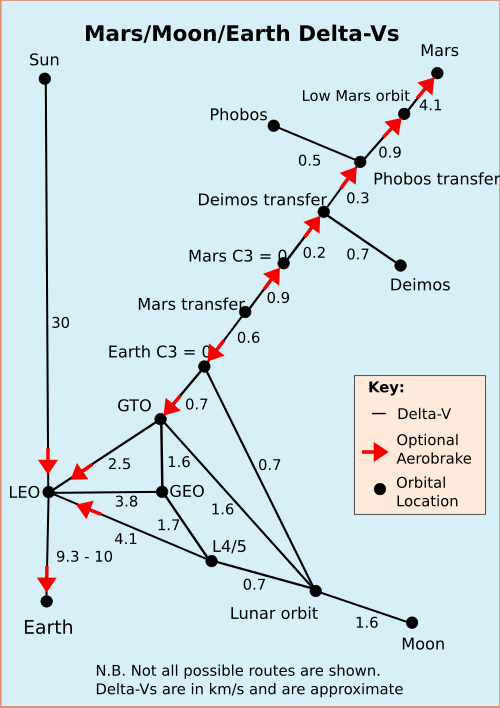
    Delta-v figures required for rendezvous in the solar system. Note the delta-v to get to the Moon is approximately 10 + 4.1 + 0.7 + 1.6 = 16.4 km/s and thus requires a whopping mass ratio of 108.4 at an effective exhaust velocity of 3500 m/s.

    The rocket’s initial mass to its final mass

    M0Mf=eΔv/ve\frac{M_0}{M_f} = e^{\Delta v / v_e}

    is known as the mass ratio. In some cases, the reciprocal of the mass ratio is used to calculate the mass fraction:

    Mass fraction=1(M0Mf)1\text{Mass fraction} = 1 – \left(\frac{M_0}{M_f}\right)^{-1}

    The mass fraction is necessarily always smaller than 1, and in the above case is equal to 117.41=94.31 – 17.4^{-1} = 94.3.

    So 94% of this rocket’s mass is fuel!

    Such figures are by no means out of the ordinary. In fact, the Space Shuttle had a mass ratio in this ballpark (15.4 = 93.5% fuel) and Europe’s Ariane V rocket has a mass ratio of 39.9 (97.5% fuel).

    If anything, flying a rocket means being perched precariously on top of a sea of highly explosive chemicals!

    The reason for the incredibly high amount of fuel is the exponential term in the above equation. The good thing is that adding fuel means we have an exponential law working in our favour: For each extra gram of fuel we can pack into the rocket we get a superlinear (better than linear) increase in delta-v. On the downside, for every piece of extra equipment, e.g. payload, we stick into the rocket we get an equally exponential reduction in delta-v.

    In reality, the situation is obviously more complex. The point of a rocket is to carry a certain payload into space and the distance we want to travel is governed by a specific amount of delta-v  (see figure to the right). For example, getting to the Moon requires a delta-v of approximately 16.4 km/s which implies a whopping mass ratio of 108.4. Therefore, if we wish to increase the payload mass, we need to simultaneously increase propellant mass to keep the mass ratio at 108.4. However, increasing the amount of fuel increases the loads acting on the rocket, and therefore more structural mass is required to safely get the rocket to the Moon. Of course, increasing structural mass similarly increases our fuel requirement, and off we go on a nice feedback loop…

    This simple example explains why the mass ratio is a key indicator of a rocket’s structural efficiency. The higher the mass ratio the greater the ratio of delta-v producing propellant to non-delta-v producing structural mass. All other factors being equal, this suggests that a high mass ratio rocket is more efficient because less structural mass is needed to carry a set amount of propellant.

    The optimal rocket is therefore propelled by high specific impulse fuel mixture (for high exhaust velocity), with minimal structural requirements to contain the propellant and resist flight loads, and minimal requirements for additional auxiliary components such as guidance systems, attitude control, etc.

    For this reason, early rocket stages typically use high-density propellants. The higher density means the propellants take up less space per unit mass. As a result, the tank structure holding the propellant is more compact as well. For example, the Saturn V rocket used the slightly lower specific impulse combination of kerosene and liquid oxygen for the first stage, and the higher specific impulse propellants liquid hydrogen and liquid oxygen for later stages.

    Closely related to this, is the idea of staging. Once, a certain amount of fuel within the tanks has been used up, it is beneficial to shed the unnecessary structural mass that was previously used to contain the fuel but is no longer contributing to delta-v. In fact, for high delta-v missions, such as getting into orbit, the total dry-mass of the rockets we use today is too great to be able to accelerate to the desired delta-v. Hence, the idea of multi-stage rockets. We connect multiple rockets in stages, incrementally discarding those parts of the structural mass that are no longer needed, thereby increasing the mass ratio and delta-v capacity of the residual pieces of the rocket.

    Cost

    The cost of getting a rocket on to the launch pad can roughly be split into three components:

    1. Propellant cost.
    2. Cost of dry mass, i.e. rocket casing, engines and auxiliary units.
    3. Operational and labour costs.

    As we saw in the last section, more than 90% of a rocket take-off mass is propellant. However, the specific cost (cost per kg) of the propellants is multiple orders of magnitude smaller than the cost per unit mass of the rocket dry mass mass, i.e. the raw material costs and operational costs required to manufacture and test them. A typical propellant combination of kerosene and liquid oxygen costs around $2/kg, whereas the dry mass cost of an unmanned orbital vehicle is at least $10,000/kg. As a result, the propellant cost of flying into low earth orbit is basically negligible.

    The incredibly high dry mass costs are not necessarily because the raw material, predominantly high-grade aerospace metals, are prohibitively expense, rather they cannot be bought at scale because of the limited number of rockets being manufactured. Second, the criticality of reducing structural mass for maximising delta-v means that very tight safety factors are employed. Operating a tight safety factor design philosophy while ensuring sufficient safety and reliability standards under the extreme load conditions exerted on the rocket means that manufacturing standards and quality control measures are by necessity state-of-the-art. Such procedures are often highly specialised technologies that significantly drive up costs.

    To clear these economic hurdles, some have proposed to manufacture simple expendable rockets at scale, while others are focusing on reusable rockets. The former approach will likely only work for unmanned smaller rockets and is being pursued by companies such as Rocket Lab Ltd. The Space Shuttle was an attempt at the latter approach that did not live up to its potential. The servicing costs associated with the reusable heat shield were unexpectedly high and ultimately forced the retirement of the Shuttle. Most, recently Elon Musk and SpaceX have picked up the ball and have successfully designed a fully reusable first stage.


    The principles outlined above set the landscape of what type of rocket we want to design. Ideally, a high specific impulse chemicals suspended in a lightweight yet strong tankage structure above an efficient means of combustion.

    Some of the more detailed questions rocket engineers are faced with are:

    • What propellants to use to do the job most efficiently and at the lowest cost?
    • How to expel and direct the exhaust gases most efficiently?
    • How to control the reaction safely?
    • How to minimise the mass of the structure?
    • How to control the attitude and accuracy of the rocket?

    We will address these questions in the next part of this series.

    References

    [1] Rolls-Royce plc (1996). The Jet Engine. Fifth Edition. Derby, England.

  • Engineering – A Manifesto

    “Engineering is not the handmaiden of physics any more than medicine is of biology”

    What is science? And how is it different from engineering? The two disciplines are closely related and the differences seem subtle at first, but science and engineering ultimately have different goals.

    A scientist attempts to gain knowledge about the underlying structure of the world using systematic observations and experimentation. Scientists are experts in dealing with doubt and uncertainty. As the great Richard Feynman pointed out: “When a scientist doesn’t know the answer to a problem, he is ignorant. When he has a hunch as to what the result is, he is uncertain. And when he is pretty darned sure of what the result is going to be, he is in some doubt” [1]. The body of science is a collection of statements of varying degrees of certainty, and in order to allow progress, scientists need to leave room for doubt. Without doubt and discussion there is no opportunity to explore the unknown or discover new insights about the structure and behaviour of the world.

    In the same manner, the role of the engineer is to explore the realm of the unknown by systematically searching for new solutions to practical problems. Engineering is less about knowing (or not knowing), and more about doing; it is about dreaming how the world could be, rather than studying how it is. Engineers rely on scientific knowledge to design, build and control hardware and software, and therefore apply scientific insights to devise creative solutions to practical problems.

    I bring up this seemingly superfluous topic because even seasoned journalists can confuse, perhaps unwillingly, the differences between the two endeavours. This article in the Guardian about the recent landing of Philae on Comet 67P refers to the great success of “scientists” on multiple occasions, but fails to give due credit to “engineers” by referring to their role only once. So, is landing a machine on an alien body hurtling through space a scientific or an engineering achievement?

    There is certainly no straightforward answer to this question. Both scientists and engineers were indispensable in the success of the Rosetta program. However, in paying credit to the fantastic achievement of engineers involved in this space endeavour, I will leave you with this brief letter by three University of Bristol professors, that so poetically captures the essence of engineering:

    Landing Philae on Comet 67P from the Rosetta probe is a fantastic achievement (One giant heartstopper, 14 November). A tremendous scientific experiment based on wonderful engineering. Engineering is the turning of a dream into a reality. So please give credit where credit is due – to the engineers. The success of the science is yet to be determined, depending on what we find out about the comet. Engineering is not the handmaiden of physics any more than medicine is of biology – all are of equal importance to our futures.

    – Emeritus professor David Blockley, Professor Stuart BurgessProfessor Paul Weaver, University of Bristol


    References

    [1] “What Do You Care What Other People Think?: Further Adventures of a Curious Character” by Richard P. Feynman. Copyright (c)1988 by Gweneth Feynman and Ralph Leighton.

  • Variable Stiffness Composites

    In previous posts I have discussed the unique characteristics and manufacturing processes of a certain type of composite material, namely continuous fibre-reinforced plastics (FRPs). Just like many other composite materials, FRPs combine two or more materials whose combined properties are superior (in a practical engineering sense) to the properties of the constituent materials on their own. What distinguishes FRPs from other composites such as short-fibre composites, nanocomposites or discrete particle composites are the highly aligned, long bundles of fibres typically glass or carbon that are arranged in a specific direction within some resin system.

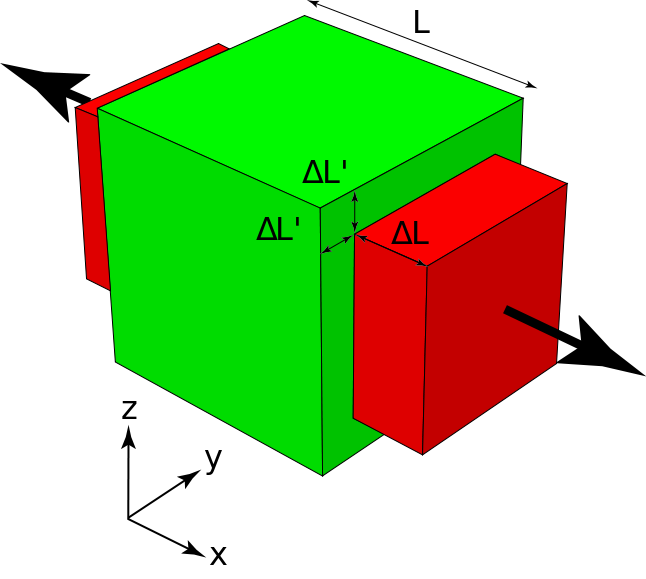
    The biggest advantage of FRPs compared to metals is not necessarily their greater specific strength and stiffness (i.e. strength/density and stiffness/density) but the increased design freedom to tailor the structural behaviour. Metals and ceramics, being isotropic materials, behave in an intuitive way since the majority of the coupling terms in the stiffness tensor vanish. If you a imagine a three-dimensional cube and pull two opposing faces apart then the other two pairs of opposing faces will move towards each other. This phenomenon of coupling between tension and compression is known as the Poisson’s effect and aptly captured by the Poisson’s ratio.

    The Poisson's effect in action
    The Poisson’s effect in action

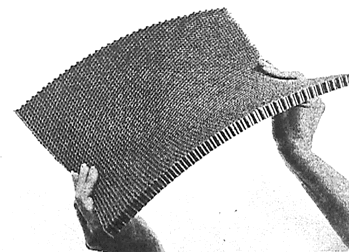
    In bending, a similar phenomenon occurs known as anti-clastic curvature. If you have ever tried bending a thin, beam-like structure made out of a soft material e.g. a rubber eraser, you might have noticed that the beam wants to develop opposite curvature in the transverse direction to the main bending axis. The structure morphs into some form of saddle shape as shown in the figure. The phenomenon occurs because the bending moment applied by the person in the picture causes tension in the top surface and compression in the bottom surface in the direction of applied bending. From the Poisson’s effect we know that this induces compression in the top surface and tension in the bottom surface in the transverse direction. By analogy, this is exactly the reverse of the bending moment applied by the hands and so the panel bends in the opposite sense in the transverse direction.

    Anticlastic curvature in action (1)
    Anticlastic curvature in action (1)

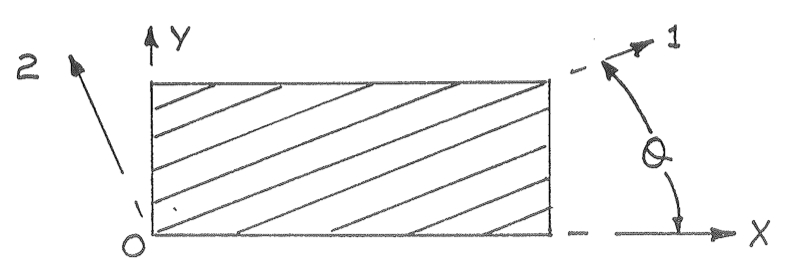
    For isotropic materials the fundamental linear constitutive equations between stress and strain eliminate a lot of the possible coupling behaviour. There is no coupling between applied bending moments and twisting. No coupling between stretching/compressing and bending/twisting. And also no coupling between stretching/compressing and shearing. FRPs, being orthotropic materials, i.e. having two orthogonal axes of different material properties, can display all of these effects. Consider a single layer of a continuous fibre-reinforced composite in the figure below. The material axes 1-2 denote the stiffer fibre in the 1-direction and the weaker resin in the 2-direction. If we align the fibres with the global x-axis and apply a load in the x-direction, the layer will stretch/compress along the fibres and compress/stretch in the resin direction in the same way as described previously for isotropic materials. However, if the fibres are aligned at an angle to the x-direction say 45°, and a load is applied in the x-direction then the layer will not only stretch/compress in the x-direction and compress/stretch in the y-direction but also shear. This is because the layer will stretch/compress less in the fibre direction than in the resin direction. This effect can be precluded if the number of +45° layers is balanced by an equal amount of -45° layers stacked on top of each other to form a laminate, e.g. a [45,-45,-45,45] laminate. However, this [45,-45,-45,45] laminate will exhibit bend-twist coupling because the 45° layers are placed further away from the mid plane than the the -45° layers. The bending stiffness of a layer is a factor of the layer thickness cubed and the distance from the axis of bending (here the mid plane) squared. Thus, the outer 45° layers contribute more to the bending stiffness of the laminate than the -45° layers such that the coupling effects do not cancel.

    A single fibre reinforced plastic layer with material and global coordinate systems
    A single fibre reinforced plastic layer with material and global coordinate systems

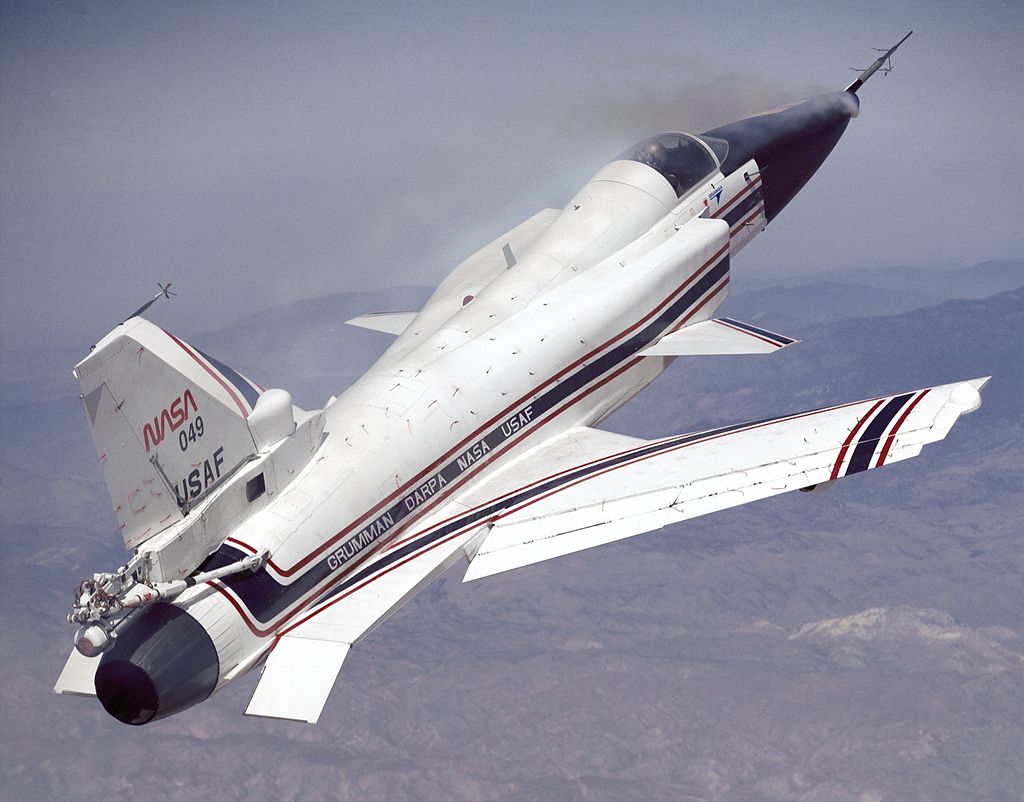
    Using metals, structural designers were constrained to tailoring the shape of a structure to optimise its performance i.e. thickness, length and width, and overall profile/shape. FRPs however add an extra dimension for optimisation by allowing designers to tailor the properties through the thickness and thereby achieve all kinds of interesting effects. For example, forward-swept wings on aircraft have and still are a nightmare due to aeroelastic instabilities like flutter and divergence. Basically, sweeping a wing forward is a neat idea because the airflow over swept wings flows spanwise towards the end furthest to the rear of the plane. Therefore, the tip-stall condition characteristic of backward-swept wings is moved towards the fuselage where it can be controlled more effectively.  The drawback is that as the lift force bends the wingtip upwards the angle of attack increases, further increasing the lift and thereby causing more bending, and so on until the wings snap off or fail. Rather than adding more material to the wing to make it stiffer (but also heavier) an alternative solution is to use the bend-twist coupling capability of composite laminates. This was successfully achieved in the iconic Grumman X-29. As the bending loads force the wing tips to bend upward and twist the wing to higher angles of attack, the inherent bend-twist coupling of the composite laminate used forces the wing to twist in the opposite direction and thereby counters an increase in the angle of attack. This is an excellent example of an efficient, autonomous and passively activated control system to prevent divergence failure.

    Grumman X-29 with forward-swept wings
    Grumman X-29 with forward-swept wings

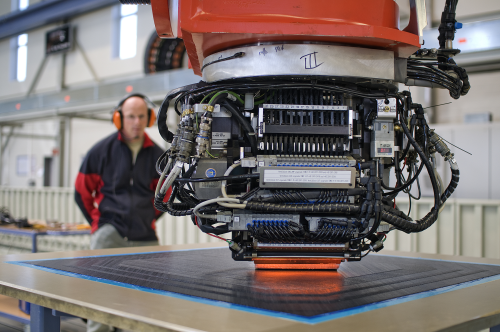
    In this manner, straight fibre composites allow structural engineers to change the stiffness and strength properties through the thickness in order to tailor the structural behaviour. The concept of variable stiffness composites adds a further dimension to the capability for tailoring. Currently this is achieved by spatially varying the point wise fiber orientations by actively steering individual fibre tows using automatic fibre placement machines. One early application that was considered by researchers was improving the stress concentrations around holes by steering fibres around them.

    Automated Fibre Placement machine (2)
    Automated Fibre Placement machine (2)

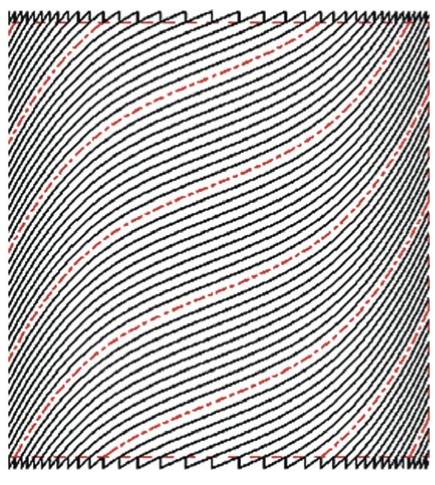
    This concept can be generalised by aligning fibres with the direction of local primary load paths which could vary across different parts of the structure. Tow steering creates the possibility for designing blended structures by facilitating smooth transitions between areas with different layup requirements. One promising application of variable stiffness composites is in buckling and postbuckling optimisation of flat and curved panels. As a panel is compressed uni-axially the capability of the panel to resist transverse bending loads reduces until a critical level is reached where the panel has lost all capability to sustain any bending loads. At this point known as the buckling load, the fundamental state of compression becomes unstable and the panel buckles outward in a single or multiple waves. It has been found that variable stiffness composites can double the buckling load of flat panels by favourably redistributing the load paths in the fundamental, pre-buckling compression state. Essentially, the middle of the panel where the buckling waves will occur is offloaded, and the edges of the panel are forced to take more load. Thus, the aim is to redirect loads to locally supported regions and remove load from regions remote from supported boundaries. This concept has also been extended to improving aircraft fuselage sections and blade-stiffened panels.

    A variable angle tow laminate
    A variable angle tow laminate (3)

    This new technology is viewed as a promising candidate for further reducing the mass of future aerospace structures. In fact recently NASA Langley Research Centre announced that they are investing heavily in this capability. The possibility of manufacturing integrated structures with smooth flow of material between components and minimal joints will not only revolutionise stress-based design, but also simplify manufacturing and facilitate entirely new aircraft designs that are currently unfeasible. In trees for example, there is a smooth transition of fibres from the trunk into the branches to strengthen the connecting joint. With the variable stiffness capabilities investigated by NASA we could apply this concept to simplify and even strengthen critical interfaces such as fuselage-wing connections.

    References

    (1) http://www.astm.org/HTTP/IMAGES/70104.gif

    (2) http://csmres.co.uk/cs.public.upd/article-images/Premium-nordenham.jpg

    (3) Kim et al. (2012). “Continuous Tow Shearing for Manufacturing Variable Angle Tow Composites”. Composites: Part A, 43, pp. 1347-1356


  • Antifragility and Aircraft Design

    Nassim Nicholas Taleb coined the term “Antifragility” in his book of the same name. Antifragility describes objects that gain from random perturbations, i.e. disorder. Taleb writes,

    Some things benefit from shocks; they thrive and grow when exposed to volatility, randomness, disorder, and stressors and love adventure , risk, and uncertainty. Yet, in spite of the ubiquity of the phenomenon, there is no word for the exact opposite of fragile. Let us call it antifragile. Antifragility is beyond resilience or robustness. The resilient resists shocks and stays the same; the antifragile gets better. This property is behind everything that has changed with time: evolution, culture, ideas, revolutions, political systems, technological innovation, cultural and economic success, corporate survival, good recipes (say, chicken soup or steak tartare with a drop of cognac), the rise of cities, cultures, legal systems, equatorial forests, bacterial resistance … even our own existence as a species on this planet. And antifragility determines the boundary between what is living and organic (or complex), say, the human body, and what is inert, say, a physical object like the stapler on your desk.

    In greek mythology the sword of Damocles is an example of a fragile object as a single large blow will break it, a phoenix can resurrect and is therefore robust, while the Hydra is an antifragile serpent because for every head that is chopped off, two will grow back in its place. Antifragile systems are extremely important in complex environments where black swan events can wreak havoc. Black swans are rare but highly consequential events; the “fat tails” located far away from the mean in a probability distribution.

    Often black swan events happen due to non-linear behaviour or a confluence of multiple drivers. Non-linearity is inherently difficult for our brains to comprehend which makes black swan events basically impossible to predict beforehandIn structural mechanics for example, it took researchers years to realise that the buckling behaviour of cylindrical shells, such as fuselage sections, is an inherently non-linear structural phenomenon, and that linear eigenvalue solutions could result in drastic over-predictions of the load carrying capacity. Theodore von Kármán managed to explain the physics of the problem through a series of papers in the first half of the 20th century, by first qualitatively investigating the phenomenon using simple experiments and then formalising the theory in what are now the non-linear von Kármán equations.

    But what does this have to do with the engineering design process?

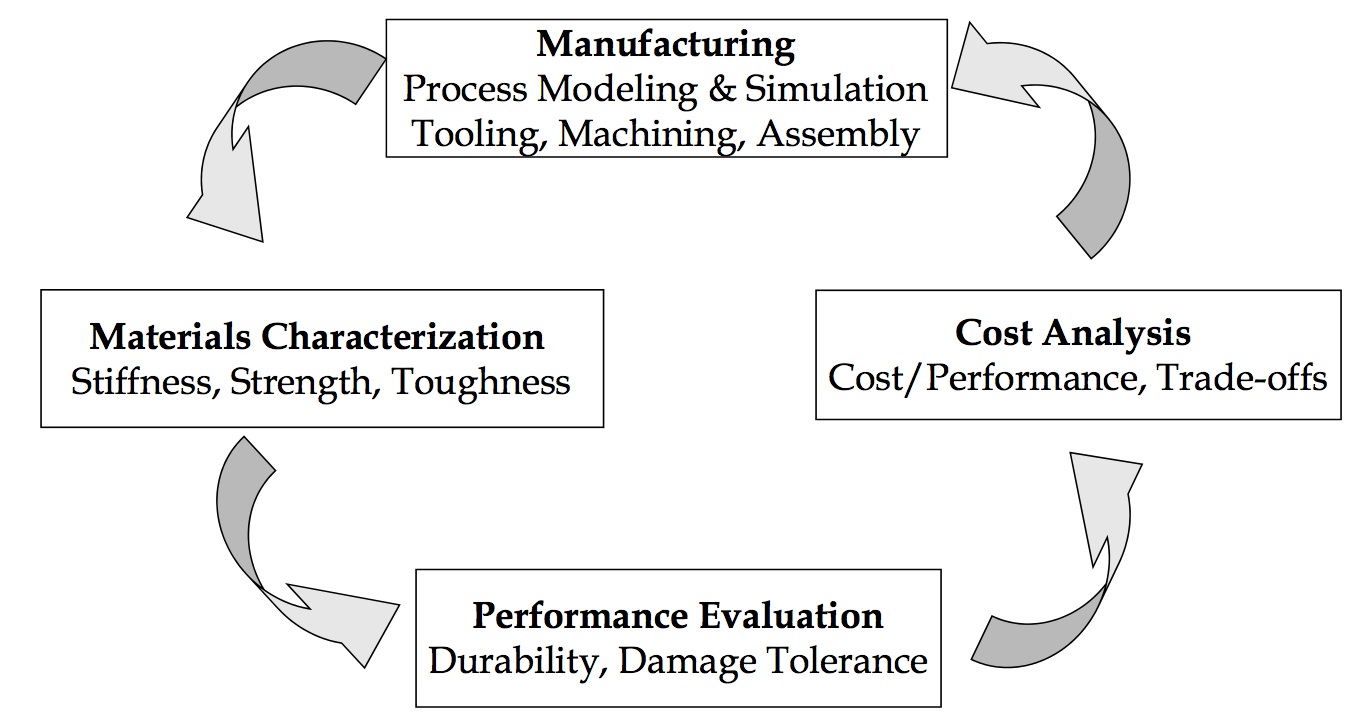
    Well, by nature the design process is iterative. Ideally we strive towards creating a system of concurrent engineering. Tasks performed by the design, structural and manufacturing engineers are parallelised and integrated to reduce the development time to market, and reach the best compromise between different technical and financial requirements. Despite this parallelisation, the design process within each of these departments is still highly iterative as engineers across different functional fields interact and refine the design. Most importantly, throughout the whole aircraft design process individual components and sub-assemblies are experimentally tested to verify the design under critical load conditions. Examples of these are cabin section pressurisation fatigue tests and catastrophic tests of whole wing sub-assemblies. The information of these stress tests is fed back into the design system to close the loop and inform the next stage in the design.

    Design Cycle Structural Engineering
    Design Cycle Structural Engineering

    Taleb calls this form innovative work “stochastic tinkering”. It is a means of experimenting and adjusting a system, aiming to discover fact “A” but in the process also learning about “B”. Stochastic tinkering is by nature antifragile as good aspects of a design are retained while failures are quickly removed; very much an analog of the evolutionary process in nature.

    Of course there is a good deal of deterministic analysis involved in engineering design. However, preliminary design calculations are often based on “back-of-the-envelope” methods. The aim of these preliminary calculations is to constrain the design space to a smaller feasible region. The design is then refined further in the detail design stage using more advanced techniques such as Finite Element Analysis or Computational Fluid Mechanics. Crucially, no matter how beautiful the design works on paper if it doesn’t perform in the validation tests it has failed.

    Finally, the notion of designing for black swan events is inherently incorporated in the design process. In structural analysis of aircraft hundreds of different load cases are tested individually and in confluence to make sure the structure can withstand the worst imaginable/historic loading scenario multiplied by a factor of safety. Furthermore, the “safe-life”, “fail-safe” and “damage tolerant” design frameworks create a checklist for components which:

    • are absolutely not allowed to fail during service (e.g. landing gear and wing root)
    • are allowed to fail, as structural redundancies are in place to re-direct load paths (e.g. wing stringers and engines)
    • and components that are assumed to contain a finite initial defect size before entering service that may grow due to fatigue loading in-service. In this manner the aircraft structure is designed to sustain structural damage without compromising safety up to a critical damage size that can be easily detected by visual inspection between flights. 

    This approach is limited to known load cases. Therefore, the reserve factors of 1.2 for limit load and 1.5 for ultimate load exist to provide a margin of safety against uncertainty, i.e. things we can not quantify, the “known unknowns” and “unknown unknowns”.

    Historically, catastrophic in-service failures have been and continue to be used as invaluable learning experiences. Thus, “fat tail” catastrophic events are continually being used to eradicate weaknesses and improve the design. This, in essence, is the definition of antifragility. As terrible as the loss of life in the DeHavilland Comet and other crashes have been, without them, airplane travel would not be as safe as it is today.

  • The Atmosphere

    Understanding the details of the atmosphere is critical for manned flight since it provides the medium through which the aircraft moves. The lift provided by the wings and drag experienced by the aircraft vary greatly with different altitudes. In fact Sir Frank Whittle was largely motivated to design a jet engine due to his insight that aircraft would be able to fly faster and more efficiently at higher altitudes due to the lower density of air. The internal combustion engines at the time would not allow higher altitudes of flight, since the lack of oxygen was starving the engines thereby reducing power output.

    In essence the atmosphere is a fluid skin that surrounds the entire earth to around 500 miles above the surface. Measured by volume the atmosphere at sea level is composed of 78% nitrogen, 20.9% oxygen, 0.9% Argon, 0.03% Carbon Dioxide and a trace of other gases. Up to about 50 miles the composition of the air is fairly constant, except for a variation in water vapour, which depends on the ambient temperature. The hotter the air the more water vapour it can hold (this is why you can see your breath on a cold morning as the cold air is saturated at this lower temperature). The heavier gases do not rise to high altitudes such that above 50 miles the atmosphere is largely comprised of hydrogen and helium. Above 18 000ft oxygen has depleted enough to prevent human’s from breathing and so oxygen is supplied mechanically to the cabin. At about 100 000ft oxygen is too low to allow combustion even in the most advanced turbojet engines.

    In lower temperature latitudes the 36 000 ft of the atmosphere are generally known as the troposphere. In the troposphere the temperature decreases from about 20°C at sea level to -53°C. The tropopause is a hypothetical boundary between the lower troposphere and the higher stratosphere. In the stratosphere the temperature is initially constant and then increases to about -20°C at 35 miles. The separating tropopause is not a clear cut line but rather a hypothetical boundary that varies from around 30 000 ft over the poles to around 54 000 ft above the equator. As a result the temperature in the stratosphere is naturally warmer over the poles than over the tropics, since the higher altitude of the tropopause over the tropics allows the temperature to fall further before the constant temperature region of the stratosphere is reached. The atmosphere is divided further into regions such as the mesosphere, mesopause, thermosphere and the exosphere. However, these regions are outside of the realms of commercial and most fighter aircraft and we will therefore not deal with them here.

    As originally observed by Sir Frank Whittle, the atmospheric conditions have a great effect on the performance of aircraft:

    1. The local ambient conditions of the air influence lift, drag and engine performance. In particular the pressure, density and temperature of the local air define the performance characteristics. 
    2. The aircraft is moving relative to a fluid mass that in turn is moving relative to the surface of the earth. This introduces navigational problems that require special on-board equipment to control flight speed and direction.
    3. Temperature variations within the atmosphere may cause adverse weather patterns such as strong winds, turbulence, thunderstorms, heavy rain, snow, hail or fog. These criteria influence the loads applied on the aircraft, safety and the comfort of the passengers.
    4. The presence of the chemical compound ozone at high altitudes prevents cabin pressurisation with ambient air. This present the designer additional problems with air conditioning and prevention against pressure-cabin failure.

    Air is a compressible fluid (i.e. it can change in volume and pressure in contrast to fluids which are largely incompressible). The compressibility of air allows it change shape and shear (flow) under the smallest pressure changes. The relation between pressure p, temperature and volume v is governed by the ideal gas equation:

    pv=RTpv = RT

    where R is the universal gas constant 287.07 J/kg/K and temperature is measured in Kelvin (T in °C + 273). In order to standardise calculations relating to the atmosphere the International Civil Aviation Organization has chosen a definition of the “standard atmosphere”. This states that air is a perfectly dry gas with a temperature at sea level of 15°C and 101.3 kPa of pressure. For the first 11 000km (i.e. in the troposphere) the temperature is assumed to change at a constant lapse rate of -6.5 °C/km, then stays constant at -56.5°C in the troposphere (11 000- 20 000 km) and then increases at different rates in the stratosphere. Another important metric for aircraft flight is the dynamic viscosity of “stickiness” of the air, which influences the drag imposed on the aircraft. You can imagine air being composed of thin layers of air that move relative to each other similar to multiple pieces of paper in a notebook. The dynamic viscosity is the constant of proportionality between the force per unit area required to shear the different sheets over each other and the velocity gradient between the layers. At ordinary pressures the dynamic viscosity generally depends only on the temperature of the air.

    Finally the local atmospheric conditions is why aircraft engineers and pilots differentiate between the quantities of true airspeed (TAS), which is measured relative to the undisturbed air, and a fictional speed called the equivalent airspeed (EAS). The latter is of prime importance for aircraft design since it defines the forces that are acting on the aircraft. TAS and EAS are equivalent at sea level in the standard atmosphere but vary at altitude. As an aircraft moves through a mass of initially stationary air it imparts momentum to the surrounding air molecules by both impact and friction. The first molecules that hit the aircraft can be imagined to stick to the aircraft surface and are therefore stationary with respect to the aircraft. Every unit volume of air that has been accelerated to the velocity of the aircraft V, has therefore been imparted with a kinetic energy of

    q=12ρV2q = \frac{1}{2} \rho V^2

    where q is known as the dynamic pressure. Aerodynamic quantities such as lift and drag are typically expressed as non-dimensional parameters i.e. they are divided by the wing area and the dynamic pressure to give the lift coefficient and drag coefficient.

    CL=LiftqSC_L= \frac{Lift}{qS}
    CD=DragqSC_D= \frac{Drag}{qS}

    The non-dimensional form of the parameters is important since it allows a performance comparison between different wings operating at different flying speeds or density conditions. Thus for an aircraft with a specific lift coefficient and wing area to generate the same aerodynamic forces at altitude as at sea level, the aircraft must be flown at a velocity that keeps the dynamic pressure a constant, regardless of any difference in air density. Thus, if the density at flying altitude is ρ\rho and the airspeed measured by the onboard controls is the TAS, then the equivalent speed at sea-level EAS with density ρ0\rho_0 is defined by,

    EAS=TASρρ0EAS = TAS \sqrt{\frac{\rho}{\rho_0}}

    Therefore the EAS is a fictional quantity used in aerodynamic calculations to defined the speed that gives the same aerodynamic forces at sea-level as those experienced at altitude.

  • Developments in Composite Materials

    I have just returned from the International Conference for Composite Materials (ICCM) in Montreal, Canada and would like to share a few observations and key points about the developments in the composite world that may not be so easily accessible to a broader audience.

    1) The Great Advance – Applications

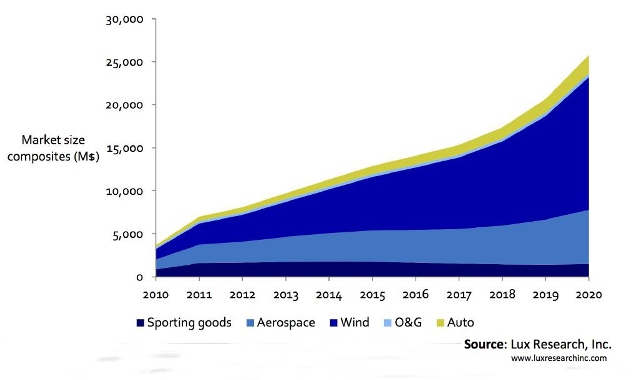
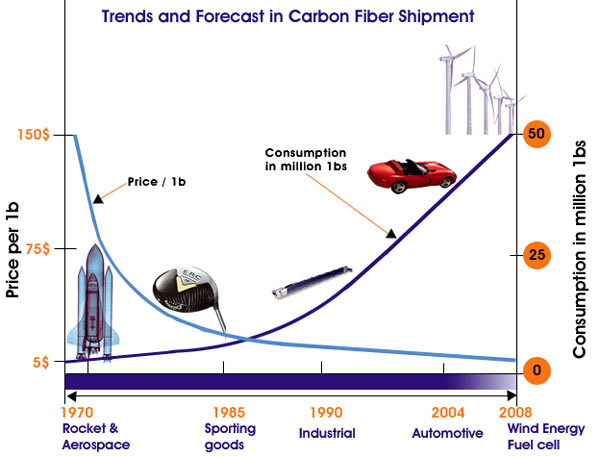
    ICCM is the biggest conference for composite materials and this year united over 1500 delegates from academia and different industrial representatives from the classical sectors aerospace, wind energy and high performance cars to newer sectors such as mass market cars (e.g. BMW i3), biomedical applications and even musical instruments. The motto of the conference “Composite Materials: The Great Advance” aptly captures the current state of technology in the industry. Since the 1960 considerable amount of research has been conducted to elucidate the mechanical and chemical properties of the fibre material, matrix and cured composite under various conditions such that the global behaviour of these materials is now sufficiently characterised. This maturity in technology coupled with the ever decreasing costs and the inherent benefits of high specific stiffness and strength that fibre-reinforced plastics have to offer, has led to the increasing application of composite materials in very different industries that we see today. Thus the “great advance” of composite materials towards wide-spread use in many industrial sectors.

    Fig. 1. Composite materials growth broken down by sectors (1)
    Fig. 2. Carbon Fibre Market (2)

    2) The Great Advance – Novel Technologies

    Furthermore, “The Great Advance” also relates to novel composite materials with much greater complexity that blur the lines between what is a material and what is a structure. Of course on a macroscopic scale one could say the steel in a steel bridge is the “material” that has been used to construct the “structure” that is the bridge. Therefore in this classical interpretation steel is just the building block to make the bridge, while the structure itself is the final product that performs a function. However on a microscopic scale we could argue that steel is a structure in itself since it is “constructed” of different sized grains that contain different metallic compounds and is thus an arrangement of small particles i.e. a microstructure. We could of course continue this argument further and further up to the atomic scale at which point we have reached the field of nanotechnology. This field of research has enjoyed much popularity in recent years since by manufacturing our products from the ground-up, i.e. from the nanoscale to the macroscale, we can control the properties of our product at multiple length-scales and therefore tailor the characteristics to be optimal for the desired function in service or even add some sort of multi-functionality to the structure/material. Since the material and structure are built at the same time the dividing line that used to distinguish between these two concepts is blurred. Even for a simple composite laminate comprised of a stack of individual layers this divide is no longer so clear since we can define the properties of each ply in the stacking direction and therefore have control over one more length scale.

    Therefore in the future there will be a great advance towards novel and multifunctional materials/structures that perform so much more than carrying structural loads. Currently the design of composite structures is still in some cases dominated by a “black aluminium” approach. That is taking the current designs that have worked so well over the last decades using aluminium and replacing them by an equivalent composite design. The problem with this is that on one hand the composite material may not be suitable to carry loads in the same configuration e.g. loads through the thickness have to be avoided to prevent delaminations. Most importantly however, such a design approach hinders the greatest advantage of this new material system, which is to facilitate entirely new structures in terms of functionality and shape that arise as a results of their inherent properties. Only by completely re-designing structures from the ground-up and taking the intricacies of this new material system into consideration can we arrive a new optimal solutions or conversely ascertain that a metal solution actually works better under some circumstances. In the following I want to share a few exciting technologies that you may see in the near future.

    1) Variable stiffness technology

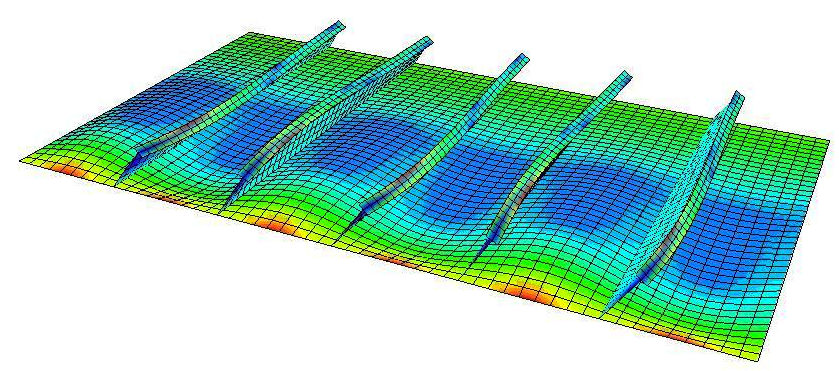
    This is my field of research and essentially what we are currently doing is changing the fibre direction over the planform of the plate such that we have curvilinear fibres rather than the straight fibre laminates that we use today. In many aerospace applications we require different laminate stacking sequences in different parts of the structure. Abruptly changing from one stacking sequence to another can lead to stress concentrations and thus structurally weaker areas at the interface. Using the variable fibre concept we can easily spatially blend from one layup to another to reduce these problems. Furthermore, we can arrange the fibre paths to follow the dominant load paths as for example around a window in an aircraft fuselage. Loads in a structure always follow the path of highest stiffness. So by aligning the fibres in the load direction in supported areas of the laminate (for example the vertical edges in Fig. 3 below if the load is applied vertically onto the horizontal edges), a large portion of the stress can be removed from the unsupported centre of the panel, which can greatly improve the elastic stability of the structure. This has great potential for future wing structures since the design of wing skins is greatly governed by local buckling (Fig. 4). It has been shown that the buckling loads can be improved by 70%-100% using variable stiffness technology (5), thus the possibility exists to reduce the weight of wing structures by up to 20% using this technology.

    Fig. 3. A variable angle tow laminates (3)
    Fig. 4. Buckling analysis of a stiffened wing panel. The stiffeners break the buckling mode shapes into smaller wavelengths that require higher energy to form than a single wave (4)

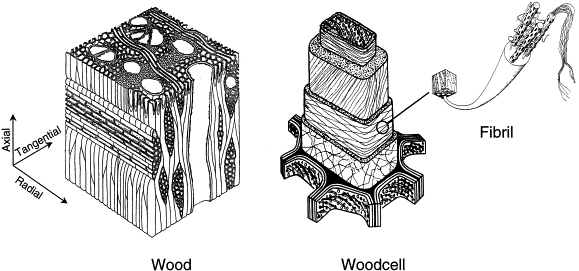
    Another form of various stiffness technology is placing material in areas where it is needed and removing it from areas where it is not required. Nature is an expert in achieving this and many of our current design are based on bio-mimicry. For example, your bones are continuously being re-modelled based on the stresses that are placed on your skeleton. In this way the density of your bones is increased in highly-stresses areas and decreased in areas that are not used so much. In the same way sea-sponge arranges its structure in a way to achieve the most efficient design. Similarly, wood possesses an incredibly complex microstructure that is composed of different structural hierarchies at different length scales. This is similar to a rope where individual fibres are twisted together to make strands, strands are twisted together to make bundles, and bundles twisted together to make the complete rope. This approach of designing at multiple length-scales makes wood very ductile and resilient to cracks. In this manner attempts have been made to reproduce such a hierarchical design by arranging short fibres using standing ultrasonic waves.

    Fig. 5. Microstructure of wood. Notice the different structures at different length scales that gives wood its inherent strength (6).
    Fig. 5. Microstructure of wood. Notice the different structures at different length scales that gives wood its inherent strength (6).

     2) Self Healing

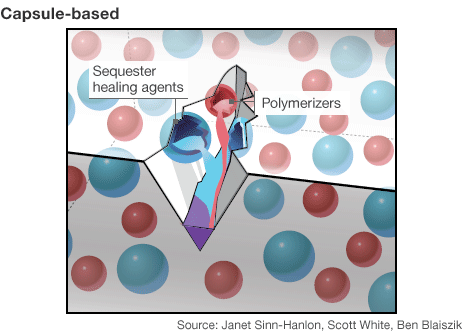
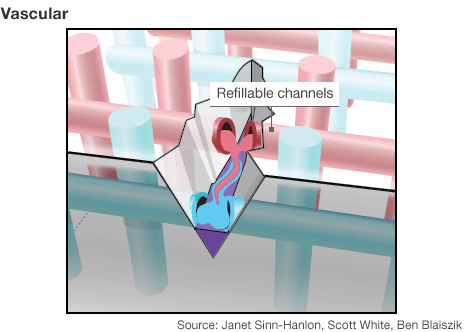
    Yes, materials can heal themselves. The most popular example is that of self-healing asphalt, which was presented a few years ago at a TED conference. In terms of composites 100% recuperation of mechanical properties have been achieved when the mode of failure has been dominated by matrix cracks. In high performance composites the matrix is currently some sort of thermoset or thermoplastic, which allows vascules of uncured resin to be included in the structure which may break open as a crack propagates. The uncured resin then permeates through the open crack and cures in-situ to repair the full functionality of the part. The dissemination of the healing process can also be achieved using very thin vascules that are arranged throughout the part. In this manner the structure starts to behave very much like a living organisms with the vascules serving as pathways for repair very similar to the veins in an organism. Recently, a great article by the BBC summarised the major achievements in this field.

    Fig. 6. Self healing capsules (7)
    Fig. 7. Self healing vascules (7)

    3) Nanotechnology

    Nanotechnology has been extremely popular during the last 20 years due to the fact that theoretical predictions promise incredible benefits for almost all applications in engineering. In terms of advanced composites however, there are still problems of evenly dispersing nanotubes in resins with agglomeration or alternatively producing continuous nano-strands at low costs. In the aerospace industry they show great promise in increasing the electrical conductivity of laminates to improve their resistance against lightning-strike, creating structures for magnetic shielding and providing interlaminar strengthening using nano-forests. One of the cooler things I saw at ICCM was research conducted on nano-muscles, which are essentially nano-fibres that have been twisted into a rope and can achieve very high actuation forces and strokes at very little mass.

    4) Structural Batteries / Energy Harvesting

    Solar power has incredible potential as an energy source since it is the largest form of energy available for consumption on earth and is limitless. However, solar power is sporadically dependent on the weather conditions, which makes energy conversion rather cost intensive and inefficient. However, solar energy harvesting might find increasing use if actively integrated into load-bearing components as a multi-functional structure. Bonding thin-film solar cells onto lightweight composites would eliminate the material redundancy of stand-alone supporting structures and could easily be integrated into current laminate manufacturing technology. Photovoltaic (PV) cells have been embedded in composite laminates and their performance has not been impeded by the curing process. However, the performance of the PV cells diminishes rapidly under static loading since the loading causes cracks in the cells. Similarly there are ideas to create structural batteries such that the load carrying chassis of a car can be “charged-up” to additionally serve as the battery for an electric powertrain. Of course this would have the great advantage that the heavy batteries used today could be eliminated to some extent. BAE systems are working on technology to embed battery chemistries into the carbon fibre fabric.

    5) Morphing

    Finally, morphing or shape-changing structures have been extensively studied since the 1970’s for providing aircraft with the possibility of adapting the shape of their wings to provide the optimal lift for different flight scenarios. Of course this is to some extent already used in aircraft with the aid of leading edge slats and trailing-edge flaps to increase the lift-coefficient for slower flight regimes such as landing and lift-off and in Formula 1 using drag reduction system of the rear wing. However, slats and flaps on an aircraft greatly increase the drag of the profile during deployment and increase the weight of the structure do the heavy actuation mechanism. Therefore the aim is to design an integral system such as the trailing-edge design shown below. Other examples of morphing structures include air intakes for cars, noise-reducing chevrons on jet-engines, or high-temperature composites used for jet-engine turbine blades that change there angle of attack based on the temperature of the airflow around them.

    Fig. 8. A morphing trailing edge using a flexible honeycomb (8).
    Fig. 8. A morphing trailing edge using a flexible honeycomb (8).

    However, in most cases these technologies are very difficult to apply to primary aircraft structures. This is because there is a direct conflict between the high-stiffness, high-strength requirement for carrying loads and the low-stiffness, large-deflections required for shape-changes. Thus, a driver to facilitate these technologies will be the development of materials that change there mechanical properties under different circumstances.

    3) The Great Advance – Solving “big” problems for larger scale implementation

    Finally, one of themes during the conference was trying to solve some of the major problems faced by the industry hindering further implementation of current composite technology in all industrial sectors. Of course for some industries such as mass consumer automobiles the biggest barrier to entry is cost. The new BMW i3, which will enter the marketplace at the start of 2014, will cost £30,000+ and is therefore quite a big investment for a small city vehicle. Of course some of the cost can be attributed to the cost of the electrical drivetrain and batteries but other manufacturers such as Renault have shown that a lot of these costs can be reduced by employing a scheme based on renting batteries rather than buying them with the vehicle. In case of the i3 a lot of the extra cost is simply down to the fact that BMW are the first to build a mass produced automobile using a large amount of fibre-reinforced plastics in primary structural parts. Not only is cost of raw material much higher than for lightweight metals such as aluminium but the manufacturing processes and supply chain management required for reliable mass production were simply not in-place beforehand. Furthermore, a shift in design methodologies is required since the chemical and mechanical behaviour of composites is so different from the metal environment that the automobile industry is so used to dealing with. As an example, proving the structural integrity for the incredible rigorous crash/impact certification using rather brittle composite materials compared to more ductile metals is a challenge in itself. Thus, the relatively high price-tag of the i3 incorporates some of the research and development costs that BMW have had to face in developing composite technology for their market sector. No doubt the cost of mass market composite cars will reduce drastically in the next decade as the raw material price further reduces and design methodologies and manufacturing processes mature.

    Another major issue hindering the implementation of composites especially in the aerospace industry is the difficulty of predicting the failure behaviour of these materials. On problem is the large number of failure modes that may occur: fibre breakage, matrix cracks, delamination, fibre crimping, fibre-matrix debonding, global and local buckling etc. and thus finding accurate failure loads for all these phenomena under different load cases. Since a larger number of these failure mechanisms originate on a local, micro-mechanical scale high-fidelity 3D Finite Element models are often needed to fully understand the mechanisms of failure and predict the load-carrying capability of different structures. Considering the size of any commercial aircraft it is absolutely inconceivable to apply such detailed and computationally expensive analysis tools to every part of an aircraft. Furthermore, the failure mechanisms are not as well defined as for metal materials. That is in classical tensile or compressive tests a specimen may undergo some form of non-linearity that may for a metal specimen be classified as a failure event but for the composite considerable residual strength is available. Conversely the failure behaviour of composites can be very brittle with very little warning compared to the gradual, ductile failure mechanism of most metals used in the aerospace industry. Considering the intricacies of composite failure modes and the fact that the individual failure modes may interact or even change in criticality depending on the size of the component and environment in which it is used, it is no wonder that currently very conservative safety factors are being employed for primary composite aircraft structures that greatly offset the weight-savings that are possible using this new material system. Thus, one of the biggest if not the biggest topic in composite structural design for the next couple of years will be the challenge of developing simple and yet robust failure criteria to be used for composite designers.

    References

    (1) http://www.luxresearchinc.com/blog/wp-content/uploads/2011/11/GotW11_27_11.jpg

    (2) http://www.lucintel.com/images/market_report_img/marketcarbon_img/CarbonMarket3.jpg

    (3) Kim et al. (2012). “Continuous Tow Shearing for Manufacturing Variable Angle Tow Composites”. Composites: Part A, 43, pp. 1347-1356

    (4) http://www.dnv.com/binaries/PULS-buckling_tcm4-284864.JPG

    (5) Gürdal Z, Tatting B, Wu C.  (2008). “Variable stiffness composite panels: Effects of stiffness variation on the in-plane and buckling response”. Composites: Part A, 39(5), pp. 911-922.

    (6) Greil P, Lifka T, Kaindl, A. (1998). “Biomorphic Cellular Silicon Carbide Ceramics from Wood: I. Processing and Microstructure”. Journal of European Ceramic Society, 18(14), pp. 1961-1973.

    (7) Rincon, P. (2012). “Time to heal: The material that heal themselves.”http://www.bbc.co.uk/news/science-environment-19781862

    (8) Daynes S & Weaver P.M. (2011). “A Morphing Wind Turbine Blade Control Surface”. Proceedings of the ASME 2011 Conference on Smart Materials, Adaptive Structures and Intelligent Systems. Phoenix, AZ: ASME.