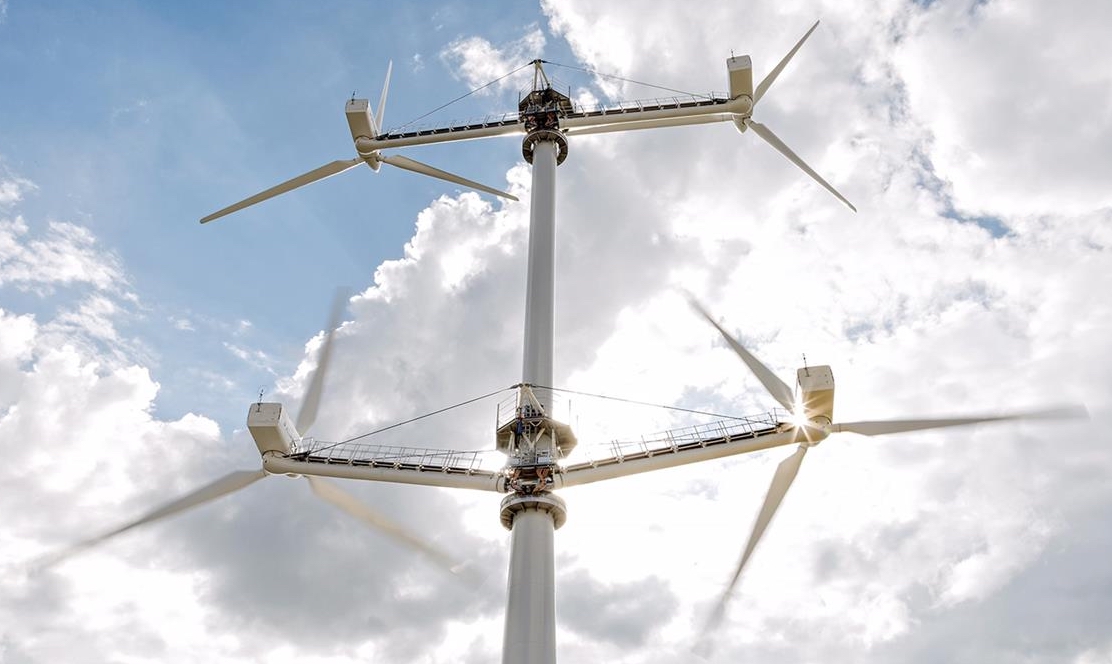
A PhD student I am co-supervising (Abdirahman Sheik Hassan) has just published his first paper—a review on multi-rotor wind turbines.
To extract more and more energy from the wind, turbine blades are getting longer and longer. This scaling places significant challenges on the materials, manufacturing, testing, transportation, operation, and maintenance of the blades. With blades exceeding 100 m in length, glass-reinforced composites are increasingly being replaced with stiffer carbon fibre; the quality of resin infusion during manufacturing is increasingly difficult; and the transportation to the final site along roads is a major logistics operation.
One possible solution out of this bottleneck is to locate multiple smaller rotors on a single supporting frame, a so-called multi-rotor system. Not only would this approach remove many of the challenges listed above around manufacturing and transportation, but it would theoretically allow the use of more sustainable bio-based composites whose inferior mechanical properties make them unsuitable for longer blades. In addition, analytical scaling arguments suggest that the cost of energy from multi-rotors decreases favourably with the number of rotors employed.
Our review paper summarises the literature on multi-rotors from the past decades including aerodynamics, materials, structures, design, control, sustainability, reliability, and
maintenance. The paper also highlights open questions around the environmental impact benefits of multi-rotors, the characterisation of rotor–rotor inter-
action effects, and the investigation of aerodynamic noise, amongst others.