Aircraft wings are designed for the worst-case scenario encountered during a service lifetime. Generally, this is a severe gust that occurs only a handful of times but produces significant bending stresses at the wing root to require substantial reinforcement. Because the aircraft spends the majority of its lifetime not experiencing such a rare, extreme load case the wing is over-designed for much of its service life.
The additional reinforcement and mass required to sustain these rare load cases unnecessarily increases fuel burn during standard operation (99.9% of the time).
What if this extreme load case could therefore be removed from the aircraft’s life cycle?
For example, by deploying a spoiler or tab into the airflow on the top wing surface to disrupt the boundary layer, detach the flow, and thereby dump lift and reduce bending moments at the root of the wing.
Such a device is possible, but usually requires the integration of an active control system with sensors and actuators that also add weight and complexity to the structure and aircraft system. A more elegant solution is to use a passive device. For example, a structure that deforms as the wing bends during a gust and then triggers the spoiler to pop-out of the top wing surface. In a way, this would represent a “reflex” of the wing to protect itself from severe loading.
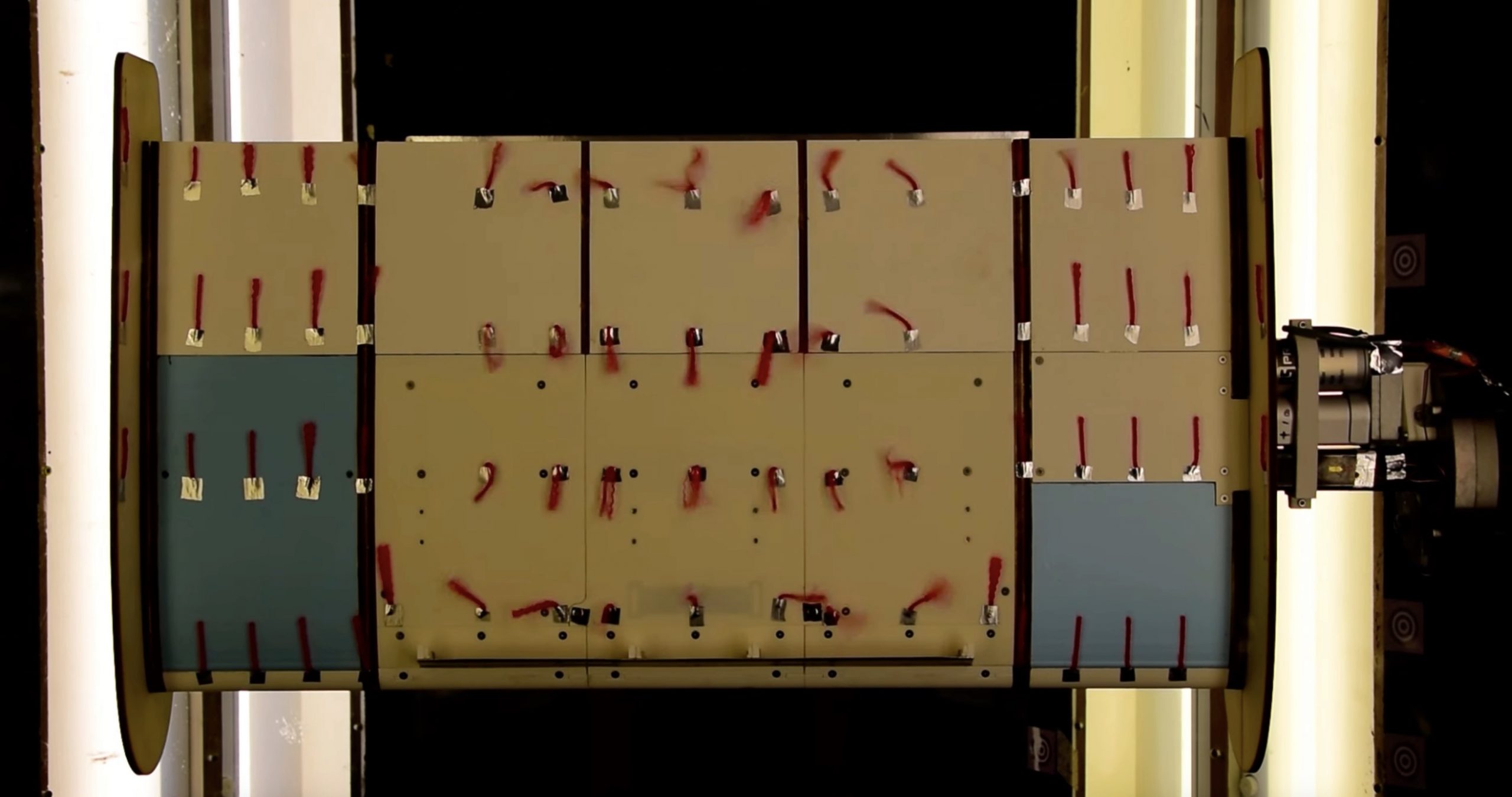
In previous work, we (PhD student Ed Wheatcroft and Bristol colleagues Mark Schenk, Alberto Pirrera and I) designed such a device (1, 2) and tested its performance in a wind tunnel (see above image). These wind tunnel experiments proved the concept that a deploying leading-edge spoiler (albeit using an actuator in this proof of concept) could effectively reduce the lift produced by the airfoil.
In our latest publication, the effectiveness of the spoiler is demonstrated on an aircraft-level study in collaboration with Airbus UK. To do this, an idealised full aircraft model was simulated and subjected to a number of different flight load cases, with the lift-reduction effect of the spoiler hard-wired into the simulation. The results demonstrated that the spoiler is capable of reducing the sizing wing root bending moment by up to 17% for the particular airframe considered.
Following these promising results, the next steps are to integrate a spoiler into a flexible wing model that can then be tested live in a wind tunnel.