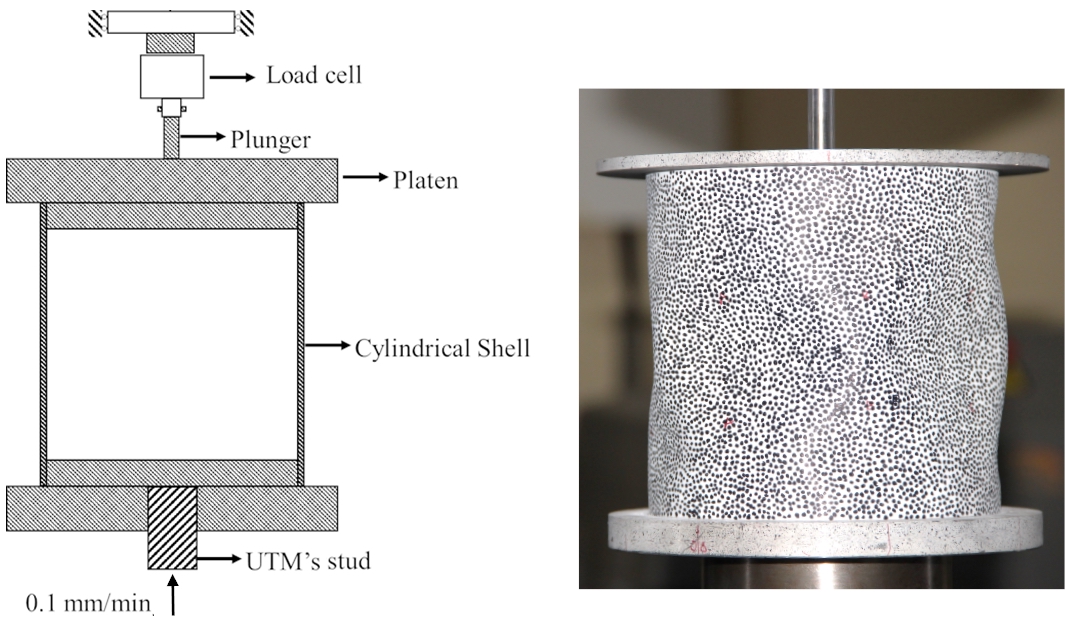
I have just published a new paper in the Proceedings of the Royal Society A with collaborators at IIT Hyderabad (India).
Thin-walled cylinders are used in various engineering applications ranging from fuselages in aircraft to fuel tanks in launch vehicle stages. When thin-walled cylinders are compressed, they are susceptible to buckling and this occurs at loads well below what is suggested by analysis. As a result, cylinders are designed with very conservative safety factors.
One way to improve the design process is to devise a non-destructive testing framework that can predict when a manufactured cylinder will buckle, which would then provide information on potential remedial measures. Such a methodology has recently been developed, where a cylinder is probed laterally from the side to measure its resistance to indentation, but the method is very dependent on the location of probing.
Buckling of cylinders is a local event, where a single dimple initiates a dynamic buckling sequence. Probing should occur at the weakest spot where the dimple initiates. However, this site is not known a priori as it depends on imperfections in manufacturing and loading.
Our paper showed that the dimple initiation site can be predicted from deformation measurements (using digital image correlation) before buckling occurs. The measured deformations are used to compute a bending energy measure which successfully reveals the presence of a developing dimple at approximately 60% of the critical buckling load.
This information can help to determine where to probe the cylinder to determine the buckling load in a non-destructive manner, i.e. without ever pushing the cylinder to the buckling point.