Tag: Fibre-reinforced plastic

  • Composite Manufacturing – Autoclave Variability

    Throughout the last four decades the exploitation of fibre-reinforced plastics (FRP) in engineering structures has been steadily diversifying from sports equipment and high performance racing cars, to helicopters and most recently commercial aeroplanes. Composite materials are essentially a combination of two or more dissimilar materials that are used together in order to combine best properties, or impart a new set of characteristics that neither of the constituent materials could achieve on their own. Engineering composites are typically built-up from individual plies that take the form of continuous, straight fibres (eg. carbon, glass, aramid etc.) embedded in a host polymer matrix (eg. phenolic, polyester, epoxy etc.), which are laminated layer-by-layer in order to built up the final material/structure.

    All manufacturing processes are subject to a certain degree of variability. Composite materials differ from most metallic manufacturing routes in that the material is generated at the same time as the structural geometry of the part. In the aerospace industry autoclave components of pre-impregnated reinforcements are the dominant mouldings being used. In this case the hardest variable to control is the thickness dimension and this will be the major concern of this article.

    Lean manufacturing calls for variability on thickness expressed as a standard deviation of 1/6th the drawing tolerance – the “6-Sigma” tolerance band – giving a thickness defect rate of 1 in 1,000,000. In reality current thickness defect rates are in the range of 1 in 10 for composite components (1). The biggest influence on laminate thickness is the consolidation pressure. As the consolidation pressure is increased the laminate is compacted more and thus more resin may be bled out of the prepreg. As a result the volume fraction of fiber can vary from just around 50% at 1 bar consolidation to almost 70% at 6 bar. Such large variations in volume fraction will naturally influence the consolidation thickness. The external pressure “felt” by the laminate is not just a function of the target autoclave setting. Insufficient contact between the vacuum bag and the laminate and wrinkles in the bag will greatly reduce the consolidation pressure experienced by the laminate. Since the vacuum bag application is a manual process and the bagging material can be quite flimsy certain amount of wrinkling is inevitable. Thus it can be very difficult to reduce this type of variability and in the worst-case defects such as delaminated plies may occur.

    During curing the external temperature is typically ramped up in two stages and held constant in between, the so-called “dwell period”, in order to allow the actual mould temperature to catch-up and ensure full consolidation and cure. During the early parts of the cure the resin viscosity will first reduce as a result of the increasing temperature but then increase suddenly as the mould temperature reaches the gelation point and thus causes the resin to solidify. When the resin viscosity is low internal flows of resin will occur.
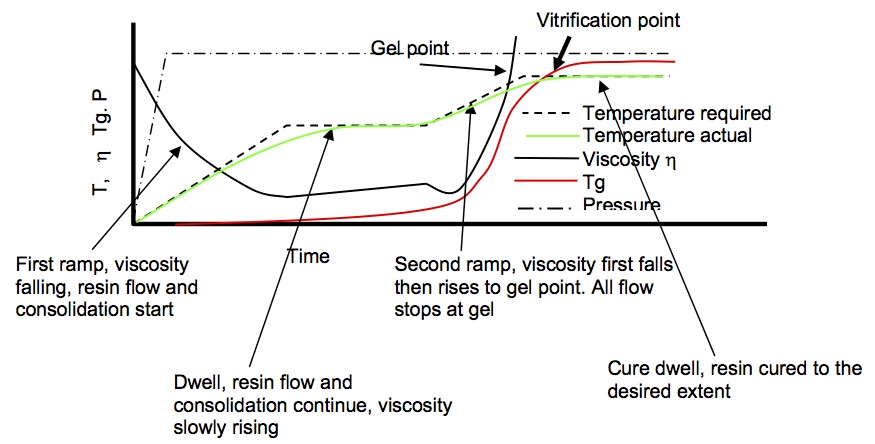
    Composite Consolidation Programme: Variation of Viscosity with Temperature (3)

    Around corners the difficulty of preventing fibre wrinkling or fibre bridging is added. If plies cannot slip over each other as they consolidate over inside radii, fibre bridging will occur and the laminate will get thicker in the corner. The fibres that bridge the radius will directly react the consolidation pressure leading to a reduced resin pressure beneath the bridged fibres. Resin will, therefore, tend to flow towards this region of bridged fibres but if this does not sufficiently occur high local voidage will result.
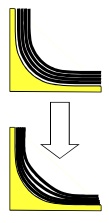
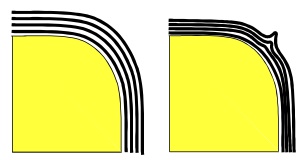
    Fibre Bridging (3)
    Fibre Wrinkling (3)

    Upon consolidation the resin will start to shrink and since it is constrained, the bridged pocket will be exerted under tensile stress. This may cause cracking in the brittle resin and thus cause internal failure before any external load has been applied on the part. Fibre bridging may be reduced by using rollers to press the fabric into the corner or by incorporating slip-lines into the layup. However, especially in the latter case this will complicate the layup and increase manufacturing times.
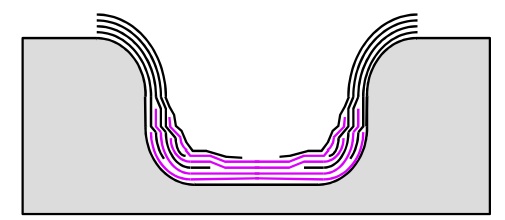
    Slip Lines in Layup (3)

    Equally, if plies cannot slip over external radii then fibre wrinkling or “earing” will occur. Although this will not produce a resin sink the wrinkled area will be voidy and have poorly controlled fibre orientation leading to a reduction in mechanical properties. Fibre wrinkling may also be exacerbated by wrinkles in the vacuum bag over the corner.

    Taking the example of the component below the real laminate thickness and target thickness can be widely different. In zone 1 the laminate is likely to be thinner as a result of resin bleeding out of the component unless some sort of resin dam is used. Zones 3 and 5 are likely to be thinner due to resin flow from these areas into the resin sink over the internal radii at zone 4. Ideally the effects of internal and external radii would cancel out at zones 4 and 5 but inaccuracies in the layup or induced tensions in the plies will typically mitigate this. The most critical section of the component is undoubtedly zone 6, where high voidage is very likely due to the difficulty of bleeding sufficient resin into the area and the two adjacent internal radii.
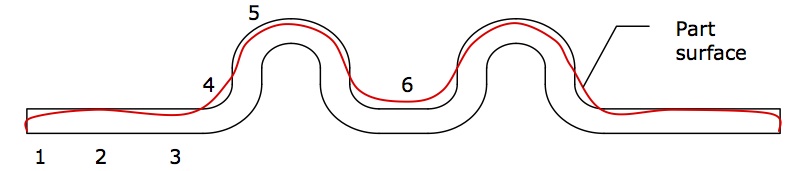
    Thickness Variation in Composite Moulding (3)

    Thickness deviations are only one form of variability. Other defects may stem from part design, manufacturing design, the lay-up process or the autoclave process. To produce reliable components with tightly toleranced dimensions lay-ups are typically made balanced (equal number of ±Angle° plies) and symmetric about the mid-plane in order to avoid thermally induced distortions. Unbalanced or unsymmetric laminates manufactured as plates on flat tools will warp and twist as a result of the different thermal expansion coefficients of different layers. However, if the resin content varies between different plies the thermal properties will naturally vary and the laminate will be unbalanced. For a typical pre-preg the weight/unit area tolerance limits can be up to 5% on both pre-preg and fibre weight, and resin contents may even have a slightly wider tolerance band (1). Considering that resin and fibre contents directly influence the mechanical properties of the composite it can be quite challenging to decrease variability and guarantee reliable components with such a wide tolerance band.

    Additional distortions arise if aluminium or steel tooling is used. Metal tools have higher coefficients of thermal expansion than composites and cure in the autoclave can occur at elevated temperatures of typically 180°C. Therefore the tooling will expand more than the composite, putting strains onto the outermost ply. These surface strains may be exacerbated by local features such as a corners and joggles.

    A considerable amount of variability around corners is the so-called “spring-in” effect. As the laminate cools down from cure it will contract far more through the thickness than in plane. In order to maintain continuity of the profile without causing residual stresses the corner angles will close up. This can result in changes of corner angle of about 1° for 150°C change in temperature. Other defects such as fibre wrinkling or bridging will worsen this effect. In general it is very difficult to accurately predict what will happen for certain geometries.
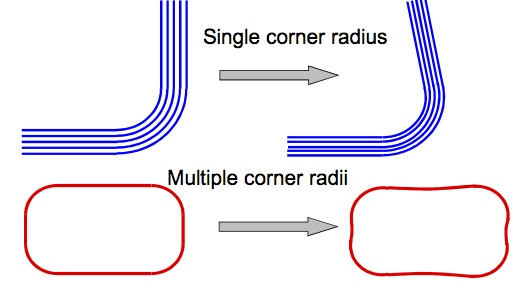
    Composite Spring-In (3)

    In addition, other sources of defects include:

    • Surface scratches, depressions and dents
    • Delaminations between plies or voids
    • Material inclusion within the layup such as a ruler
    • Undercure or overcure (burning)
    • Tool drop or other impact events that can cause internal resin damage or delaminations

    In general most of these defects can be controlled by well-trained and highly motivated factory staff. Engineers and factory management should work together to ensure that all employees involved with the layup and curing process are aware of all possible sources of variability and how to mitigate these. In this respect detailed technical training entrusts more responsibility on the shoulders of employees and gives the staff the deserved recognition of being an important cog in the works of the company. Furthermore, the importance of a well-lit, comfortable working environment and positive atmosphere should not be understated and can go a long way to guaranteeing high-quality mouldings. A well-trained, highly motivated and happy staff is the first line of defence against poor parts.

    Next it is important to follow a concurrent design philosophy throughout the development process of a component. Thus the design, stress, manufacturing and quality control engineers must simultaneously work together in order to come up with a solution that fulfils all functional needs but can also be manufactured to a profit without unnecessary defects. The classical philosophy of separately designing a functional component, which is handed to the production engineers, makes manufacturing high-quality laminates incredibly difficult and will incur significant secondary costs.

    Finally, specific details of possible sources of variability can then be handled on a case-by-case basis. Thus the component’s shape and type of prepreg to be used will influence the mould material shape design; curing temperature and pressure; possible inclusion of slip lines and laminate stacking sequence as discussed above. In conclusion, manufacturing high-quality laminates for the aerospace industry is not an easy task and is even more daunting considering the size of the current all composite Boeing 787 Dreamliner and Airbus A350 XWB projects. Each design decision must be weighed against the influence on manufacturing process and every little detail is important!

    References

    (1) Potter, Kevin (1996). An Introduction to Composite Products: Design, Development and Manufacture. Springer, 5th Ed. Chapman & Hall, London.

    (2) http://en.wikipedia.org/wiki/File:Delamination-CFRP.jpg

    (3) Potter, Kevin (2011). Lecture 4. Basic Processes – Variability and defects. University of Bristol, Bristol.
  • Composites Manufacturing

    Throughout the last four decades the exploitation of fibre-reinforced plastics (FRP) in engineering structures has been steadily diversifying from sports equipment and high performance racing cars, to helicopters and most recently commercial aeroplanes. Composite materials are essentially a combination of two or more dissimilar materials that are used together in order to combine best properties, or impart a new set of characteristics that neither of the constituent materials could achieve on their own. Engineering composites are typically built-up from individual plies that take the form of continuous, straight fibres (eg. carbon, glass, aramid etc.) embedded in a host polymer matrix (eg. phenolic, polyester, epoxy etc.), which are laminated layer-by-layer in order to built up the final material/structure.

    In terms of manufacturing advanced fibre-reinforced composites the single most important aspect to recognize is that the material and the structure are created at the same time. Consequently any defects that are induced during the manufacturing process directly influence the strength and stiffness of the material and structure. Every little detail is important.

    A large number of composite manufacturing processes have been developed over the last 40 years including: contact moulding, compression moulding, vacuum bag/autoclave moulding, rotational moulding, resin transfer moulding (RTM), tape wrapping, filament winding, pultrusion, expanding bladder moulding etc. All these processes have several characteristics in common; the reinforcements are brought into the required shape in a tool or mould, resin and fibres are brought together possibly under elevated temperature and pressure to cure the resin, and the moulding stripped from the part once the resin has cured. The different fabrication techniques can either be classified as direct processes (eg. RTM, pultrusion, contact moulding) that use separate fibres and resin brought together at the point of moulding or indirect processes that use fibres pre-impregnated with resin (eg. vacumm bag/autoclave moulding, compression moulding).

    The selection of the manufacturing process will naturally have a great effect on the quality, the mechanical properties and fabrication cost of the component. According to Potter (1996) an ideal process can be defined as having:

    1. High Productivity – short cycle times, low labour contents etc.
    2. Minimum materials cost – low value added materials, low material storage and handling cost
    3. Maximum geometrical flexibility – shape complexity and size of component
    4. Maximum property flexibility – range of matrices, range of reinforcement types, ability to control mechanical properties and tailor characteristics
    5. Minimum finishing requirements – net shape manufacturing
    6. Reliable and high quality manufacture – low reject rates, low variability etc.
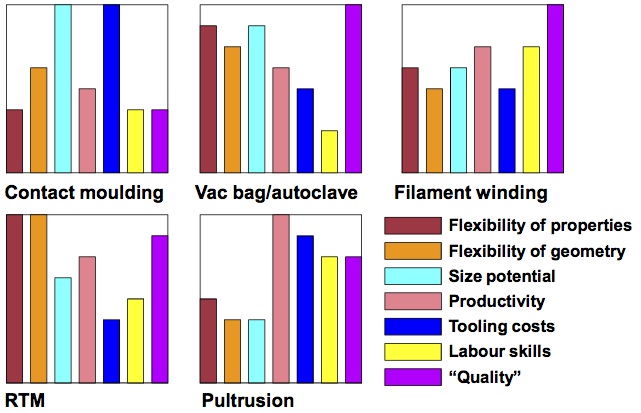
    Comparison of Composite Manufacturing Techniques (1)

    No manufacturing process exists that can simultaneously fulfill all these requirements; most importantly some of these requirements may be mutually exclusive. A comparison of the 5 most common processes is shown below.

     Contact Moulding

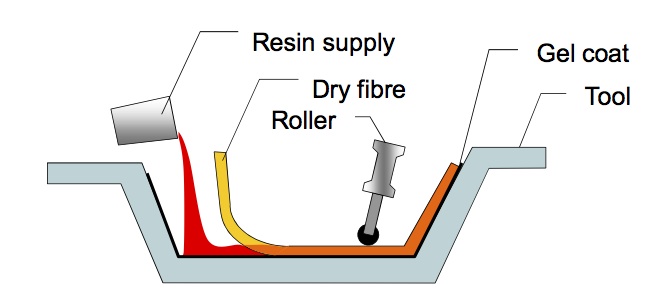
    This is the oldest and most primitive manufacturing process but also the most widely used around the world. In contact moulding resin is manually applied to a dry reinforcement placed onto a tool surface and can be compared to glueing wall paper with a brush. The tool and fabric are then enclosed by a vacuum bag and the air under the bag removed in order to cure the laminate under atmospheric pressure. However, since the applied pressure is relatively low and cure typically occurs at room temperature the volume fraction of reinforcement is limited to the natural packing density. Furthermore, the quality is totally dependent on the skill of the workforce and due to the difficulty in reliably guaranteeing high-quality laminates it is almost impossible to qualify contact moulded structural components for commercial aircraft. Finally, due to the limited external pressure voidage is difficult to control, which has a great effect on the variability in the thickness of laminates.

    Contact Moulding Schematic (1)

    On the other hand the process is highly flexible, ideal for one-off-production and requires minimal infrastructure. While contact moulding is process of choice for very large structures the geometrical flexibility is more constrained in terms of creating parts with fine details, corner radii, etc. For this reason the process is extensively used in glassfibre/polyester resin shipbuilding and for gliders.

    Vac. Bag/Autoclave

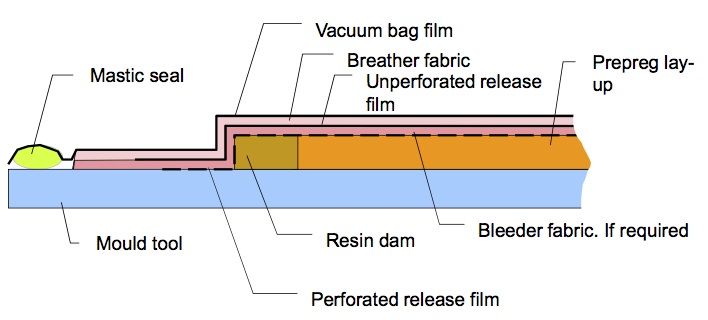
    In advanced composites autoclave processes are by far the most widely used and autoclave moulding is the process of choice for the aerospace industry. These processes use pre-impregnated uni-directional plies or woven cloths, which have been partially cured or beta-staged. One disadvantage is that pre-preg has to be kept in a freezer in order to prevent the resin from going-off. Multiple prepreg plies are laid down onto a tool surface with the pre-defined fibre orientations, to build up the required thickness, and then covered with a release film, breather fabric and a vacuum bag or silicon pressure bag. The air is drawn out from the bag to create a vacuum and the tool heated under elevated temperature and pressure to cure the resin. In principle multiple demoulding cycles are performed by covering the laminate and applying a vacuum after every 3-4 ply layers in order to remove any excess air between layers. This reduces the bulk factor and helps to prevent delaminations between plies and controls the thickness dimension. Regular demoulding cycles and sufficient hydrostatic pressure on the part during curing are the two basic requirements for achieving good mouldings. The productivity of autoclave moulding is generally quite low since the manual lay-up, bagging and demoulding cycles consume significant labour and time. Furtermore, the capital expenditure of autoclaves are enourmous, which constrains its use to larger structures where these expendictures are justified. Since, pre-preg is no longer in a low-value added state the material costs are also higher.

    Prepreg Layup for Autoclave Cure (1)
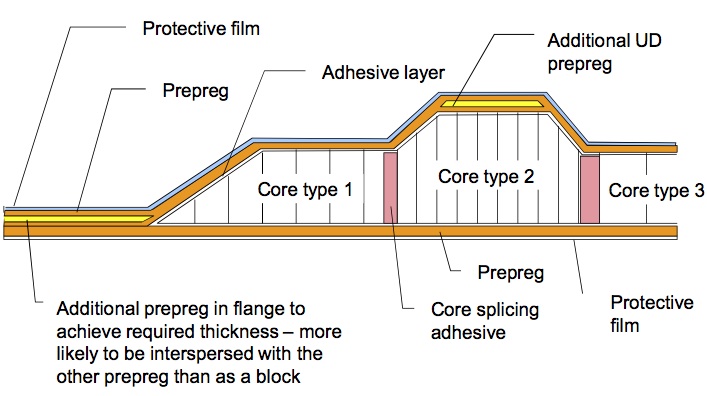
    Honeycomb Sandwich with Pre-preg for Autoclave Cure (1)

    Geometrical flexibility in both shape and size are better than for most processes. Recently it has been possible to manufacture the entire floor of a helicopter in one piece, which would not be possible with a metallic approach. Autoclave mouldings are often used in conjunction with honeycomb cores such that very lightweight components can be manufactured. This is one of the reasons why the dominance of autoclave mouldings seems very likely to continue in the near future, at least in the aerospace environment.

    Filament Winding

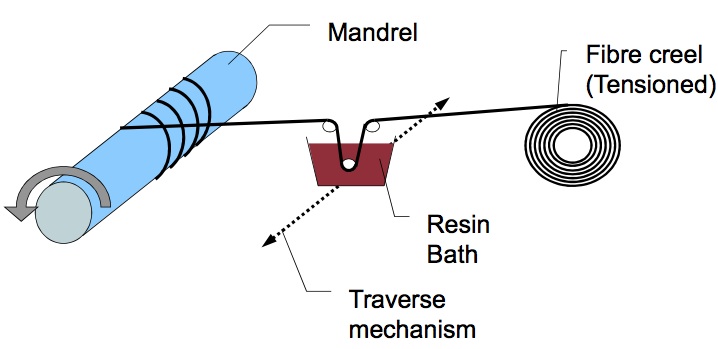
    In filament winding a tow of fibres is passed through a bath of resin and wound onto a revolving mandrel by traversing longitudinally along the axis of the rotating mandrel. Unless tacky pre-impregnated fibre tows are used the path followed by the tow must closely follow a geodesic path (fibre paths that do not cause fibres to slip if tensioned). Any simple helical path on a cylinder is defined to be a geodesic path but once curvature in two directions is introduced (e.g. a globe) the number of possible paths becomes very limited. For this reason property flexibility is rather constrained such that filament winding is typically used for manufacturing pipework, pressure vessels and rockets motors. Especially, pressure vessels are conducive to filament winding since they have two clearly defined stress-directions (the hoop and longitudinal stresses) that can be accommodated by the winding direction.

    Schematic of Filament Winding Process (1)

    One disadvantage of filament winding is that the mandrel is often enclosed within the winding. If a liner of metal or polymer is used as a mandrel it may form a permanent part of the structure but it is more common that the winding is slit-off at the ends to demould the part. The geometrical flexibility is also constrained by having to wind around circular or prismatic mouldings. One major advantage is that the process lends itself to automation such that cycle times and labour costs can be kept low with high reliability and quality. This latter aspect is one of the reasons why efforts are being made to widen the process’ geometrical limits and possible applications.

    Resin Transfer Moulding (RTM)

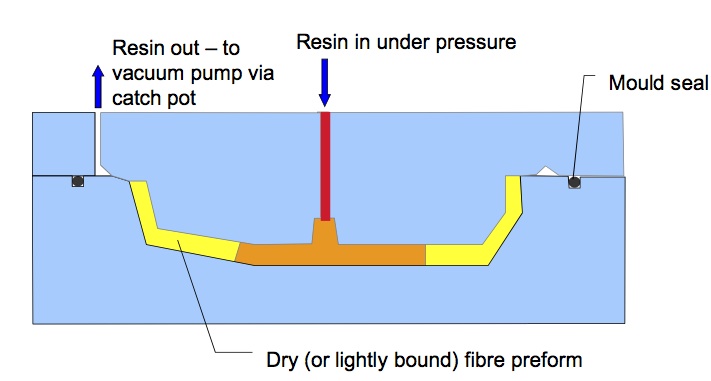
    RTM can not be considered as a single process but is better regarded as a “manufacturing philosophy in which the resin and fibres are held apart until the very last moment” (Potter, 1996). However, all process variations have the common features of holding unresinated fibres within a closed tool cavity with a differential pressure applied to a supply of resin such that the resin permeates into the reinforcement. The tool may be rigid or contain flexible elements. The consolidation pressure on the tool is applied by means of mechanical clamps, a tooling press or the use of internal vacuum and defines the achieved volume fraction of fibre with respect to resin. RTM has been used since the 1970s to build radomes as well as aeroengine compressor blades. The main driver behind further developing RTM processes is to devise fabrication methods that can overcome the geometrical complexity limitations imposed by autoclave mouldings. In terms of productivity cycles times are lower than most other processes and in the automotive industry small components are manufactured within minutes.

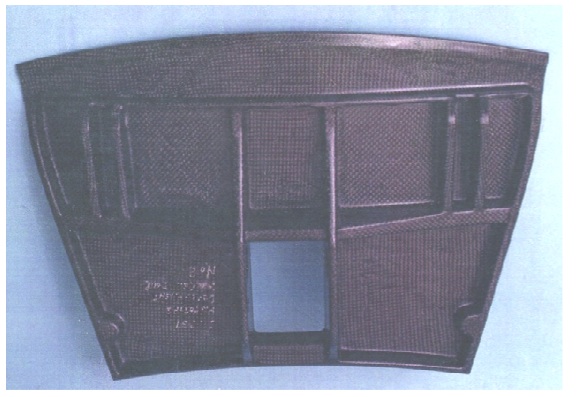
    Automotive Panel Manufactured via RTM

    A major advantage of RTM is the use of low added value materials (dry fibres and low viscosity resins) which do not have to be stored in freezers, thus driving down material and handling costs. The major advantages of RTM however lie within their geometrical and property flexibility. RTM can be used with UD stitched cloths, woven fabrics and 3D fabrics, and the resin injection can be varied to control the volume fraction and therefore the stiffness and strength of the component. Furthermore, small components with very fine details are manufactured on rigid metal tooling while larger components can be produced on flexible moulds. Finally, with a closely controlled process it is possible to create net-shape mouldings with minimal finishing requirements. However, all this comes at the cost at a slightly trickier production technique. In order to guarantee high-quality components the resin injection and resin flow has to be closely controlled such that all of the reinforcement is equally wetted-out. This requires quite advanced fluid dynamics simulations and extensive testing in order to come up with a mould shape that allows even resin flow to all parts of the component.

    Pultrusion

    In this process fibres are drawn from a creel board and passed through a resin bath to impregnate the fibres with resin. The impregnated fibres are then passed through a pre-die to remove any excess resin and to pre-form the approximate final shape. The curing die is then entered, which takes the shape of the final required cross-section of the pultruded part. The curing die applies heat to the component to consolidate the resin and the cured, shaped profile is pulled from the die under tension. This means that productivity can be very high in an ongoing production but will fall for lower production volumes that require changes to new cross-section dies. Since the operation is automated labour costs are low and the reliability and quality of components is high. The process is generally limited to constant cross-section components, which greatly restricts applications. Pultrusion has been used very little in aerospace environments but has found application in manufacturing standardized profile beams for civil engineering structures.

    Schematic of Pultrusion Process (1)

    Automated Processes

    The use of robotics in composite manufacturing is growing at a rapid rate and is probably the most promising technology for the future. Obvious advantages of automating the manufacturing process include reduced variability in dimensions and less manufacturing defects. Furthermore, the feed material can be used more efficiently and labour costs are reduced. One promising class of system are the so-called Automated Fibre Placement (AFP) machines which use a robotic fibre placement head that deposits multiple pre-impregnated tows of “slit-tape” allowing cutting, clamping and restarting of every single tow. While the robotic head follows a specific fibre path tows are heated shortly before deposition and then compacted onto the substrate using a special roller. Due to the high fidelity of current robot technology AFP machines can provide high productivity and handle complex geometries. Current applications include the manufacture of the Boeing 787 fuselage and winding of square boxes, that are then slit lengthwise to make two ‘C’ sections for wing spars. Integrated manufacturing systems as designed by companies like ElectroImpact offer exciting turnkey capabilities for future aircraft structures. These systems combine multiple manufacturing processes, for example fibre placement and additive manufacturing on one robot head, and therefore facilitate the production of blended and integrated structures with fewer joints and connections. These systems will also allow engineers to design more efficient structures, such as integrated orthogrid or isogrid composite panels, that are currently hard to manufacture economically on a large scale.

    References

    (1) Potter, Kevin (1996). An Introduction to Composite Products: Design, Development and Manufacture. Springer, 5th Ed. Chapman & Hall, London.

    (2) http://www.tca2000.co.uk/wilton3small.jpg

    (3) http://csmres.co.uk/cs.public.upd/article-images/nose-72668.jpg