Tag: drag

  • How Quickly Do Bubbles Rise in a Pint of Beer?

    The material we covered in the last two posts (skin friction and pressure drag) allows us to consider a fun little problem:

    How quickly do the small bubbles of gas rise in a pint of beer?

    To answer this question we will use the concept of aerodynamic drag introduced in the last two posts – namely,

    • skin friction drag – frictional forces acting tangential to the flow that arise because of the inherent stickiness (viscosity) of the fluid.
    • pressure drag – the difference between the fluid pressure upstream and downstream of the body, which typically occurs because of boundary layer separation and the induced turbulent wake behind the body.

    The most important thing to remember is that both skin friction drag and profile drag are influenced by the shape of the boundary layer.

    What is this boundary layer?

    As a fluid flows over a body it sticks to the body’s external surface due to the inherent viscosity of the fluid, and therefore a thin region exists close to the surface where the velocity of the fluid increases from zero to the mainstream velocity. This thin region of the flow is known as the boundary layer and the velocity profile in this region is U-shaped as shown in the figure below.
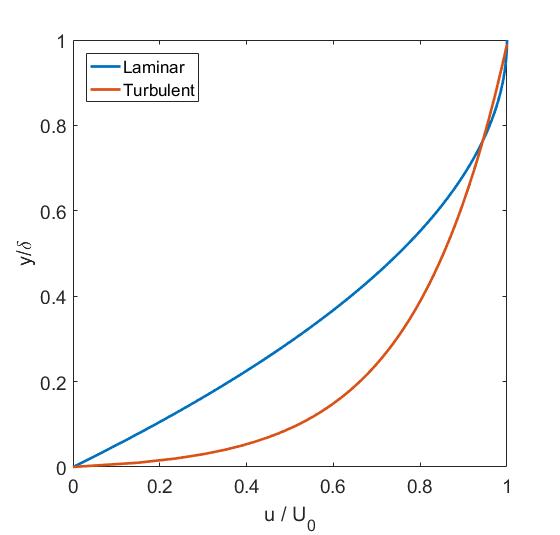
    Velocity profile of laminar versus turbulent boundary layer
    Velocity profile of laminar versus turbulent boundary layer

    As shown in the figure above, the flow in the boundary layer can either be laminar, meaning it flows in stratified layers with no to very little mixing between the layers, or turbulent, meaning there is significant mixing of the flow perpendicular to the surface. Due to the higher degree of momentum transfer between fluid layers in a turbulent boundary layer, the velocity of the flow increases more quickly away from the surface than in a laminar boundary layer. The magnitude of skin friction drag at the surface of the body (y = 0 in the figure above) is given by

    [latex] \tau_w = \mu \frac{\mathrm{d}u}{\mathrm{d}y}_w [/latex]

    where [latex] \mathrm{d}u/\mathrm{d}y [/latex] is the so-called velocity gradient, or how quickly the fluid increases its velocity as we move away from the surface. As this velocity gradient at the surface (y = 0 in the figure above) is much steeper for turbulent flow, this type of flow leads to more skin friction drag than laminar flow does.

    Skin friction drag is the dominant form of drag for objects whose surface area is aligned with the flow direction. Such shapes are called streamlined and include aircraft wings at cruise, fish and low-drag sports cars. For these streamlined bodies it is beneficial to maintain laminar flow over as much of the body as possible in order to minimise aerodynamic drag.

    Conversely, pressure drag is the difference between the fluid pressure in front of (upstream) and behind (downstream) the moving body. Right at the tip of any moving body, the fluid comes to a standstill relative to the body (i.e. it sticks to the leading point) and as a result obtains its stagnation pressure.

    The stagnation pressure is the pressure of a fluid at rest and, for thermodynamic reasons, this is the highest possible pressure the fluid can obtain under a set of pre-defined conditions. This is why from Bernoulli’s law we know that fluid pressure decreases/increases as the fluid accelerates/decelerates, respectively.

    At the trailing edge of the body (i.e. immediately behind it) the pressure of the fluid is naturally lower than this stagnation pressure because the fluid is either flowing smoothly at some finite velocity, hence lower pressure, or is greatly disturbed by large-scale eddies. These large-scale eddies occur due to a phenomenon called boundary layer separation.
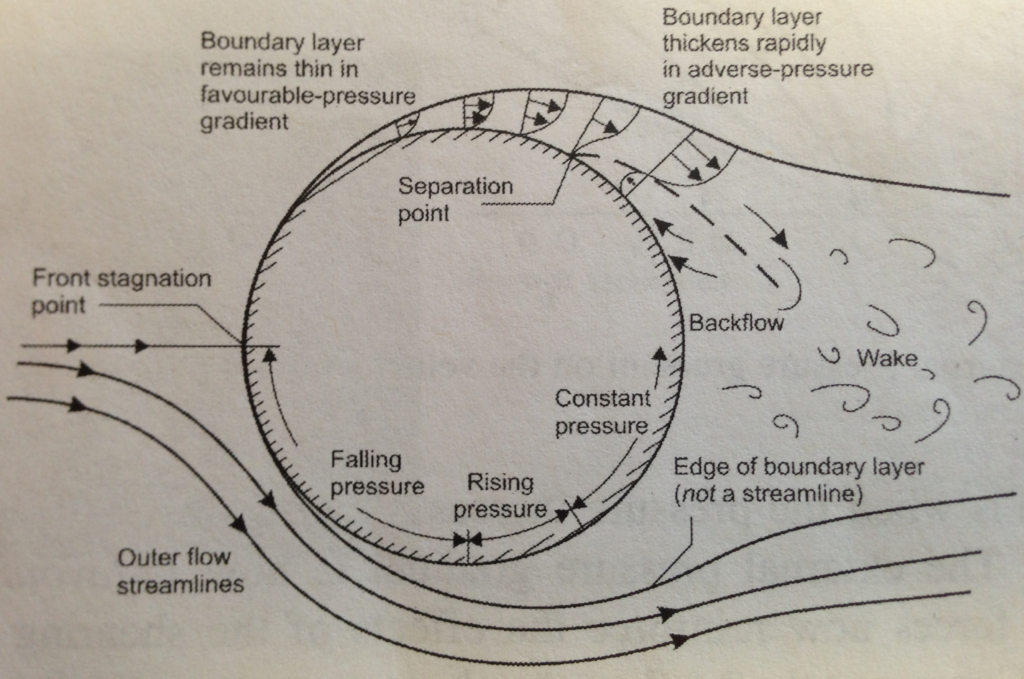
    Boundary layer separation over cylinder
    Boundary layer separation over a cylinder


    Why does the boundary layer separate?

    Any body of finite thickness will force the fluid to flow in curved streamlines around it. Towards the leading edge this causes the flow to speed up in order to balance the centripetal forces created by the curved streamlines. This creates a region of falling fluid pressure, also called a favourable pressure gradient. Further along the body, the streamlines straighten out and the opposite phenomenon occurs – the fluid flows into a region of rising pressure, also known as an adverse pressure gradient. This adverse pressure gradient decelerates the flow and causes the slowest parts of the boundary layer, i.e. those parts closest to the surface, to reverse direction. At this point, the boundary layer “separates” from the body and the combination of flow in two directions induces a wake of turbulent vortices; in essence a region of low-pressure fluid.

    The reason why this is detrimental for drag is because we now have a lower pressure region behind the body than in front of it, and this pressure difference results in a force that pushes against the direction of travel. The magnitude of this drag force greatly depends on the location of the boundary layer separation point. The further upstream this point, the higher the pressure drag.

    To minimise pressure drag it is beneficial to have a turbulent boundary layer. This is because the higher velocity gradient at the external surface of the body in a turbulent boundary layer means that the fluid has more momentum to “fight” the adverse pressure gradient. This extra momentum pushes the point of separation further downstream. Pressure drag is typically the dominant type of drag for bluff bodies, such as golf balls, whose surface area is predominantly perpendicular to the flow direction.

    So to summarise: laminar flow minimises skin-friction drag, but turbulent flow minimises pressure drag.

    Given this trade-off between skin friction drag and pressure drag, we are of course interested in the total amount of drag, known as the profile drag. The propensity of a specific shape in inducing profile drag is captured in the dimensionless drag coefficient [latex]C_D[/latex]

    [latex] C_D = \frac{D}{1/2 \rho U_0^2A}[/latex]

    where [latex]D[/latex] is the total drag force acting on the body, [latex]\rho[/latex] is the density of the fluid, [latex]U_0[/latex] is the undisturbed mainstream velocity of the flow, and [latex]A[/latex] represents a characteristic area of the body. For bluff bodies [latex]A[/latex] is typically the frontal area of the body, whereas for aerofoils and hydrofoils [latex]A[/latex] is the product of wing span and mean chord. For a flat plate aligned with the flow direction, [latex]A[/latex] is the total surface area of both sides of the plate.

    The denominator of the drag coefficient represents the dynamic pressure of the fluid ([latex]1/2 \rho U_0^2[/latex]) multiplied by the specific area ([latex]A[/latex]) and is therefore equal to a force. As a result, the drag coefficient is the ratio of two forces, and because the units of the denominator and numerator cancel, we call this a dimensionless number that remains constant for two dynamically similar flows. This means [latex]C_D[/latex] is independent of body size, and depends only on its shape. As discussed in the wind tunnel post, this mathematical property is why we can create smaller scaled versions of real aircraft and test them in a wind tunnel.
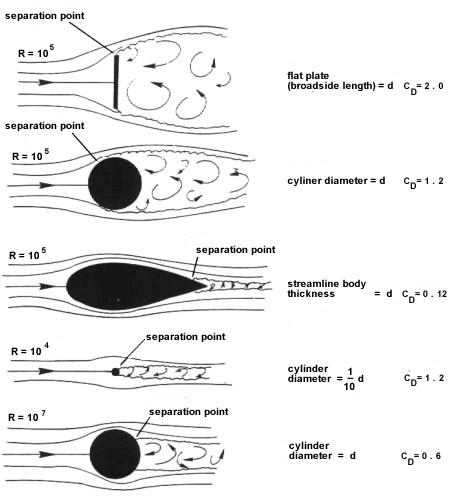
    Skin friction drag versus pressure drag for differently shaped bodies

    Looking at the diagram above we can start to develop an appreciation for the relative magnitude of pressure drag and skin friction drag for different bodies. The “worst” shape for boundary layer separation is a plate perpendicular to the flow as shown in the first diagram. In this case, drag is clearly dominated by pressure drag with negligible skin friction drag. The situation is similar for the cylinder shown in the second diagram, but in this case the overall profile drag is smaller due to the greater degree of streamlining.

    The degree of boundary layer separation, and therefore the wake of eddies behind the cylinder, depends to a large extent on the surface roughness of the body and the Reynolds number of the flow. The Reynolds number is given by

    [latex] R = \frac{\rho U_0 d}{\mu}[/latex]

    where [latex]U_0[/latex] is the free-stream velocity and [latex]d[/latex] is the characteristic dimension of the body. The reason why the Reynolds number influences boundary layer separation is because it is the dominant factor in influencing the nature, laminar or turbulent, of the boundary layer. The transition from laminar to turbulent boundary layer is different for different problems, but as a general rule of thumb a value of [latex] R = 10^5 [/latex] can be used.

    This influence of Reynolds number can be observed by comparing the second diagram to the bottom diagram. The flow over the cylinder in the bottom diagram has increased by a factor of 100 ([latex] R = 10^7[/latex]), thereby increasing the extent of turbulent flow and delaying the onset of boundary layer separation (smaller wake). Hence, the drag coefficient of the bottom cylinder is half the drag coefficient of the cylinder in the second diagram ([latex] R = 10^5[/latex]) even though the diameter has remained unchanged. Remember though that only the drag coefficient has been halved, whereas the overall drag force will naturally be higher for [latex] R = 10^7[/latex] because the drag force is a function of [latex] C_D U_0^2 [/latex] and the velocity [latex]U_0[/latex] has increased by a factor of 100.

    Notice also that the streamlined aircraft wing shown in the third diagram has a much lower drag coefficient. This is because the aircraft wing is essentially a “drawn-out” cylinder of the same “thickness” [latex]d[/latex] as the cylinder in the second diagram, but by streamlining (drawing out) its shape, boundary layer separation occurs much further downstream and the size of the wake is much reduced.

    Terminal velocity of rising beer bubbles

    The terminal velocity is the speed at which the forces accelerating a body equal those decelerating it. For example, the aerodynamic drag acting on a sky diver is proportional to the square of his/her falling velocity. This means that at some point the sky diver reaches a velocity at which the drag force equals the force of gravity, and the sky diver cannot accelerate any further. Hence, the terminal velocity represents the velocity at which the forces accelerating a body are equal to those decelerating it.
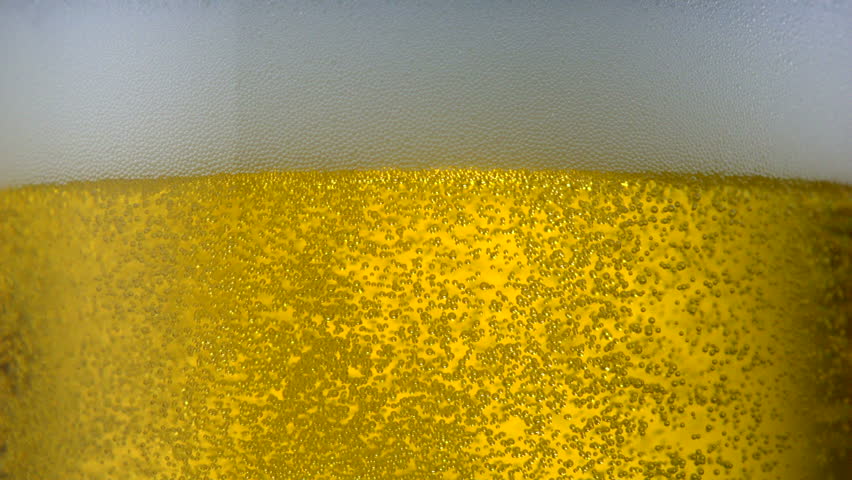
    Beer bubbles rising to the surface
    Turbulent wake behind a moving sphere. We will model the gas bubbles rising to the top of beer as a sphere moving through a liquid

    The net accelerating force of a bubble of air/gas in a liquid is the buoyancy force, i.e. the difference in density between the liquid and the gas. This buoyancy force [latex] F_B [/latex] force is given by

    [latex] F_B = \frac{\pi}{6} d^3 \left( \rho_l-\rho_g \right)g[/latex]

    where [latex] d [/latex] is the diameter of the spherical gas bubble, [latex] \rho_g [/latex] is the density of the gas, [latex] \rho_l [/latex] is the density of the liquid and [latex] g [/latex] is the gravitational acceleration [latex]9.81 m/s^2[/latex]. The buoyancy force essentially expresses the force required to displace a sphere volume [latex] \frac{\pi}{6} d^3 [/latex] given a certain difference in density between the gas and liquid.

    At terminal velocity the buoyancy force is balanced by the total drag acting on the gas bubble. Using the equation for the drag coefficient above we know that the total drag [latex] D [/latex] is

    [latex] D = 1/2 C_D \rho_l U_T^2 \left( \frac{\pi}{4} d^2\right) [/latex]

    where [latex] U_T [/latex] is the terminal velocity and we have replaced [latex] A [/latex] with the frontal area of the gas bubble [latex] \frac{\pi}{4} d^2 [/latex], i.e. the area of a circle. Thus, equating [latex] D [/latex] and [latex] F_B [/latex]

    [latex] \frac{\pi}{6} d^3 \left( \rho_l-\rho_g \right)g = 1/2 C_D \rho_l U_T^2 \left( \frac{\pi}{4} d^2\right) [/latex]

    and re-arranging for terminal velocity gives us

    [latex] U_T^2 = \frac{4d\left(\rho_l-\rho_g\right)g}{3C_D\rho_l} [/latex]

    At this point we can calculate the terminal velocity of a spherical gas bubble driven by buoyancy forces for a certain drag coefficient. The problem now is that the drag coefficient of a sphere is not constant; it changes with the flow velocity. Fortunately, the drag coefficient of a sphere plateaus at around 0.5 for Reynolds numbers [latex] 10^3-10^5 [/latex] (see digram below) and it is reasonable to assume that the flow considered here falls within this range. Some good old engineering judgement at work!

    Drag coefficient of a sphere as a function of Reynolds number
    Drag coefficient as a function of Reynolds number. The curve flattens out between 10^3 and 10^5.
    Hence, for our simplified calculation we will assume a drag coefficient of 0.5, a gas bubble 3 mm in diameter, density of the gas equal to [latex]1.2 kg/m^3[/latex] and density of the fluid equal to [latex]989 kg/m^3[/latex] (5% volume beer).

    Therefore, the terminal velocity of gas bubbles rising in a beer are somewhere in the range of

    [latex] U_T^2 = \frac{4 \times 0.003 \times \left(989-1.2\right) \times 9.81}{3 \times 0.5 \times 989} = 0.0790 \ m^s/s^2 [/latex]

    and taking the square root

    [latex] U_T = 0.281 \ m/s = 28.1 \ cm/s \left( 11 \ inches/s \right)[/latex]

    Given that the viscosity of the fluid is around [latex]\mu = 0.001 Ns/m^2[/latex] we can now check that we are in the right Reynolds number range:

    [latex] R = \frac{\rho_l U_T d}{\mu} = \frac{989 \times 0.281 \times 0.003}{0.001} = 833 [/latex]

    which is right at the bottom of R = [latex] 10^3-10^5 [/latex]!

    So there you have it: Beer bubbles rise at around a foot per second.

    Perhaps the next time you gaze pensively into a glass of beer after a hard day’s work, this little fun-fact will give you something else to think (or smile) about.

    Acknowledgements

    This post is based on a fun little problem that Prof. Gary Lock set his undergraduate students at the University of Bath. Prof. Lock was probably the most entertaining and effective lecturer I had during my undergraduate studies and has influenced my own lecturing style. If I can only pass on a fraction of the passion for engineering and teaching that Prof. Lock instilled in me, I consider my job well done.

  • Boundary Layer Separation and Pressure Drag

    At the start of the 19th century, after studying the highly cambered thin wings of many different birds, Sir George Cayley designed and built the first modern aerofoil, later used on a hand-launched glider. This biomimetic, highly cambered and thin-walled design remained the predominant aerofoil shape for almost 100 years, mainly due to the fact that the actual mechanisms of lift and drag were not understood scientifically but were explored in an empirical fashion. One of the major problems with these early aerofoil designs was that they experienced a phenomenon now known as boundary layer separation at very low angles of attack. This significantly limited the amount of lift that could be created by the wings and meant that bigger and bigger wings were needed to allow for any progress in terms of aircraft size. Lacking the analytical tools to study this problem, aerodynamicists continued to advocate thin aerofoil sections, as there was plenty of evidence in nature to suggest their efficacy. The problem was considered to be more one of degree, i.e. incrementally iterating the aerofoil shapes found in nature, rather than of type, that is designing an entirely new shape of aerofoil in accord with fundamental physics.

    During the pre-WWI era, the misguided notions of designers was compounded by the ever-increasing use of wind-tunnel tests. The wind tunnels used at the time were relatively small and ran at very low flow speeds. This meant that the performance of the aerofoils was being tested under the conditions of laminar flow (smooth flow in layers, no mixing perpendicular to flow direction) rather than the turbulent flow (mixing of flow via small vortices) present over the wing surfaces. Under laminar flow conditions, increasing the thickness of an aerofoil increases the amount of skin-friction drag (as shown in last month’s post), and hence thinner aerofoils were considered to be superior.

    The modern plane – born in 1915

    The situation in Germany changed dramatically during WWI. In 1915 Hugo Junkers pioneered the first practical all-metal aircraft with a cantilevered wing – essentially the same semi-monocoque wing box design used today. The most popular design up to then was the biplane configuration held together by wires and struts, which introduced considerable amounts of parasitic drag and thereby limited the maximum speed of aircraft. Eliminating these supporting struts and wires meant that the flight loads needed to be carried by other means. Junkers cantilevered a beam from either side of the fuselage, the main spar, at about 25% of the chord of the wing to resist the up and down bending loads produced by lift. Then he fitted a smaller second spar, known as the trailing edge spar, at 75% of the chord to assist the main spar in resisting fore and aft bending induced by the drag on the wing. The two spars were connected by the external wing skin to produce a closed box-section known as the wing box. Finally, a curved piece of metal was fitted to the front of the wing to form the “D”-shaped leading edge, and two pieces of metal were run out to form the trailing edge. This series of three closed sections provided the wing with sufficient torsional rigidity to sustain the twisting loads that arise because the centre of pressure (the point where the lift force can be considered to act) is offset from the shear centre (the point where a vertical load will only cause bending and no twisting). Junker’s ideas were all combined in the world’s first practical all-metal aircraft, the Junker J 1, which although much heavier than other aircraft at the time, developed into the predominant form of construction for the larger and faster aircraft of the coming generation.

    Junkers J 1 at Döberitz in 1915
    Structures + Aerodynamics = Superior Aircraft

    Junkers construction naturally resulted in a much thicker wing due to the room required for internal bracing, and this design provided the impetus for novel aerodynamics research. Junker’s ideas were supported by Ludwig Prandtl who carried out his famous aerodynamics work at the University of Göttingen. As discussed in last month’s post, Prandtl had previously introduced the notion of the boundary layer; namely the existence of a U-shaped velocity profile with a no-flow condition at the surface and an increasing velocity field towards the main stream some distance away from the surface. Prandtl argued that the presence of a boundary layer supported the simplifying assumption that fluid flow can be split into two non-interacting portions; a thin layer close to the surface governed by viscosity (the stickiness of the fluid) and an inviscid mainstream. This allowed Prandtl and his colleagues to make much more accurate predictions of the lift and drag performance of specific wing-shapes and greatly helped in the design of German WWI aircraft. In 1917 Prandtl showed that Junker’s thick and less-cambered aerofoil section produced much more favourable lift characteristics than the classic thinner sections used by Germany’s enemies. Second, the thick aerofoil could be flown at a much higher angle of attack without stalling and hence improved the manoeuvrability of a plane during dog fighting.

    Skin Friction versus Pressure Drag

    The flow in a boundary layer can be either laminar or turbulent. Laminar flow is orderly and stratified without interchange of fluid particles between individual layers, whereas in turbulent flow there is significant exchange of fluid perpendicular to the flow direction. The type of flow greatly influences the physics of the boundary layer. For example, due to the greater extent of mass interchange, a turbulent boundary layer is thicker than a laminar one and also features a steeper velocity gradient close to the surface, i.e. the flow speed increases more quickly as we move away from the wall.

    Velocity profile of laminar versus turbulent boundary layer
    Velocity profile of laminar versus turbulent boundary layer. Note how the turbulent flow increases velocity more rapidly away from the wall.

    Just like your hand experiences friction when sliding over a surface, so do layers of fluid in the boundary layer, i.e. the slower regions of the flow are holding back the faster regions. This means that the velocity gradient throughout the boundary layer gives rise to internal shear stresses that are akin to friction acting on a surface. This type of friction is aptly called skin-friction drag and is predominant in streamlined flows where the majority of the body’s surface is aligned with the flow. As the velocity gradient at the surface is greater for turbulent than laminar flow, a streamlined body experiences more drag when the boundary layer flow over its surfaces is turbulent. A typical example of a streamlined body is an aircraft wing at cruise, and hence it is no surprise that maintaining laminar flow over aircraft wings is an ongoing research topic.

    Over flat surfaces we can suitably ignore any changes in pressure in the flow direction. Under these conditions, the boundary layer remains stable but grows in thickness in the flow direction. This is, of course, an idealised scenario and in real-world applications, such as curved wings, the flow is most likely experiencing an adverse pressure gradient, i.e. the pressure increases in the flow direction. Under these conditions the boundary layer can become unstable and separate from the surface. The boundary layer separation induces a second type of drag, known as pressure drag. This type of drag is predominant for non-streamlined bodies, e.g. a golfball flying through the air or an aircraft wing at a high angle of attack.

    So why does the flow separate in the first place?

    To answer this question consider fluid flow over a cylinder. Right at the front of the cylinder fluid particles must come to rest. This point is aptly called the stagnation point and is the point of maximum pressure (to conserve energy the pressure needs to fall as fluid velocity increases, and vice versa). Further downstream, the curvature of the cylinder causes the flow lines to curve, and in order to equilibrate the centripetal forces, the flow accelerates and the fluid pressure drops. Hence, an area of accelerating flow and falling pressure occurs between the stagnation point and the poles of the cylinder. Once the flow passes the poles, the curvature of the cylinder is less effective at directing the flow in curved streamlines due to all the open space downstream of the cylinder. Hence, the curvature in the flow reduces and the flow slows down, turning the previously favourable pressure gradient into an adverse pressure gradient of rising pressure.

    Boundary layer separation over cylinder
    Boundary layer separation over a cylinder (axis out out the page).

    To understand boundary layer separation we need to understand how these favourable and adverse pressure gradients influence the shape of the boundary layer. From our discussion on boundary layers, we know that the fluid travels slower the closer we are to the surface due to the retarding action of the no-slip condition at the wall. In a favourable pressure gradient, the falling pressure along the streamlines helps to urge the fluid along, thereby overcoming some of the decelerating effects of the fluid’s viscosity. As a result, the fluid is not decelerated as much close to the wall leading to a fuller U-shaped velocity profile, and the boundary layer grows more slowly.

    By analogy, the opposite occurs for an adverse pressure gradient, i.e. the mainstream pressure increases in the flow direction retarding the flow in the boundary layer. So in the case of an adverse pressure gradient the pressure forces reinforce the retarding viscous friction forces close to the surface. As a result, the difference between the flow velocity close to the wall and the mainstream is more pronounced and the boundary layer grows more quickly. If the adverse pressure gradient acts over a sufficiently extended distance, the deceleration in the flow will be sufficient to reverse the direction of flow in the boundary layer. Hence the boundary layer develops a point of inflection, known as the point of boundary layer separation, beyond which a circular flow pattern is established.

    For aircraft wings, boundary layer separation can lead to very significant consequences ranging from an increase in pressure drag to a dramatic loss of lift, known as aerodynamic stall. The shape of an aircraft wing is essentially an elongated and perhaps asymmetric version of the cylinder shown above. Hence the airflow over the top convex surface of a wing follows the same basic principles outlined above:

    • There is a point of stagnation at the leading edge.
    • A region of accelerating mainstream flow (favourable pressure gradient) up to the point of maximum thickness.
    • A region of decelerating mainstream flow (adverse pressure gradient) beyond the point of maximum thickness.

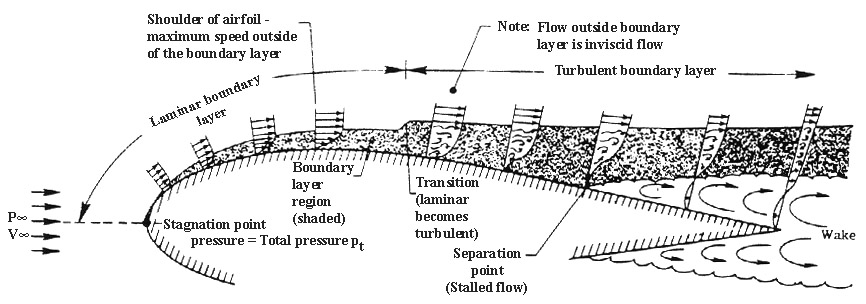
    These three points are summarised in the schematic diagram below.

    Boundary layer separation over the top surface of a wing
    Boundary layer separation over the top surface of a wing.

    Boundary layer separation is an important issue for aircraft wings as it induces a large wake that completely changes the flow downstream of the point of separation. Skin-friction drag arises due to inherent viscosity of the fluid, i.e. the fluid sticks to the surface of the wing and the associated frictional shear stress exerts a drag force. When a boundary layer separates, a drag force is induced as a result of differences in pressure upstream and downstream of the wing. The overall dimensions of the wake, and therefore the magnitude of pressure drag, depends on the point of separation along the wing. The velocity profiles of turbulent and laminar boundary layers (see image above) show that the velocity of the fluid increases much slower away from the wall for a laminar boundary layer. As a result, the flow in a laminar boundary layer will reverse direction much earlier in the presence of an adverse pressure gradient than the flow in a turbulent boundary layer.

    To summarise, we now know that the inherent viscosity of a fluid leads to the presence of a boundary layer that has two possible sources of drag. Skin-friction drag due to the frictional shear stress between the fluid and the surface, and pressure drag due to flow separation and the existence of a downstream wake. As the total drag is the sum of these two effects, the aerodynamicist is faced with a non-trivial compromise:

    •  skin-friction drag is reduced by laminar flow due to a lower shear stress at the wall, but this increases pressure drag when boundary layer separation occurs.
    • pressure drag is reduced by turbulent flow by delaying boundary layer separation, but this increases the skin-friction drag due to higher shear stresses at the wall.

    As a result, neither laminar nor turbulent flow can be said to be preferable in general and judgement has to be made regarding the specific application. For a blunt body, such as a cylinder, pressure drag dominates and therefore a turbulent boundary layer is preferable. For more streamlined bodies, such as an aircraft wing at cruise, the overall drag is dominated by skin-friction drag and hence a laminar boundary layer is preferable. Dolphins, for example, have very streamlined bodies to maintain laminar flow. Early golfers, on the other hand, realised that worn rubber golf balls flew further than pristine ones, and this led to the innovation of dimples on golf balls. Fluid flow over golf balls is predominantly laminar due to the relatively low flight speeds. Dimples are therefore nothing more than small imperfections that transform the predominantly laminar flow into a turbulent one that delays the onset of boundary layer separation and therefore reduces pressure drag.

    Aerodynamic Stall

    The second, and more dramatic effect, of boundary layer separation in aircraft wings is aerodynamic stall. At relatively low angles of attack, for example during cruise, the adverse pressure gradient acting on the top surface of the wing is benign and the boundary layer remains attached over the entire surface. As the angle of attack is increased, however, so does the pressure gradient. At some point the boundary layer will start to separate near the trailing edge of the wing, and this separation point will move further upstream as the angle of attack is increased. If an aerofoil is positioned at a sufficiently large angle of attack, separation will occur very close to the point of maximum thickness of the aerofoil and a large wake will develop behind the point of separation. This wake redistributes the flow over the rest of the aerofoil and thereby significantly impairs the lift generated by the wing. As a result, the lift produced is seriously reduced in a condition known as aerodynamic stall. Due to the high pressure drag induced by the wake, the aircraft can further lose airspeed, pushing the separation point further upstream and creating a deleterious feedback loop where the aircraft literally starts to fall out of the sky in an uncontrolled spiral. To prevent total loss of control, the pilot needs to reattach the boundary as quickly as possible which is achieved by reducing the angle of attack and pointing the nose of the aircraft down to gain speed.

    The lift produced by a wing is given by

    [latex]L = \frac{1}{2}C_L \rho V^2 S[/latex]

    where [latex]\rho[/latex] is the density of the surrounding air, [latex]V[/latex] is the flight velocity, [latex]S[/latex] is the wing area and [latex]C_L[/latex] is the lift coefficient of the aerofoil shape. The lift coefficient of a specific aerofoil shape increases linearly with the angle of attack up to a maximum point [latex]C_{Lmax}[/latex]. The maximum lift coefficient of a typical aerofoil is around 1.4 at an angle of attack of around [latex]16^\circ[/latex], which is bounded by the critical angle of attack where the stall condition occurs.

    During cruise the angle of attack is relatively small ([latex]\approx 2^\circ[/latex]) as sufficient lift is guaranteed by the high flight velocity [latex]V[/latex]. Furthermore, we actually want to maintain a small angle of attack as this minimises the pressure drag induced by boundary layer separation. At takeoff and landing, however, the flight velocity is much smaller which means that the lift coefficient has to be increased by setting the wings at a more aggressive angle of attack ([latex]\approx 15^\circ[/latex]). The issue is that even with a near maximum lift coefficient of 1.4, large jumbo jets have a hard time achieving the necessary lift force at safe speeds for landing. While it would also be possible to increase the wing area, such a solution would have detrimental effect on the aircraft weight and therefore fuel efficiency.

    High-lift Devices

    A much more elegant solution are leading-edge slats and trailing-edge flaps. A slat is a thin, curved aerofoil that is fitted to the front of the wing and is intended to induce a secondary airflow through the gap between the slat and the leading edge. The air accelerates through this gap and thereby injects high momentum fluid into the boundary on the upper surface, delaying the onset of flow reversal in the boundary layer. Similarly, one or two curved aerofoils may be placed at the rear of wing in order to invigorate the flow near the trailing edge. In this case the high momentum fluid reinvigorates the flow which has been slowed down by the adverse pressure gradient. The maximum lift coefficient can typically be doubled by these devices and therefore allows big jumbo jets to land and takeoff at relatively low runway speeds.

    Leading edge slats and trailing edge flaps on an aircraft wing

    The next time you are sitting close to the wings observe how these devices are retracted after take-off and activated before landing. In fact, birds have a similar devices on their wings. The wings of bats are comprised of thin and flexible membranes reinforced by small bones which roughen the membrane surface and help to transition the flow from laminar to turbulent and prevent boundary layer separation. As is so often the case in engineering design, a lot of inspiration can be taken from nature!

  • On Boundary Layers: Laminar, Turbulent and Skin Friction

    In the early 20th century, a group of German scientists led by Ludwig Prandtl at the University of Göttingen began studying the fundamental nature of fluid flow and subsequently laid the foundations for modern aerodynamics. In 1904, just a year after the first flight by the Wright brothers, Prandtl published the first paper on a new concept, now known as the boundary layer. In the following years, Prandtl worked on supersonic flow and spent most of his time developing the foundations for wing theory, ultimately leading to the famous red triplane flown by Baron von Richthofen, the Red Baron, during WWI.

    Prandtl’s key insight in the development of the boundary layer was that as a first-order approximation it is valid to separate any flow over a surface into two regions: a thin boundary layer near the surface where the effects of viscosity cannot be ignored, and a region outside the boundary layer where viscosity is negligible. The nature of the boundary layer that forms close to the surface of a body significantly influences how the fluid and body interact. Hence, an understanding of boundary layers is essential in predicting how much drag an aircraft experiences, and is therefore a mandatory requirement in any first course on aerodynamics.


    Boundary layers develop due to the inherent stickiness or viscosity of the fluid. As a fluid flows over a surface, the fluid sticks to the solid boundary which is the so-called “no-slip condition”. As sudden jumps in flow velocity are not possible for flow continuity requirements, there must exist a small region within the fluid, close to the body over which the fluid is flowing, where the flow velocity increases from zero to the mainstream velocity. This region is the so-called boundary layer.

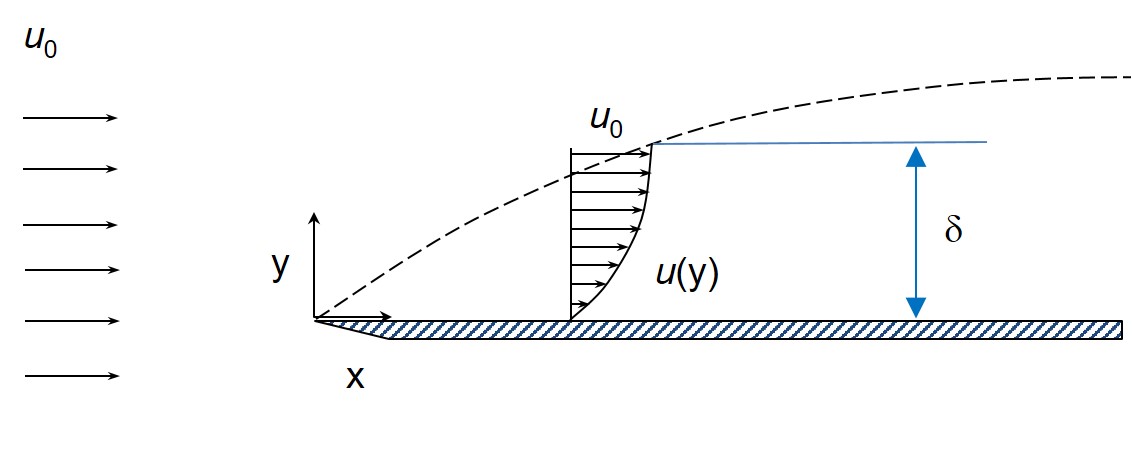
    The U-shaped profile of the boundary layer can be visualised by suspending a straight line of dye in water and allowing fluid flow to distort the line of dye (see below). The distance of a distorted dye particle to its original position is proportional to the flow velocity. The fluid is stationary at the wall, increases in velocity moving away from the wall, and then converges to the constant mainstream value [latex]u_0[/latex] at a distance [latex]\delta[/latex] equal to the thickness of the boundary layer.

    Laminar boundary layer scheme

    To further investigate the nature of the flow within the boundary layer, let’s split the boundary layer into small regions parallel to the surface and assume a constant fluid velocity within each of these regions (essentially the arrows in the figure above). We have established that the boundary layer is driven by viscosity. Therefore, adjacent regions within the boundary layer that move at slightly different velocities must exert a frictional force on each other. This is analogous to you running your hand over a table-top surface and feeling a frictional force on the palm of your hand. The shear stresses [latex]\tau[/latex] inside the fluid are a function of the viscosity or stickiness of the fluid [latex]\mu[/latex], and also the velocity gradient [latex]du/dy[/latex]:

    [latex] \tau = \mu \frac{\mathrm{d}u}{\mathrm{d}y}[/latex]

    where [latex]y[/latex] is the coordinate measuring the distance from the solid boundary, also called the “wall”.

    Prandtl first noted that shearing forces are negligible in mainstream flow due to the low viscosity of most fluids and the near uniformity of flow velocities in the mainstream. In the boundary layer, however, appreciable shear stresses driven by steep velocity gradients will arise.

    So the pertinent question is: Do these two regions influence each other or can they be analysed separately?

    Prandtl argued that for flow around streamlined bodies, the thickness of the boundary layer is an order of magnitude smaller than the thickness of the mainstream, and therefore the pressure and velocity fields around a streamlined body may analysed disregarding the presence of the boundary layer.

    Eliminating the effect of viscosity in the free flow is an enormously helpful simplification in analysing the flow. Prandtl’s assumption allows us to model the mainstream flow using Bernoulli’s equation or the equations of compressible flow that we have discussed before, and this was a major impetus in the rapid development of aerodynamics in the 20th century. Today, the engineer has a suite of advanced computational tools at hand to model the viscid nature of the entire flow. However, the idea of partitioning the flow into an inviscid mainstream and viscid boundary layer is still essential for fundamental insights into basic aerodynamics.

    Laminar and turbulent boundary layers

    One simple example that nicely demonstrates the physics of boundary layers is the problem of flow over a flat plate.

    Development of boundary layer over a flat plate including the transition from a laminar to turbulent boundary layer.

    The fluid is streaming in from the left with a free stream velocity [latex]U_0[/latex] and due to the no-slip condition slows down close to the surface of the plate. Hence, a boundary layer starts to form at the leading edge. As the fluid proceeds further downstream, large shearing stresses and velocity gradients develop within the boundary layer. Proceeding further downstream, more and more fluid is slowed down and therefore the thickness, [latex]\delta[/latex], of the boundary layer grows. As there is no sharp line splitting the boundary layer from the free-stream, the assumption is typically made that the boundary layer extends to the point where the fluid velocity reaches 99% of the free stream. At all times, and at at any distance [latex]x[/latex] from the leading edge, the thickness of the boundary layer [latex]\delta[/latex] is small compared to [latex]x[/latex].

    Close to the leading edge the flow is entirely laminar, meaning the fluid can be imagined to travel in strata, or lamina, that do not mix. In essence, layers of fluid slide over each other without any interchange of fluid particles between adjacent layers. The flow speed within each imaginary lamina is constant and increases with the distance from the surface. The shear stress within the fluid is therefore entirely a function of the viscosity and the velocity gradients.

    Further downstream, the laminar flow becomes unstable and fluid particles start to move perpendicular to the surface as well as parallel to it. Therefore, the previously stratified flow starts to mix up and fluid particles are exchanged between adjacent layers. Due to this seemingly random motion this type of flow is known as turbulent. In a turbulent boundary layer, the thickness [latex]\delta[/latex] increases at a faster rate because of the greater extent of mixing within the main flow. The transverse mixing of the fluid and exchange of momentum between individual layers induces extra shearing forces known as the Reynolds stresses. However, the random irregularities and mixing in turbulent flow cannot occur in the close vicinity of the surface, and therefore a viscous sublayer forms beneath the turbulent boundary layer in which the flow is laminar.

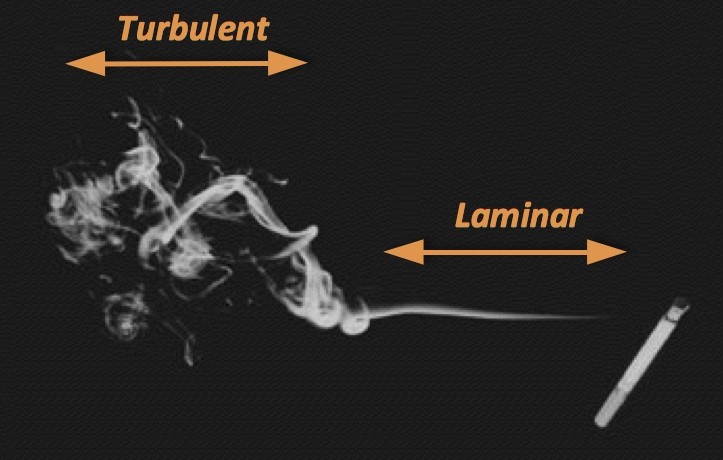
    An excellent example contrasting the differences in turbulent and laminar flow is the smoke rising from a cigarette.

    Laminar and turbulent flow in smoke
    Laminar and turbulent flow in smoke

    As smoke rises it transforms from a region of smooth laminar flow to a region of unsteady turbulent flow. The nature of the flow, laminar or turbulent, is captured very efficiently in a single parameter known as the Reynolds number

    [latex]Re = \frac{\rho U d}{\mu}[/latex]

    where [latex]\rho[/latex] is the density of the fluid, [latex]U[/latex] the local flow velocity, [latex]d[/latex] a characteristic length describing the geometry, and [latex]\mu[/latex] is the viscosity of the fluid.

    There exists a critical Reynolds number in the region [latex]2300-4000[/latex] for which the flow transitions from laminar to turbulent. For the plate example above, the characteristic length is the distance from the leading edge. Therefore [latex]d[/latex] increases as we proceed downstream, increasing the Reynolds number until at some point the flow transitions from laminar to turbulent. The faster the free stream velocity [latex]U[/latex], the shorter the distance from the leading edge where this transition occurs.

    Velocity profiles

    Due to the different degrees of fluid mixing in laminar and turbulent flows, the shape of the two boundary layers is different. The increase in fluid velocity moving away from the surface (y-direction) must be continuous in order to guarantee a unique value of the velocity gradient [latex]du/dy[/latex]. For a discontinuous change in velocity, the velocity gradient [latex]du/dy[/latex], and therefore the shearing forces [latex] \tau = \mu \frac{\mathrm{d}u}{\mathrm{d}y}[/latex] would be infinite, which is obviously not feasible in reality. Hence, the velocity increases smoothly from zero at the wall in some form of parabolic distribution. The further we move away from the wall, the smaller the velocity gradient and the retarding action of the shearing stresses decreases.

    In the case of laminar flow, the shape of the boundary layer is indeed quite smooth and does not change much over time. For a turbulent boundary layer however, only the average shape of the boundary layer approximates the parabolic profile discussed above. The figure below compares a typical laminar layer with an averaged turbulent layer.

    Velocity profile of laminar versus turbulent boundary layer
    Velocity profile of laminar versus turbulent boundary layer

    In the laminar layer, the kinetic energy of the free flowing fluid is transmitted to the slower moving fluid near the surface purely means by of viscosity, i.e. frictional shear stresses. Hence, an imaginary fluid layer close to the free stream pulls along an adjacent layer close to the wall, and so on. As a result, significant portions of fluid in the laminar boundary layer travel at a reduced velocity. In a turbulent boundary layer, the kinetic energy of the free stream is also transmitted via Reynolds stresses, i.e. momentum exchanges due to the intermingling of fluid particles. This leads to a more rapid rise of the velocity away from the wall and a more uniform fluid velocity throughout the entire boundary layer. Due to the presence of the viscous sublayer in the close vicinity of the wall, the wall shear stress in a turbulent boundary layer is governed by the usual equation [latex] \tau = \mu \frac{\mathrm{d}u}{\mathrm{d}y}[/latex]. This means that because of the greater velocity gradient at the wall the frictional shear stress in a turbulent boundary is greater than in a purely laminar boundary layer.

    Skin Friction drag

    Fluids can only exert two types of forces: normal forces due to pressure and tangential forces due to shear stress. Pressure drag is the phenomenon that occurs when a body is oriented perpendicular to the direction of fluid flow. Skin friction drag is the frictional shear force exerted on a body aligned parallel to the flow, and therefore a direct result of the viscous boundary layer.

    Due to the greater shear stress at the wall, the skin friction drag is greater for turbulent boundary layers than for laminar ones. Skin friction drag is predominant in streamlined aerodynamic profiles, e.g. fish, airplane wings, or any other shape where most of the surface area is aligned with the flow direction. For these profiles, maintaining a laminar boundary layer is preferable. For example, the crescent lunar shaped tail of many sea mammals or fish has evolved to maintain a relatively constant laminar boundary layer when oscillating the tail from side to side.

    One of Prandtl’s PhD students, Paul Blasius, developed an analytical expression for the shape of a laminar boundary layer over a flat plate without a pressure gradient. Blasius’ expression has been verified by experiments many times over and is considered a standard in fluid dynamics. The two important quantities that are of interest to the designer are the boundary layer thickness [latex]\delta[/latex] and the shear stress at the wall [latex]\tau_w[/latex] at a distance [latex]x[/latex] from the leading edge. The boundary layer thickness is given by

    [latex] \delta=\frac{5.2 x}{\sqrt{Re_x}}[/latex]

    with [latex]Re_x[/latex] the Reynolds number at a distance [latex]x[/latex] from the leading edge. Due to the presence of [latex]x[/latex] in the numerator and [latex]\sqrt{x}[/latex] in the denominator, the boundary layer thickness scales proportional to [latex]x^{1/2}[/latex], and hence increases rapidly in the beginning before settling down.

    Next, we can use a similar expression to determine the shear stress at the wall. To do this we first define another non dimensional number known as the drag coefficient

    [latex]C_f=\frac{\tau_w}{1/2 \rho U_f^2}[/latex]

    which is the value of the shear stress at the wall normalised by the dynamic pressure of the free-flow. According to Blasius, the skin-friction drag coefficient is simply governed by the Reynolds number

    [latex]C_f=\frac{0.664}{\sqrt{Re_x}}[/latex]

    This simple example reiterates the power of dimensionless numbers we mentioned before when discussing wind tunnel testing. Even though the shear stress at the wall is a dimensional quantity, we have been able to express it merely as a function of two non-dimensional quantities [latex]Re[/latex] and [latex]C_f[/latex]. By combining the two equations above, the shear stress can be written as

    [latex]\tau_{w}=\frac{0.332 \rho u_f^2}{\sqrt{Re_x}}[/latex]

    and therefore scales proportional to [latex]x^{-1/2}[/latex], tending to zero as the distance from the leading edge increases. The value of [latex]\tau_w[/latex] is the frictional shear stress at a specific point [latex]x[/latex] from the leading edge. To find the total amount of drag [latex]D_{sf}[/latex] exerted on the plate we need to sum up (integrate) all contributions of [latex]\tau_w[/latex] over the length of the plate

    [latex]D_{sf} = 0.332 \rho U_f^2 \int_0^L \frac{\mathrm{d}x}{\sqrt{Re_x}}=\frac{0.664 \rho U_f^2 L}{\sqrt{\rho U_f L / \mu}} = \frac{0.664 \rho U_f^2 L}{\sqrt{Re_L}}[/latex]

    where [latex]Re_L[/latex] is now the Reynolds number of the free stream calculated using the total length of the plate [latex]L[/latex]. Similar to the skin friction coefficient [latex]C_f[/latex] we can define a total skin friction drag coefficient [latex]\eta_f[/latex]

    [latex]\eta_f = \frac{2D_{sf}}{\rho U_f^2 L} = \frac{1.328}{\sqrt{Re_L}}[/latex]

    Hence, [latex]C_f[/latex] can be used to calculate the local amount of shear stress at a point [latex]x[/latex] from the leading edge, whereas [latex]\eta_f[/latex] is used to find the total amount of skin friction drag acting on the surface.

    Unfortunately, do to the chaotic nature of turbulent flow, the boundary layer thickness and skin drag coefficient for a turbulent boundary layer cannot be determined as easily in a theoretical manner. Therefore we have to rely on experimental results to define empirical approximations of these quantities. The scientific consensus of the these relations are as follows:

    [latex]\delta = \frac{0.37 x}{(Re_x)^{0.2}}[/latex]
    [latex]\eta_f = \frac{0.074}{(Re_L)^{0.2}}[/latex]

    Therefore the thickness of a turbulent boundary layer grows proportional to [latex]x^{4/5}[/latex] (faster than the [latex]x^{1/2}[/latex] relation for laminar flow) and the total skin friction drag coefficient varies as [latex]L^{-1/5}[/latex] (also faster than the [latex]L^{-1/2}[/latex] relation of laminar flow). Hence, the total skin drag coefficient confirms the qualitative observations we made before that the frictional shear stresses in a turbulent boundary layer are greater than those in a laminar one.

    Skin friction drag and wing design

    The unfortunate fact for aircraft designers is that turbulent flow is much more common in nature than laminar flow. The tendency for flow to be random rather than layered can be interpreted in a similar way to the second law of thermodynamics. The fact that entropy in a closed system only increases is to say that, if left to its own devices, the state in the system will tend from order to disorder. And so it is with fluid flow.

    However, the shape of a wing can be designed in such a manner as to encourage the formation of laminar flow. The P-51 Mustang WWII fighter was the first production aircraft designed to operate with laminar flow over its wings. The problem back then, and to this day, is that laminar flow is incredibly unstable. Protruding rivet heads or splattered insects on the wing surface can easily “trip” a laminar boundary layer into turbulence, and preempt any clever design the engineer concocted. As a result, most of the laminar flow wings that have been designed based on idealised conditions and smooth wing surfaces in a wind tunnel have not led to the sweeping improvements originally imagined.

    P-51-361

    For many years NASA conducted a series of experiments to design a natural laminar flow (NLF) aircraft. Some of their research suggested the wrapping of a glove around the leading edge of a Boeing 757 just outboard of the engine. The modified shape of this wing promotes laminar flow at the high altitudes and almost sonic flight conditions of a typical jet airliner. To prevent the build up of insect splatter at take-off a sheath of paper was wrapped around the glove which was then torn away at altitude. Even though the range of such an aircraft could be increased by almost 15% this, rather elaborate scheme, never made it into production.

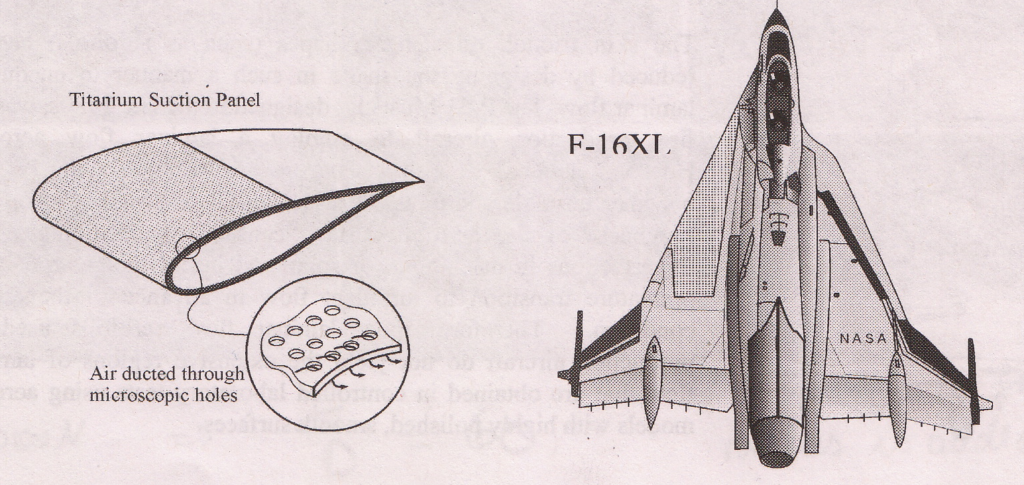
    In the mid 1990s NASA fitted active test panels to the wings of two F-16’s in order to test the possibility of achieving laminar flow on swept delta-wings flying at supersonic speed; in NASA’s view a likely wing configuration for future supersonic cruise aircraft. The active test panels essentially consisted of titanium covers perforated with millions of microscopic holes, which were attached to the leading edge and the top surface of the wing. The role of these panels was to suck most of the boundary layer off the top surface through perforations using an internal pumping system. By removing air from the boundary layer its thickness decreased and thereby promoted the stability of the laminar boundary layer over the wing. This Supersonic Laminar Flow (SLFC) project successfully maintained laminar flow over a large portion of the wing during supersonic flight of up to Mach 1.6.

    F-16 XL with suction panels to promote laminar flow
    F-16 XL with suction panels to promote laminar flow

    While these elaborate schemes have not quite found their way into mass production (probably due to their cost, maintenance problems and risk), laminar flow wings are a very viable future technology in terms of reducing greenhouse gases as stipulated by environmental legislation. An important driver in reducing greenhouse gases is maximising the lift-to-drag ratio of the wings, and therefore I would expect research to continue in this field for some time to come.