Tag: Biomimetics

  • High-Lift Devices

    In a previous post I introduced the concept of boundary layer separation and how aquatic animals actively or passively morph their skins to delay this phenomenon. As a brief recap, when flow over a surface encounters an adverse pressure gradient (i.e. the fluid pressure increases in the flow direction) the fluid has to work against this increasing pressure, which leads to momentum losses and decelerations in flow. A classical example where this occurs is after the point of maximum thickness in an aircraft wing (Figure 1). The flow speed in the boundary layer close to the surface continues to decrease in the direction of the adverse pressure gradient until at some point the slowest moving fluid close to the wall will change direction. This is called boundary layer separation and leads to a larger wake of vortices forming behind the body. These vortices not only lead to greater pressure drag on the body but also compromise the amount of upward lift the aerofoil can produce, in effect reducing the efficiency of the wing.

    Fig. 1. Boundary layer separation over aerofoil (1).

    An aircraft is lifted up in the air by the net pressure difference between the top and bottom surfaces of the wing. The bottom surface of the wing is known as the pressure surface while the top is called the suction surface. This is because the cambered shape of the aerofoil and the angle of attack α with respect to the flight direction redirects the flow such as to produce a higher fluid pressure on the bottom than the top surface, resulting in a net upwards lift force L. The amount of lift force an aerofoil produces is characterised by the lift coefficient CL,

    Fig. 2. Lift Coefficient versus Angle of Attack (2).

    Equation (1) shows that the lift that the aerofoil generates can be increased by flying quicker (V), increasing the density of the fluid (ρ – generally fixed by nature), the planform area of the wing (S – generally fixed by construction) the lift coefficient CL. Now during take-off and landing the velocity of the aircraft is limited by the length of the runway. During take-off the aircraft can only achieve a certain speed before reaching the end of the runway, while during landing the aircraft must be able to break in the space available on the airfield. While moving at the typical take-off and landing speeds of 300 km/hr a typical wing is not capable of producing enough lift to keep the aircraft from falling out of the sky. Luckily, the lift coefficient Ccan be enhanced by various parameters such as increasing the camber of the wing or the angle of attack α. Various experiments have shown that the lift coefficient CL increases linearly with angle of attack α (Figure 2). The downside is that the adverse pressure gradient over the aerofoil and profile drag on the wing increase at the same time. At some critical angle of attack the boundary layer starts separating towards the trailing edge of the aerofoil resulting in a precipitous drop of the lift coefficient with any further increases in α. This phenomenon is known as aerodynamic stall, and αstall (around 14° for a typical plain aerofoil) corresponds to the angle of attack at which the maximum lift coefficient CLmax is achieved (around 1.4 for ordinary wing). Videos of an aircraft stalling during flight can be quite dramatic as the pilot attempts to regain control of the spiralling aircraft and often end with the deployment of the ejector seat.

    As you might intuitively expect the maximum angle of attack also depends on the velocity of the aircraft, as higher fluid flow will delay flow reversal. This means that during cruise when the air velocity V is high the aircraft flies with a low lift coefficient configuration in order to decrease higher profile drag at large angles of attack. During take-off and landing however the aircraft must increase the angle of attack in order to compromise for the low flight velocity. The issue is that for modern, heavy jumbo jets the typical CLmax of 1.4 is not enough to lift the aircraft from the ground, and any further increases in angle of attack would of course lead to the precipitous drop in CL of aerodynamic stall.

    Fig. 3. Leading-edge Slats and trailing-edge Flaps deployed (2)

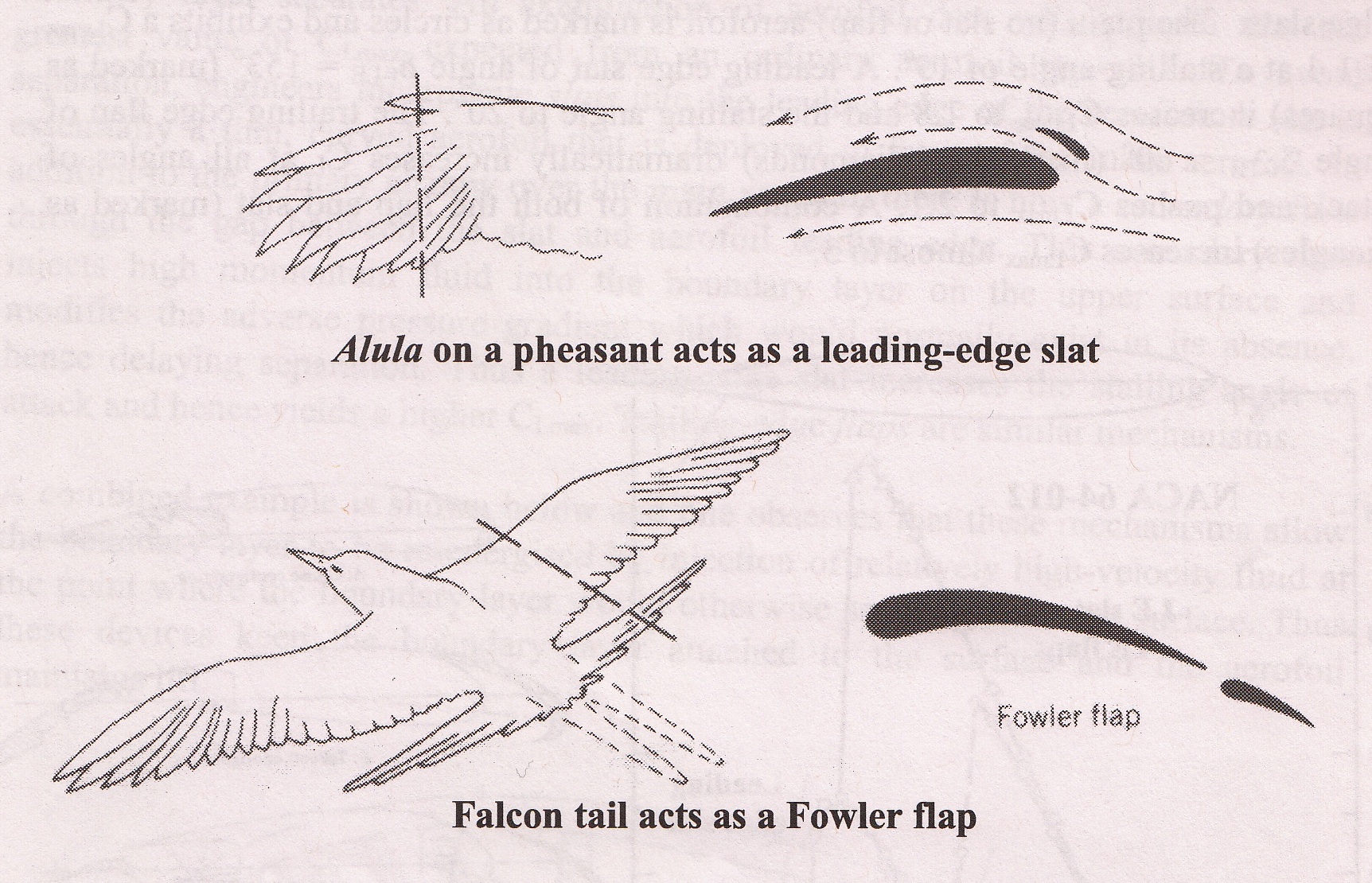
    To avoid separation of the boundary layer engineers use high-lift devices such as slats and flaps, which you have probably seen deployed from the leading and trailing edges of the wings respectively. Leading-edge slats are additional thin aerofoils deployed at the front of the main aerofoil, which channel secondary airflow from the bottom of the main airfoil through a gap into to the primary airflow above (Figure 3). This secondary flow injects additional high momentum fluid into the boundary layer on the upper surface and consequently modifies the adverse pressure gradient and delaying boundary layer separation. Similarly, trailing-edge flaps are placed at points where the boundary layer would naturally start to separate from the surface, and invigorate the “tired” boundary layer by the same mechanism. In this manner the critical stalling angle astall is increased and the aerofoil yields a higher value of CLmax often around 2.8 (double the plain aerofoil).

    Nature has provided the perfect laboratory for the evolution of aerofoils and similar to many other engineering innovations leading-edge slats and trailing-edge flaps are mimicked from bird flight. The sketches below show that the pheasant uses the front Alula feather as a leading edge slat, while the tail of the Falcon takes the form of a trailing edge flap (Figure 6). Many research institutes are currently spending considerable amounts of money into the development of other shape morphing mechanisms exhibited by birds such as ruffling of feathers, increasing the camber of the wing, lengthening the span or inducing a degree of surface roughness. However, these technologies require materials that are compliant enough to rapidly deform into the required shape, while stiff enough to resist the aerodynamic loads. Unfortunately our current material systems do not facilitate such capabilities.

    Fig. 4. Different Wing configurations during flight (2).
    Fig. 5 The position of the leading edge slats on an airliner (Airbus A310-300). (Photo credit: Wikipedia)
    Fig. 6. Slats and Flaps as seen on birds in Nature (2).


    References

    (1) http://www.centennialofflight.gov/essay/Theories_of_Flight/Skin_Friction/TH11G3.htm

    (2) Lock, G.D. (01. 2009). “Fluid Mechanics with a Historical Perspective”. University of Bath. Bath, UK

  • Bio-mimetic Drag Reduction – Part 3: Morphing

    In the previous two posts of this blog series I introduced the different sensing mechanism that aquatic animals possess to create spatial images of the largely turbulent flow fields around them. Flow sensing has been shown to serve as a means of communication in schooling fish, for orientation in currents and for sensing the surrounding environment when the tactile or visual senses are impaired [1]. In 1936, Gray used a simple hydrodynamic model of a rigid dolphin with a turbulent boundary layer to calculate the power required to overcome the drag exerted by the water [2]. Quite surprisingly, the results suggested that the calculated drag could not be overcome by the available dolphin muscle power…

    This controversy has since been known as “Gray’s Paradox”, and Gray concluded that dolphins must possess some sort of mechanism to reduce skin friction drag by maintaining a fully laminar boundary layer. Today it has been shown that basic assumptions in Gray’s analysis were flawed and that experimental data on the muscle power of dolphins was largely underestimated [3 – 4]. Nevertheless, the idea that dolphins are capable of maintaining a laminar boundary layer became the basic premise for research into dolphin drag reduction for almost 60 years. While it is now known that the boundary layer around swimming dolphins is largely turbulent, this focus of research has led to some interesting observations that may give useful insight into bio-mimetic applications for future aircraft or marine vehicles.

    The study of dolphins and sharks is especially interesting because they have undergone millions of years of natural selection and, according to Darwin’s argument, are therefore pretty “fit” for survival in the aquatic environment. For dolphins the streamlined “teardrop” shape (Figure 1) provides the most drag reduction and other perceived “wonder-mechanisms” such as skin-folds observed by Essapian [5] do not contribute to any reductions in drag. In actual fact, the skin-folds observed by Essapian occur due to the compliance of the soft dolphin skin and are also observed for swimming humans [6]. The streamlined shape of the dolphin has a point of maximum thickness at 45% of the body length, and since adverse pressure gradients only occur beyond this point, the “teardrop” profile helps to confine boundary layer separation to a posterior section of the body, thus resulting in less pressure drag. Unsurprisingly, this streamlined profile has since been exploited in modern boat hulls and submarines such as the 1953 USS Albacore (Figure 2).

    Fig. 1 Streamlined teardrop profile of dolphin (4)
    Fig. 2. USS Albacore. Profile inspired by streamlined bodies found in nature (12)

    An active control mechanism employed by many fish to reduce the high skin friction drag inherent of a turbulent boundary layer  is mucus excretion. Fish secrete a combination of polysaccharides, lipids and lipoproteins through pores on the skin into the boundary layer to fill irregularities of the surface and improve streamlining. Most importantly, the mucus has a lower viscosity than the water around the fish, which helps to reduce the frictional shear stresses arising from the “stickiness” or viscosity of water. As can be observed in Figure 3 the velocity gradient at the wall is consequently less pronounced resembling a laminar boundary layer with reduced skin friction drag (Figure 4). In the oil industry soluble, long-chain polymer additives have achieved very promising results. A ratio as small as one-in-a-million of these additives in oil pipelines has reduced skin friction drag by up to 30% [7].

    Fig. 3. Classic turbulent boundary layer profile and quasi-laminar boundary layer due to mucus excretion
    Fig. 4. Contribution of different forms of drag for laminar and turbulent flow (13)

    Similar to the flat plate parallel to oncoming flow discussed in the hydrodynamics post, flow measurements of swimming dolphins show that boundary layer is fully turbulent along the posterior section of the body while laminar and transitional boundary layers are observed towards the head. Kramer showed that dolphins are able to delay the transition to turbulent flow using their soft, compliant skin and therefore achieve some reductions in skin friction drag [8 – 9]. The viscoelastic properties of the skin interact with the flow over the body as a viscous damper and absorb energy from pressure oscillations known as “Tollmien-Schlichting waves” that can trip the boundary layer to go turbulent (Figure 5). Dolphins sense these pressure oscillations using canal neuromasts and then activate controlled muscular microvibrations to produce tremor-like skin vibrations of up to 5 mm amplitude at 7 – 13 Hz that destructively interfere with the Tollmien-Schlichting pressure waves (Figure 6). The transition to a turbulent boundary layer is thus delayed in order to achieve the best compromise of lower laminar skin-friction drag towards the head and allow turbulent flow in the posterior parts of the body to prevent boundary layer separation.

    Fig. 5 Tollmien-Schichting Wave over compliant dolphin skin.
    Fig. 6. Compliant dolphin skin acting as a viscous damper (14)

    Rather than trying to delay the onset of turbulent flow, sharks have evolved with an incredibly clever system of reducing turbulent skin friction drag using their denticle scales. At the same time the scales also serve to passively (without any muscular effort from the shark) prevent boundary layer separation. During the 1980’s research at NASA Langley revealed that a turbulent boundary layer on a surface with longitudinal ribs develops lower shear stress and consequently exerts less drag than the same flow profile on a smooth surface. In the previous post I explained that the exchange of fluid normal to the surface in a turbulent boundary layer causes a steeper velocity gradient and therefore higher skin friction drag. In 3-D flow this momentum transfer will also occur in the lateral z-direction by cross flow vortices (Figure 7).Ribs on the surface aligned in the mean flow direction prevent this lateral transfer of momentum and result in a more gradual velocity profile with less shear stress. With optimal ribbed blade height of half the rib spacing Bechert et al. [7] showed a drag reduction of 9.9% using a metal plate. Unsurprisingly such a ribbed profile is also present on the scales of sharks (Figure 8).

    Fig. 7. Riblets preventing lateral crossflow of turbulent boundary layer (top) and graph of subsequent drag reduction (7)
    Fig. 8. Shark scales (top) and ribbed plate tested by Bechert et al. (7)

    Bechert et al. manufactured a representative wind-tunnel model of 800 plastic scales using electric discharge machining with compliant anchorings to model the bristling of the scales. With this model only a modest decrease in drag of 3.3% was achieved due to losses arising from the gaps between the scales. On the other hand a significant increase in drag of over 10% was measured if the scales were bristled, thus forced upright as observed on swimming sharks.

    Consequently, the researchers were facing the question why shark scales bristle and not remain nicely attached to maintain a streamlined profile?

    Boundary layer separation is initiated by a flow reversal in the boundary layer i.e. the flow locally flows opposite to the direction of motion (Figure 9). As the boundary layer is about to separate the flow reversal causes the scales to bristle and erect passively (without any input from the shark) acting as vortex generators, which on one hand increase friction drag, but on the other hand energise the boundary layer by forcing high momentum fluid from the free stream towards the skin surface [10] (Figure 10). Thus, just as the boundary layer is about to separate, bristling is automatically activated and boundary layer separation is prevented which would otherwise lead to a significant increase in pressure drag.

    Fig. 9. Boundary layer separation initiated by local flow reversal (15)
    Fig. 10. Bristled scales (right) and subsequent formation of vortices between scales (10)

    The riblet research by NASA Langley led 3M to develop a riblet polymer film that could readily be coated on a surface like an exterior paint. This smart skin helped the American Stars and Stripes yacht win the America’s cup in 1987 before the technology was banned. Since then the technology has been tested on large civil aircraft such as the Airbus A320 and also smaller business jets and fighter aircraft with more moderate reductions in drag of around 2% [7]. At the same time researchers at MIT have been trying to emulate the canal neuromasts sensory system found in fish using a flexible membrane covering a number of cavities with integrated microelectromechanical systems (MEMS) to serve as pressure sensors for flow over a surface (Figure 11) [11].

    Fig. 11. Pressure sensing skin using MEMS (11)

    At the same time compliance of the elastomer membrane would allow active changes to the skin profile to either prevent boundary layer separation (e.g. via “bristling” controlled by skin buckling) or mitigate laminar-to-turbulent boundary layer transition (e.g. via skin vibrations). In this manner a truly multifunctional “smart” skin could be developed that actively senses the flow field around a body via the pressure sensors and then changes the profile of the skin by thin film deformations. However, considerable research is yet required to make such systems a reality in the future…


    References

    [1] Windsor, S., & McHenry, M. (2009). The influence of viscous hydrodynamics on the fish lateral-line system. Integrative

    and Comparative Biology , 49, 691-701.

    [2]Gray J 1936 Studies in animal locomotion: VI. The propulsive powers of the dolphin J. Exp. Biol. 13 192–9

    [3]Williams T M, Friedl W A, Fong M L, Yamada R M, Sedivy P and Haun J E 1992 Travel at low energetic cost by swimming and wave-riding bottlenose dolphins Nature 355 821–3

    [4] Fish, F. (2006). Thy myth and reality of Gray’s paradox: implication of dolphin drag reduction for technology. Bioinspiration & Biomechanics , 1, R17-R25.

    [5] Essapian F S 1955 Speed-induced skin folds in the bottle-nosed porpoise Tursiops. truncatus. Breviora Mus. Comp. Zool. 43 1–4

    [6] Aleyev Y G 1977 Nekton (The Hague: Junk)

    [7] Bechert, D., et al. (2000). Fluid Mechanics of Biological Surfaces and their Technological Application. Naturwissenschaften , 87, 157-171.

    [8] Kramer M O 1960a Boundary layer stabilization by distributed damping J. Am. Soc. Nav. Eng. 72 25–33

    [9] Kramer M O 1960b The dolphins’ secret New Sci. 7 1118–20

    [10] Lang, A., et al. (2008). Bristled shark skin: a microgeometry for boundary layer control? Bioinspration & Biomimetics , 3, 1-9.

    [11] Stauffer, N. (2011). Going with the flow: Biomechanic pressure sensors help guide oceangoing vessels. MIT. MIT.

    [12] http://www.britannica.com/EBchecked/media/142063/USS-Albacore

    [13] Fish, F. Imaginative solutions by marine organisms for drag reduction. West Chester: West Chester University.

    [14] Wiplier, O., & Ehrenstein, U. (2000). Numerical simulation of linear and nonlinear disturbance evolution in a boundary layer with compliant walls. Journal of Fluids and Structures , 14, 157-182.

    [15] http://sci-fix.blogspot.co.uk/2010/08/paragliding-aerodynamics.html

    Gallery


  • Bio-mimetic Drag Reduction – Part 2: Aero- and Hydrodynamics

    Part 1 of this blog series outlined the different sensing mechanisms that aquatic animals possess to create spatial images of the flow fields around them. In summary fish were found to possess a network of mechanosensors distributed over their bodies called the lateral line. The lateral line consists of two separate sensory subsystems:

    • a system of velocity-sensitive superficial neuromasts that responds to slow, uniform motions and that integrates large scale stimuli at the periphery such as constant currents

    and

    • a system of acceleration- or pressure-gradient-sensitive canal neuromasts that responds to rapidly changing motions and gives the fish the opportunity to orient towards sources such as prey or optimize swimming speed or tail-flapping frequency.

    In this post I will give a brief overview of general hydrodynamic theory and specifically the flow patterns that swimming fish are expected to sense with their network of neuromasts.

    When a body moves relative to a fluid, a boundary layer exists close to the wall because of the “no slip” condition, which arises from the inherent stickiness or so-called viscosity of the fluid. Therefore, fluid in direct contact with the wall adheres to the surface while fluid further away is slowed due to the frictional forces arising from viscosity. This results in a thin layer of fluid where the velocity increases in a U-profile from zero at the wall to the free stream velocity some distance d from the surface; defined as the boundary layer thickness (Figure 1).

    Fig. 1. Boundary layer close to a surface (1).

    Generally speaking fluid flow can be classified as either laminar or turbulent. In laminar flow (derived from “lamina” meaning finite layers) the fluid moves in lamina or layers of finite speed and with no mixing of the fluid perpendicular to the wall i.e. across layers. As the name suggest in turbulent flow everything is a bit more chaotic with active mixing of the fluid and momentum transfer throughout the boundary layer (Figure 2).

    Fig. 2. Laminar and Turbulent Boundary Layer (2).

    The type of flow depends on the shape of the body, upstream history of the flow, surface roughness and most importantly the Reynolds Number. The Reynold’s number Re is a non-dimensional ration of the inertial forces to the viscous forces arising in the fluid defined by,

    where p is the density of the fluid, v the velocity, u the viscosity and D a characteristic dimensions that describes the body under investigation. At certain critical Reynold’s number there is a natural transition from laminar to turbulent flow. For example if we consider the plate in Figure 3 we can observe that a boundary layer forms close to the surface once the flow encounters the leading edge of the plate. Initially the boundary layer thickness is very small but as we proceed along the length of the plate the boundary layer becomes thicker as increasingly more fluid is slowed down by the frictional effects of viscosity. The characteristic dimension for Re in this case is the distance l from the leading edge. This means that close to the leading edge where l is small the flow will be laminar while at a certain distance lcritical the critical value of Re is reached an the flow naturally transitions to turbulent flow.

    Fig. 3. Laminar to turbulent transition over flat plate (2).

    Now there are two major types of drag: skin friction drag, which is similar to the friction force you feel when you rub your hand over a table-top, and pressure drag, which results from a difference in fluid pressure between the front and rear of the body. As intuitively expected skin friction drag depends on the viscosity (stickiness) of the fluid but also the relative difference in velocity between different layers of fluid. Figure 3 shows that in a turbulent boundary layer the flow velocity increases more rapidly as we move away from the wall compared to a laminar boundary layer. The steeper velocity gradient close to the wall therefore means that skin friction drag is higher for a turbulent boundary layer (Figure 6).

    Fig. 4. Boundary layer separation (3).

    On the other hand pressure drag is greatly exacerbated by a phenomenon called boundary layer separation. When flow encounters an adverse pressure gradient (i.e. the fluid pressure increases in the flow direction as found after the point of maximum thickness in aerofoils e.g. Figure 5) the flow has to work against the increase in pressure leading to momentum losses and decelerations in flow. As the flow speed in the boundary layer continues to decreases in the direction of the adverse pressure gradient, at some point the slowest moving fluid close to the wall will actually change direction (Figure 4). This is called boundary layer separation and leads to a larger wake of vortices forming behind the body. The fluid pressure in the vortex wake is much lower than in regions of attached flow close to the leading edge and this pressure difference will therefore push the body backwards. As described earlier the flow velocity in a turbulent boundary layer close to the wall is higher than in a turbulent boundary layer.  This initially higher fluid momentum means that flow separation occurs further downstream than for laminar flow, resulting in a narrower wake and thus less pressure drag.

    Fig. 5. Boundary layer separation over aerofoil (4).
    Fig. 6. Effect of flow type on drag (5)

    Therefore, we have two conflicting criteria to minimise drag as depicted in Figure 6:

    • Skin friction drag is minimised by laminar flow and greatly worsened by turbulent flow

    While

    • Pressure drag is minimised by turbulent flow and greatly worsened by laminar flow

    However, it is also clear that overall minimum drag is encountered for purely frictional drag with a laminar boundary layer. Now it is often very difficult to maintain a laminar boundary layer due to chaotic flow conditions that occur further upstream or just due to the inherent surface roughness that can “trip” the boundary layer to go turbulent. In actual fact this “tripping” of the boundary layer is utilised in a controlled fashion in a golf ball. The dimples or indentations on a golf ball serve to trip the naturally low Reynold’s number and therefore laminar flow around a golf ball to go turbulent. The delayed boundary layer separation results in a narrower wake, less pressure drag and thus more distance on Tiger’s drive (Figure 7).

    Fig. 7. Delay of flow separation by dimples on a golf ball (6).

    If we look at a cross-section of a dolphin (Figure 8) we observe that the general shape is very much the same as that of the aerofoil wing-shape in Figure 5. In fact early wing designs were based on anatomical studies on dolphins, trout and tuna by the “father of aerodynamics” Sir Lord Cayley during the late 18th century. In dolphins the point of maximum thickness occurs at around 45% of its length in order to push the point of flow separation backwards and minimise pressure drag. This design has since inspired the shape of modern boat hulls and submarines such as the USS Albacore launched in 1953 (Figure 9).

    Fig. 8. Streamlined “teardrop” shape of dolphin (7).
    Fig. 9. USS Albacore based on biomimetic dolphin design (8).

    Similar to the plate example of Figure 3 for gliding fish the boundary layer is laminar close to the head and then transitions to turbulent flow further downstream. However, for actively swimming fish the boundary layer is generally highly turbulent due to the unsteadiness created by the undulation motion of the body. Based on the fact that it is very difficult to maintain laminar flow around their bodies, the third and final post of this series will investigate how fish attempt to reduce the naturally higher skin friction drag associated with turbulent flow.


    References

    [1] Anderson, E., et al. (2001). The boundary layer of swimming fish. The Journal of Experimental Biology , 204, 81-102.
    [2] http://www.lcs.syr.edu/faculty/glauser/mae315/fluids/MAE315Lab4Week1.htm
    [3] http://sci-fix.blogspot.co.uk/2010/08/paragliding-aerodynamics.html
    [4] http://www.centennialofflight.gov/essay/Theories_of_Flight/Skin_Friction/TH11G3.htm
    [5] Fish, F. Imaginative solutions by marine organisms for drag reduction. West Chester: West Chester University.
    [6] http://www.pinoygolfer.com/forum/viewtopic.php?f=4&t=3291
    [7] Fish, F. (2006). Thy myth and reality of Gray’s paradox: implication of dolphin drag reduction for technology. Bioinspiration & Biomechanics , 1, R17-R25.
    [8] http://www.britannica.com/EBchecked/media/142063/USS-Albacore
  • Bio-mimetic Drag Reduction – Part 1: Sensing

    Fish have a remarkable ability to sense the flow conditions around their bodies and subsequently manipulate their swimming behaviour to achieve efficient locomotion [1 – 2]. It has been observed that dolphins and sharks use a network of mechanosensors on their skin to create a spatial image of the flow around them and use this flow information to minimise drag by active skin vibrations [1, 3 – 4], mucus excretion [1, 4 – 5], undulation frequency optimisation [4, 6], vortex generation [1 – 2, 3, 5], passive bristling of scales and external riblet profiles [3, 7 – 8]. This will be the first part of a three-piece post on drag reduction techniques inspired by fish.

    This post will focus on flow sensing, while in future posts I will introduce the different morphing mechanism that fish, dolphins and sharks exhibit and how bio-mimetic inspiration could be utilised to reduce drag on future aircraft. For the purpose of this post I will refer to the family of undulating fish, dolphins and sharks as “fishes” even though they may not be classified in the same biological family.

    Water currents in aquatic environments are of equal importance to life as gravity and light to us on shore. Plankton-feeding fish sense the flow direction of surrounding currents to orient themselves facing into the flow and intercept drifting food items. Furthermore, fishes hold position in low velocity flows that provide and abundance of invertebrate drift around there bodies. When fishes glide they create a dipole flow field around their bodies that has been shown to serve as a means of communication during schooling. In the case of the blind Mexican cave fish, Astyanax fasciatus mexicanus, the reflections of the disturbance waves created by the swimming fish is also used to create a spatial image of the environment around them. It is therefore no wonder that fishes are well equipped anatomically to respond and take advantage of the flow fields around them.

    Similar to humans, fish make use of the otolith organs of the inner ear to transduce whole body accelerations with respect to gravity. The visual and tactile senses are mainly used to signal translational movement with respect to an external visual landmark or to sense contact slippage with a substrate. However, fishes have an additional network of mechanosensors distributed along the length of the body called the “lateral line”. The lateral line system contains between 100 to over 1000 sense organs, so-called neuromasts that are usually visible as faint lines running lengthwise down each side, from the vicinity of the gill covers to the base of the tail. Superficial neuromasts are located on the skin in direct contact with the flow while canal neuromasts exist in sub-epidermal canals connecting pore openings on the skin surface [12].

    Fig. 1. Superficial and Canal Neuromasts of the Lateral Line (9).
    Fig. 2. Superficial neuromast with 4 hair cells. Each hair cell has a staircase arrangement of cilia (9).
    Fig. 3. Stair-case arrangement of stereocilia (10).

    Each of these neuromasts contains multiple columnar hair cells embedded in nervous tissue and capped by a gelatinous cupula. Each of these hair cells has a protruding bundle of short stereocilia arranged in a stair-case step fashion and a single kinocilium adjacent to the tallest stereocilium. The stereocilia and kinocilium form synaptic connections with the nervous tissue at the basal end and project into a potassium ion rich endolymph. The stereocilia are connected together by filamentous tip links joining the tip of a lower stereocilia to the side of the adjacent higher one. These connection points are locations of ion channels that preferentially admit potassium ions of the endolymph. When a fish encounters flow relative to its surface the surrounding cupula encounters a drag force proportional to the flow velocity and thus deflects in one direction. This stimulus displaces the stereocilia towards the kinocilium and elongates the tip link, thus opening the gate of the ion channel and admitting potassium ions that depolarises the cell. When stereocilia are displaced in the opposite sense the tension in the tip link is reduced and mechanical ion gate is shut, thus repolarising the cell [12]. The firing response of the nerve cells has been shown to vary with the cosine of the flow direction angle relative to the staircase axis. Consequently, based on the relative signals from different hair cells orientated in different directions the fish can get an exact image of the flow direction and velocity.

    Fig. 4. Depolarization of hair cell due to flow-coupled deflection of stereocilia (11).

    Now, superficial neuromasts occur individually or in rows on the fish skin and possesses between 4 and 15 hair cells each with their own stair case arrangement of cilia. The cupula extends directly into fluid flow around the fish and since the drag exerted on the cupula is a function of velocity, superficial neuromasts act as flow velocity detectors. Superficial neuromasts respond best to same direction flows up to 20 Hz alternating flows and thus serve behaviours depending on large-scale stimuli such as upstream orientation to bulk water flow and overall flow rate measuring.

    Canal neuromasts are located between pores inside fluid filled canals under the skin and are sensitive to pressure gradients over broad range of stimulus frequencies. The simplest form is a straight-sided tube with water movements within the canal driven by the pressure difference between adjacent pore openings. By Bernouilli’s principle, faster flow will have lower pressure such that flow velocity in the canal is proportional to net acceleration between fish and surrounding water. The flow inside the canals is impeded by frictional forces of the boundary layer such that high inertial forces are required before any fluid motion occurs. Consequently, the canal neuromasts function as high-pass filters to attenuate the sensitivity to low frequency noise and respond best to rapid AC flows between 30-100 Hz.

    Fig. 5. Canal Neuromast and Surface Pore (12).

    Thus, the lateral line appears to consist of two subsystems that divide the frequency spectrum into low frequencies and higher frequency stimuli:

    •     A system of velocity-sensitive superficial neuromasts that responds to slow, uniform motions and that integrates large scale stimuli at the periphery such as constant currents

    and

    •    A system of acceleration- or pressure-gradient-sensitive canal neuromasts that responds to rapidly changing motions and gives the fish the opportunity to orient towards sources such as prey or optimize swimming speed or tail-flapping frequency.

    The next post will discuss the methods in which fishes take advantage of the the flow information provided by the neuromasts in order to “morph” their skins and locomotive behaviour for drag reduction.


    References

    [1] Fish, F. Imaginative solutions by marine organisms for drag reduction. West Chester: West Chester University.

    [2] Fish, F., & Lauder, G. (2006). Passive and Active Flow Control by Swimming Fishes and Mammals. Annu. Rev. Fluid. Mech. , 38, 193-224.

    [3] Bechert, D., et al. (2000). Fluid Mechanics of Biological Surfaces and their Technological Application. Naturwissenschaften , 87, 157-171.

    [4] Fish, F. (2006). Thy myth and reality of Gray’s paradox: implication of dolphin drag reduction for technology. Bioinspiration & Biomechanics , 1, R17-R25.

    [5] Bushnell, D.M. & Moore, K.J. (1991). Drag reduction in nature. Annu. Rev. Fluid. Mech. , 23, 65-79.

    [6] Anderson, E., et al. (2001). The boundary layer of swimming fish. The Journal of Experimental Biology , 204, 81-102.

    [7] Lang, A., et al. (2008). Bristled shark skin: a microgeometry for boundary layer control? Bioinspration & Biomimetics , 3, 1-9.

    [8] Lang, A., et al. (2011). Shark Skin Separation Control Mechanism. Marine Technology Society Journal , 45 (4), 208-215.

    [9] Windsor, S., & McHenry, M. (2009). The influence of viscous hydrodynamics on the fish lateral-line system. Integrative and Comparative Biology , 49, 691-701.

    [10] http://scienceblogs.com/retrospectacle/2007/02/basic_concepts_hearing_1.php

    [11] http://labspace.open.ac.uk/mod/resource/view.php?id=432278

    [12] Montgomery, J., Coombs, S., & Halstead, M. (1995). Biology of the mechanosensory lateral line in fishes. Reviews in Fish Biology and Fisheries , 5, 399-416.