Tag: Aerodynamics

  • The Atmosphere

    Understanding the details of the atmosphere is critical for manned flight since it provides the medium through which the aircraft moves. The lift provided by the wings and drag experienced by the aircraft vary greatly with different altitudes. In fact Sir Frank Whittle was largely motivated to design a jet engine due to his insight that aircraft would be able to fly faster and more efficiently at higher altitudes due to the lower density of air. The internal combustion engines at the time would not allow higher altitudes of flight, since the lack of oxygen was starving the engines thereby reducing power output.

    In essence the atmosphere is a fluid skin that surrounds the entire earth to around 500 miles above the surface. Measured by volume the atmosphere at sea level is composed of 78% nitrogen, 20.9% oxygen, 0.9% Argon, 0.03% Carbon Dioxide and a trace of other gases. Up to about 50 miles the composition of the air is fairly constant, except for a variation in water vapour, which depends on the ambient temperature. The hotter the air the more water vapour it can hold (this is why you can see your breath on a cold morning as the cold air is saturated at this lower temperature). The heavier gases do not rise to high altitudes such that above 50 miles the atmosphere is largely comprised of hydrogen and helium. Above 18 000ft oxygen has depleted enough to prevent human’s from breathing and so oxygen is supplied mechanically to the cabin. At about 100 000ft oxygen is too low to allow combustion even in the most advanced turbojet engines.

    In lower temperature latitudes the 36 000 ft of the atmosphere are generally known as the troposphere. In the troposphere the temperature decreases from about 20°C at sea level to -53°C. The tropopause is a hypothetical boundary between the lower troposphere and the higher stratosphere. In the stratosphere the temperature is initially constant and then increases to about -20°C at 35 miles. The separating tropopause is not a clear cut line but rather a hypothetical boundary that varies from around 30 000 ft over the poles to around 54 000 ft above the equator. As a result the temperature in the stratosphere is naturally warmer over the poles than over the tropics, since the higher altitude of the tropopause over the tropics allows the temperature to fall further before the constant temperature region of the stratosphere is reached. The atmosphere is divided further into regions such as the mesosphere, mesopause, thermosphere and the exosphere. However, these regions are outside of the realms of commercial and most fighter aircraft and we will therefore not deal with them here.

    As originally observed by Sir Frank Whittle, the atmospheric conditions have a great effect on the performance of aircraft:

    1. The local ambient conditions of the air influence lift, drag and engine performance. In particular the pressure, density and temperature of the local air define the performance characteristics. 
    2. The aircraft is moving relative to a fluid mass that in turn is moving relative to the surface of the earth. This introduces navigational problems that require special on-board equipment to control flight speed and direction.
    3. Temperature variations within the atmosphere may cause adverse weather patterns such as strong winds, turbulence, thunderstorms, heavy rain, snow, hail or fog. These criteria influence the loads applied on the aircraft, safety and the comfort of the passengers.
    4. The presence of the chemical compound ozone at high altitudes prevents cabin pressurisation with ambient air. This present the designer additional problems with air conditioning and prevention against pressure-cabin failure.

    Air is a compressible fluid (i.e. it can change in volume and pressure in contrast to fluids which are largely incompressible). The compressibility of air allows it change shape and shear (flow) under the smallest pressure changes. The relation between pressure p, temperature and volume v is governed by the ideal gas equation:

    [latex] pv = RT [/latex]

    where R is the universal gas constant 287.07 J/kg/K and temperature is measured in Kelvin (T in °C + 273). In order to standardise calculations relating to the atmosphere the International Civil Aviation Organization has chosen a definition of the “standard atmosphere”. This states that air is a perfectly dry gas with a temperature at sea level of 15°C and 101.3 kPa of pressure. For the first 11 000km (i.e. in the troposphere) the temperature is assumed to change at a constant lapse rate of -6.5 °C/km, then stays constant at -56.5°C in the troposphere (11 000- 20 000 km) and then increases at different rates in the stratosphere. Another important metric for aircraft flight is the dynamic viscosity of “stickiness” of the air, which influences the drag imposed on the aircraft. You can imagine air being composed of thin layers of air that move relative to each other similar to multiple pieces of paper in a notebook. The dynamic viscosity is the constant of proportionality between the force per unit area required to shear the different sheets over each other and the velocity gradient between the layers. At ordinary pressures the dynamic viscosity generally depends only on the temperature of the air.

    Finally the local atmospheric conditions is why aircraft engineers and pilots differentiate between the quantities of true airspeed (TAS), which is measured relative to the undisturbed air, and a fictional speed called the equivalent airspeed (EAS). The latter is of prime importance for aircraft design since it defines the forces that are acting on the aircraft. TAS and EAS are equivalent at sea level in the standard atmosphere but vary at altitude. As an aircraft moves through a mass of initially stationary air it imparts momentum to the surrounding air molecules by both impact and friction. The first molecules that hit the aircraft can be imagined to stick to the aircraft surface and are therefore stationary with respect to the aircraft. Every unit volume of air that has been accelerated to the velocity of the aircraft V, has therefore been imparted with a kinetic energy of

    [latex]q = \frac{1}{2} \rho V^2[/latex]

    where q is known as the dynamic pressure. Aerodynamic quantities such as lift and drag are typically expressed as non-dimensional parameters i.e. they are divided by the wing area and the dynamic pressure to give the lift coefficient and drag coefficient.

    [latex]C_L= \frac{Lift}{qS}, [/latex]

    [latex]C_D= \frac{Drag}{qS} [/latex]

    The non-dimensional form of the parameters is important since it allows a performance comparison between different wings operating at different flying speeds or density conditions. Thus for an aircraft with a specific lift coefficient and wing area to generate the same aerodynamic forces at altitude as at sea level, the aircraft must be flown at a velocity that keeps the dynamic pressure a constant, regardless of any difference in air density. Thus, if the density at flying altitude is [latex]\rho[/latex] and the airspeed measured by the onboard controls is the TAS, then the equivalent speed at sea-level EAS with density [latex]\rho_0[/latex] is defined by,

    [latex]EAS = TAS \sqrt{\frac{\rho}{\rho_0}}[/latex]

    Therefore the EAS is a fictional quantity used in aerodynamic calculations to defined the speed that gives the same aerodynamic forces at sea-level as those experienced at altitude.

  • Reducing Skin-Friction Drag by Laminar Flow

    Laminar to Turbulent Transition in Cigarette Smoke

    In a previous post I introduced the concept of skin-friction and pressure drag, and discussed the contradicting aerodynamic conditions to minimise either of the two types of drag. Overall the minimum resistance of slender shapes (such as aerofoils) to a fluid is attained with an attached laminar boundary layer over the entire surface. However, at some point from the leading edge the boundary layer will naturally transition to turbulent flow (see example of cigarette smoke), and any curvature in the shape will induce an adverse pressure gradient that can cause boundary layer separation. Consequently, laminar flow is generally restricted to a small percentage of the wing around the leading edge. For aircraft wings considerable research has been conducted to come up with mechanisms that maintain laminar flow over large parts of the wings and therefore reduce drag, fuel consumption and increase flying speeds.

    One of the the first aircraft to attempt to take advantage of laminar flow was the WW II fighter P-51 Mustang. During the War the Americans and British developed a very slender aerofoil shape, now known as NACA 45-100, with the point of maximum thickness about half-way along the camber line in order to reduce the effects of the adverse pressure gradient. With the maximum camber in the middle it was thus possible to maintain a larger percentage of laminar flow over the wing. In 1938 wind-tunnel tests on the aerofoil recorded a drag coefficient of .003 which was about half of the lowest ever recorded for an aerofoil of similar thickness [1]. On the aircraft however the results of the controlled laboratory tests were never achieved. Laminar flow is a sensitive phenomenon and the slightest roughness of the aerofoil surface roduced by splattered insects, protruding rivets or imperfections in machining will cause premature transition to turbulent flow before the design condition. Furthermore, the air passing through the propeller produces a highly turbulent slipstream which is exacerbated by the vibration of the entire fuselage.

    The North American XP-51 Mustang was the first...
    The North American XP-51 Mustang was the first aircraft to incorporate an NACA laminar-flow airfoil. (Photo credit: Wikipedia)

    In order to improve on this early design NASA has conducted an array of flight tests on aircraft designed for natural laminar flow (NLF). To protect the leading edge from insect contamination one concept features wrapping the leading edge with paper during take-off, which is then torn-off at higher altitudes. A rather resource wasteful solution! Another solution using wire and felt pad scrapers, to as the name suggests, scrape dead insects from the surface of the wing. Furthermore, covering the leading edge with a curved deflector plate known as a Krüger nose-flap has been investigated on various aircraft. The drawback of these designs is that they disturb the streamlined profile of the aerofoil and therefore induces parasitic drag that outweighs the improvements of maintaining laminar flow. The Krüger flap concept is nowadays incorporated in high-lift devices but only used during landing and take-off, which only accounts for a fraction of the full flight time

    Tests on an experimental F-16XL aircraft were used in a NASA programme to assess laminar flow on aircraft flying at supersonic speeds. The main aim was to assess the merit of swept-wings for future high speed civil aircraft. The swept delta-wings used active perforated titanium “gloves” attached to the surface featuring tiny holes through which most of the boundary layer was drained-off by an internal suction system. The panels covered 60% of the wing’s leading edge perforated with about 10 million microscopic size laser-cut holes. Through these holes the suction system in the wing drew away a significant portion of the slower fluid in the boundary layer close to the surface, thereby expanding the extent of laminar flow across the wing. The Supersonic Laminar Flow Control (SLFC) successfully achieved laminar flow over large portions of the wing up to supersonic speeds of Mach 1.6 [2].

    The concept of using suction wings to maintain laminar boundary layers has thus far been the most researched and promising solution. Before these technologies can be applied issues such acceptable reliability, maintainability and operational characteristics have to be resolved and the long-term technical and economic viability of the technology demonstrated. The current legislative framework requires the development of novel aircraft design in the near future in order to meet the ambitious fuel economy requirements. Perhaps advances in micro-machining, nanotechnology and smart-material technologies will lead to LFC devices becoming integral parts of revolutionary new aircraft.

    F-16XL fighter with suction panels


    References

    [1] http://yarchive.net/mil/laminar_flow.html

    [2] R.D. Roslin (1998). Overview of Laminar Flow Control. NASA Technical Report. NASA Langley

  • High-Lift Devices

    In a previous post I introduced the concept of boundary layer separation and how aquatic animals actively or passively morph their skins to delay this phenomenon. As a brief recap, when flow over a surface encounters an adverse pressure gradient (i.e. the fluid pressure increases in the flow direction) the fluid has to work against this increasing pressure, which leads to momentum losses and decelerations in flow. A classical example where this occurs is after the point of maximum thickness in an aircraft wing (Figure 1). The flow speed in the boundary layer close to the surface continues to decrease in the direction of the adverse pressure gradient until at some point the slowest moving fluid close to the wall will change direction. This is called boundary layer separation and leads to a larger wake of vortices forming behind the body. These vortices not only lead to greater pressure drag on the body but also compromise the amount of upward lift the aerofoil can produce, in effect reducing the efficiency of the wing.

    Fig. 1. Boundary layer separation over aerofoil (1).

    An aircraft is lifted up in the air by the net pressure difference between the top and bottom surfaces of the wing. The bottom surface of the wing is known as the pressure surface while the top is called the suction surface. This is because the cambered shape of the aerofoil and the angle of attack α with respect to the flight direction redirects the flow such as to produce a higher fluid pressure on the bottom than the top surface, resulting in a net upwards lift force L. The amount of lift force an aerofoil produces is characterised by the lift coefficient CL,

    Fig. 2. Lift Coefficient versus Angle of Attack (2).

    Equation (1) shows that the lift that the aerofoil generates can be increased by flying quicker (V), increasing the density of the fluid (ρ – generally fixed by nature), the planform area of the wing (S – generally fixed by construction) the lift coefficient CL. Now during take-off and landing the velocity of the aircraft is limited by the length of the runway. During take-off the aircraft can only achieve a certain speed before reaching the end of the runway, while during landing the aircraft must be able to break in the space available on the airfield. While moving at the typical take-off and landing speeds of 300 km/hr a typical wing is not capable of producing enough lift to keep the aircraft from falling out of the sky. Luckily, the lift coefficient Ccan be enhanced by various parameters such as increasing the camber of the wing or the angle of attack α. Various experiments have shown that the lift coefficient CL increases linearly with angle of attack α (Figure 2). The downside is that the adverse pressure gradient over the aerofoil and profile drag on the wing increase at the same time. At some critical angle of attack the boundary layer starts separating towards the trailing edge of the aerofoil resulting in a precipitous drop of the lift coefficient with any further increases in α. This phenomenon is known as aerodynamic stall, and αstall (around 14° for a typical plain aerofoil) corresponds to the angle of attack at which the maximum lift coefficient CLmax is achieved (around 1.4 for ordinary wing). Videos of an aircraft stalling during flight can be quite dramatic as the pilot attempts to regain control of the spiralling aircraft and often end with the deployment of the ejector seat.

    As you might intuitively expect the maximum angle of attack also depends on the velocity of the aircraft, as higher fluid flow will delay flow reversal. This means that during cruise when the air velocity V is high the aircraft flies with a low lift coefficient configuration in order to decrease higher profile drag at large angles of attack. During take-off and landing however the aircraft must increase the angle of attack in order to compromise for the low flight velocity. The issue is that for modern, heavy jumbo jets the typical CLmax of 1.4 is not enough to lift the aircraft from the ground, and any further increases in angle of attack would of course lead to the precipitous drop in CL of aerodynamic stall.

    Fig. 3. Leading-edge Slats and trailing-edge Flaps deployed (2)

    To avoid separation of the boundary layer engineers use high-lift devices such as slats and flaps, which you have probably seen deployed from the leading and trailing edges of the wings respectively. Leading-edge slats are additional thin aerofoils deployed at the front of the main aerofoil, which channel secondary airflow from the bottom of the main airfoil through a gap into to the primary airflow above (Figure 3). This secondary flow injects additional high momentum fluid into the boundary layer on the upper surface and consequently modifies the adverse pressure gradient and delaying boundary layer separation. Similarly, trailing-edge flaps are placed at points where the boundary layer would naturally start to separate from the surface, and invigorate the “tired” boundary layer by the same mechanism. In this manner the critical stalling angle astall is increased and the aerofoil yields a higher value of CLmax often around 2.8 (double the plain aerofoil).

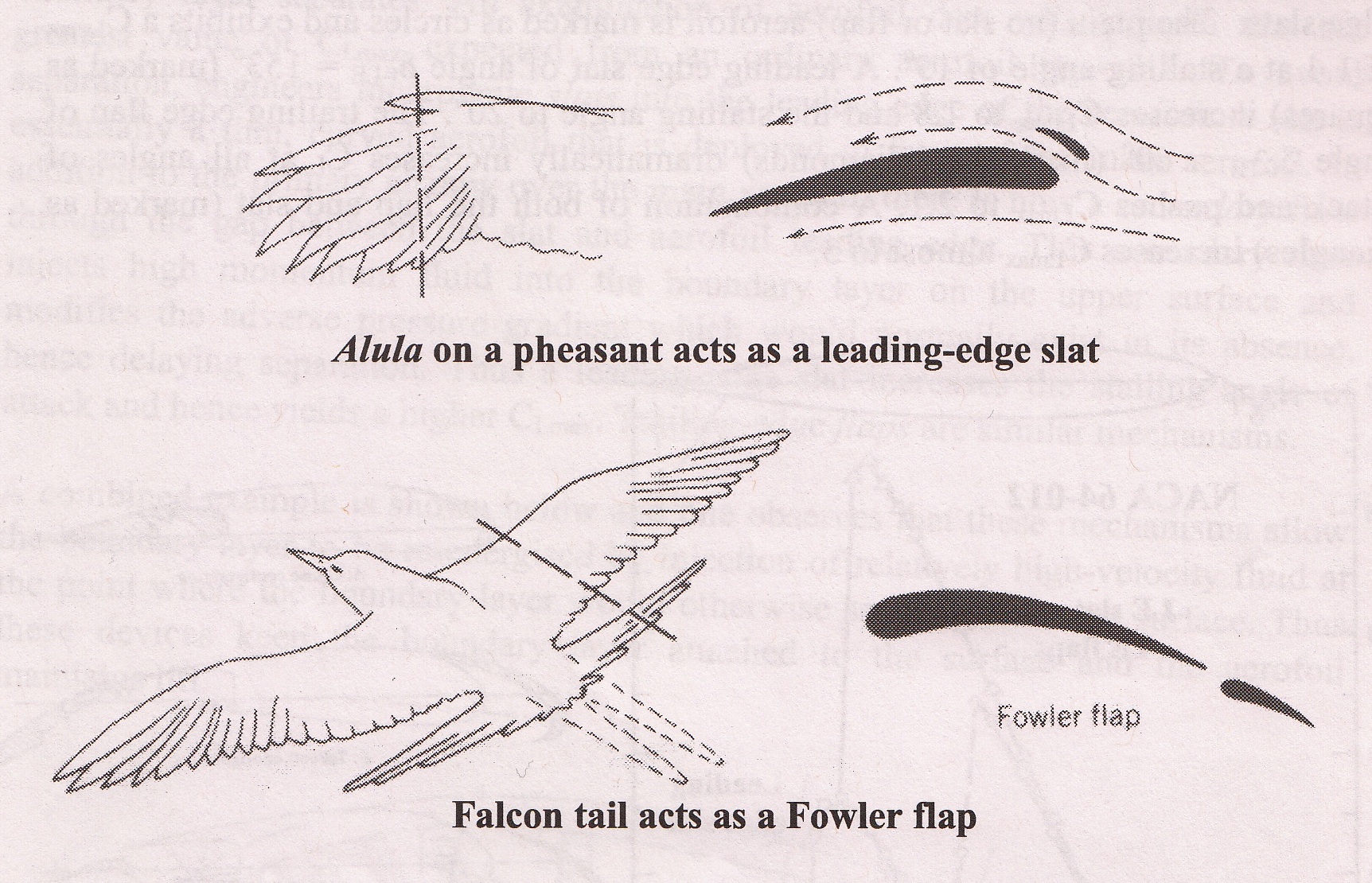
    Nature has provided the perfect laboratory for the evolution of aerofoils and similar to many other engineering innovations leading-edge slats and trailing-edge flaps are mimicked from bird flight. The sketches below show that the pheasant uses the front Alula feather as a leading edge slat, while the tail of the Falcon takes the form of a trailing edge flap (Figure 6). Many research institutes are currently spending considerable amounts of money into the development of other shape morphing mechanisms exhibited by birds such as ruffling of feathers, increasing the camber of the wing, lengthening the span or inducing a degree of surface roughness. However, these technologies require materials that are compliant enough to rapidly deform into the required shape, while stiff enough to resist the aerodynamic loads. Unfortunately our current material systems do not facilitate such capabilities.

    Fig. 4. Different Wing configurations during flight (2).
    Fig. 5 The position of the leading edge slats on an airliner (Airbus A310-300). (Photo credit: Wikipedia)
    Fig. 6. Slats and Flaps as seen on birds in Nature (2).


    References

    (1) http://www.centennialofflight.gov/essay/Theories_of_Flight/Skin_Friction/TH11G3.htm

    (2) Lock, G.D. (01. 2009). “Fluid Mechanics with a Historical Perspective”. University of Bath. Bath, UK

  • Bio-mimetic Drag Reduction – Part 3: Morphing

    In the previous two posts of this blog series I introduced the different sensing mechanism that aquatic animals possess to create spatial images of the largely turbulent flow fields around them. Flow sensing has been shown to serve as a means of communication in schooling fish, for orientation in currents and for sensing the surrounding environment when the tactile or visual senses are impaired [1]. In 1936, Gray used a simple hydrodynamic model of a rigid dolphin with a turbulent boundary layer to calculate the power required to overcome the drag exerted by the water [2]. Quite surprisingly, the results suggested that the calculated drag could not be overcome by the available dolphin muscle power…

    This controversy has since been known as “Gray’s Paradox”, and Gray concluded that dolphins must possess some sort of mechanism to reduce skin friction drag by maintaining a fully laminar boundary layer. Today it has been shown that basic assumptions in Gray’s analysis were flawed and that experimental data on the muscle power of dolphins was largely underestimated [3 – 4]. Nevertheless, the idea that dolphins are capable of maintaining a laminar boundary layer became the basic premise for research into dolphin drag reduction for almost 60 years. While it is now known that the boundary layer around swimming dolphins is largely turbulent, this focus of research has led to some interesting observations that may give useful insight into bio-mimetic applications for future aircraft or marine vehicles.

    The study of dolphins and sharks is especially interesting because they have undergone millions of years of natural selection and, according to Darwin’s argument, are therefore pretty “fit” for survival in the aquatic environment. For dolphins the streamlined “teardrop” shape (Figure 1) provides the most drag reduction and other perceived “wonder-mechanisms” such as skin-folds observed by Essapian [5] do not contribute to any reductions in drag. In actual fact, the skin-folds observed by Essapian occur due to the compliance of the soft dolphin skin and are also observed for swimming humans [6]. The streamlined shape of the dolphin has a point of maximum thickness at 45% of the body length, and since adverse pressure gradients only occur beyond this point, the “teardrop” profile helps to confine boundary layer separation to a posterior section of the body, thus resulting in less pressure drag. Unsurprisingly, this streamlined profile has since been exploited in modern boat hulls and submarines such as the 1953 USS Albacore (Figure 2).

    Fig. 1 Streamlined teardrop profile of dolphin (4)
    Fig. 2. USS Albacore. Profile inspired by streamlined bodies found in nature (12)

    An active control mechanism employed by many fish to reduce the high skin friction drag inherent of a turbulent boundary layer  is mucus excretion. Fish secrete a combination of polysaccharides, lipids and lipoproteins through pores on the skin into the boundary layer to fill irregularities of the surface and improve streamlining. Most importantly, the mucus has a lower viscosity than the water around the fish, which helps to reduce the frictional shear stresses arising from the “stickiness” or viscosity of water. As can be observed in Figure 3 the velocity gradient at the wall is consequently less pronounced resembling a laminar boundary layer with reduced skin friction drag (Figure 4). In the oil industry soluble, long-chain polymer additives have achieved very promising results. A ratio as small as one-in-a-million of these additives in oil pipelines has reduced skin friction drag by up to 30% [7].

    Fig. 3. Classic turbulent boundary layer profile and quasi-laminar boundary layer due to mucus excretion
    Fig. 4. Contribution of different forms of drag for laminar and turbulent flow (13)

    Similar to the flat plate parallel to oncoming flow discussed in the hydrodynamics post, flow measurements of swimming dolphins show that boundary layer is fully turbulent along the posterior section of the body while laminar and transitional boundary layers are observed towards the head. Kramer showed that dolphins are able to delay the transition to turbulent flow using their soft, compliant skin and therefore achieve some reductions in skin friction drag [8 – 9]. The viscoelastic properties of the skin interact with the flow over the body as a viscous damper and absorb energy from pressure oscillations known as “Tollmien-Schlichting waves” that can trip the boundary layer to go turbulent (Figure 5). Dolphins sense these pressure oscillations using canal neuromasts and then activate controlled muscular microvibrations to produce tremor-like skin vibrations of up to 5 mm amplitude at 7 – 13 Hz that destructively interfere with the Tollmien-Schlichting pressure waves (Figure 6). The transition to a turbulent boundary layer is thus delayed in order to achieve the best compromise of lower laminar skin-friction drag towards the head and allow turbulent flow in the posterior parts of the body to prevent boundary layer separation.

    Fig. 5 Tollmien-Schichting Wave over compliant dolphin skin.
    Fig. 6. Compliant dolphin skin acting as a viscous damper (14)

    Rather than trying to delay the onset of turbulent flow, sharks have evolved with an incredibly clever system of reducing turbulent skin friction drag using their denticle scales. At the same time the scales also serve to passively (without any muscular effort from the shark) prevent boundary layer separation. During the 1980’s research at NASA Langley revealed that a turbulent boundary layer on a surface with longitudinal ribs develops lower shear stress and consequently exerts less drag than the same flow profile on a smooth surface. In the previous post I explained that the exchange of fluid normal to the surface in a turbulent boundary layer causes a steeper velocity gradient and therefore higher skin friction drag. In 3-D flow this momentum transfer will also occur in the lateral z-direction by cross flow vortices (Figure 7).Ribs on the surface aligned in the mean flow direction prevent this lateral transfer of momentum and result in a more gradual velocity profile with less shear stress. With optimal ribbed blade height of half the rib spacing Bechert et al. [7] showed a drag reduction of 9.9% using a metal plate. Unsurprisingly such a ribbed profile is also present on the scales of sharks (Figure 8).

    Fig. 7. Riblets preventing lateral crossflow of turbulent boundary layer (top) and graph of subsequent drag reduction (7)
    Fig. 8. Shark scales (top) and ribbed plate tested by Bechert et al. (7)

    Bechert et al. manufactured a representative wind-tunnel model of 800 plastic scales using electric discharge machining with compliant anchorings to model the bristling of the scales. With this model only a modest decrease in drag of 3.3% was achieved due to losses arising from the gaps between the scales. On the other hand a significant increase in drag of over 10% was measured if the scales were bristled, thus forced upright as observed on swimming sharks.

    Consequently, the researchers were facing the question why shark scales bristle and not remain nicely attached to maintain a streamlined profile?

    Boundary layer separation is initiated by a flow reversal in the boundary layer i.e. the flow locally flows opposite to the direction of motion (Figure 9). As the boundary layer is about to separate the flow reversal causes the scales to bristle and erect passively (without any input from the shark) acting as vortex generators, which on one hand increase friction drag, but on the other hand energise the boundary layer by forcing high momentum fluid from the free stream towards the skin surface [10] (Figure 10). Thus, just as the boundary layer is about to separate, bristling is automatically activated and boundary layer separation is prevented which would otherwise lead to a significant increase in pressure drag.

    Fig. 9. Boundary layer separation initiated by local flow reversal (15)
    Fig. 10. Bristled scales (right) and subsequent formation of vortices between scales (10)

    The riblet research by NASA Langley led 3M to develop a riblet polymer film that could readily be coated on a surface like an exterior paint. This smart skin helped the American Stars and Stripes yacht win the America’s cup in 1987 before the technology was banned. Since then the technology has been tested on large civil aircraft such as the Airbus A320 and also smaller business jets and fighter aircraft with more moderate reductions in drag of around 2% [7]. At the same time researchers at MIT have been trying to emulate the canal neuromasts sensory system found in fish using a flexible membrane covering a number of cavities with integrated microelectromechanical systems (MEMS) to serve as pressure sensors for flow over a surface (Figure 11) [11].

    Fig. 11. Pressure sensing skin using MEMS (11)

    At the same time compliance of the elastomer membrane would allow active changes to the skin profile to either prevent boundary layer separation (e.g. via “bristling” controlled by skin buckling) or mitigate laminar-to-turbulent boundary layer transition (e.g. via skin vibrations). In this manner a truly multifunctional “smart” skin could be developed that actively senses the flow field around a body via the pressure sensors and then changes the profile of the skin by thin film deformations. However, considerable research is yet required to make such systems a reality in the future…


    References

    [1] Windsor, S., & McHenry, M. (2009). The influence of viscous hydrodynamics on the fish lateral-line system. Integrative

    and Comparative Biology , 49, 691-701.

    [2]Gray J 1936 Studies in animal locomotion: VI. The propulsive powers of the dolphin J. Exp. Biol. 13 192–9

    [3]Williams T M, Friedl W A, Fong M L, Yamada R M, Sedivy P and Haun J E 1992 Travel at low energetic cost by swimming and wave-riding bottlenose dolphins Nature 355 821–3

    [4] Fish, F. (2006). Thy myth and reality of Gray’s paradox: implication of dolphin drag reduction for technology. Bioinspiration & Biomechanics , 1, R17-R25.

    [5] Essapian F S 1955 Speed-induced skin folds in the bottle-nosed porpoise Tursiops. truncatus. Breviora Mus. Comp. Zool. 43 1–4

    [6] Aleyev Y G 1977 Nekton (The Hague: Junk)

    [7] Bechert, D., et al. (2000). Fluid Mechanics of Biological Surfaces and their Technological Application. Naturwissenschaften , 87, 157-171.

    [8] Kramer M O 1960a Boundary layer stabilization by distributed damping J. Am. Soc. Nav. Eng. 72 25–33

    [9] Kramer M O 1960b The dolphins’ secret New Sci. 7 1118–20

    [10] Lang, A., et al. (2008). Bristled shark skin: a microgeometry for boundary layer control? Bioinspration & Biomimetics , 3, 1-9.

    [11] Stauffer, N. (2011). Going with the flow: Biomechanic pressure sensors help guide oceangoing vessels. MIT. MIT.

    [12] http://www.britannica.com/EBchecked/media/142063/USS-Albacore

    [13] Fish, F. Imaginative solutions by marine organisms for drag reduction. West Chester: West Chester University.

    [14] Wiplier, O., & Ehrenstein, U. (2000). Numerical simulation of linear and nonlinear disturbance evolution in a boundary layer with compliant walls. Journal of Fluids and Structures , 14, 157-182.

    [15] http://sci-fix.blogspot.co.uk/2010/08/paragliding-aerodynamics.html

    Gallery


  • Bio-mimetic Drag Reduction – Part 2: Aero- and Hydrodynamics

    Part 1 of this blog series outlined the different sensing mechanisms that aquatic animals possess to create spatial images of the flow fields around them. In summary fish were found to possess a network of mechanosensors distributed over their bodies called the lateral line. The lateral line consists of two separate sensory subsystems:

    • a system of velocity-sensitive superficial neuromasts that responds to slow, uniform motions and that integrates large scale stimuli at the periphery such as constant currents

    and

    • a system of acceleration- or pressure-gradient-sensitive canal neuromasts that responds to rapidly changing motions and gives the fish the opportunity to orient towards sources such as prey or optimize swimming speed or tail-flapping frequency.

    In this post I will give a brief overview of general hydrodynamic theory and specifically the flow patterns that swimming fish are expected to sense with their network of neuromasts.

    When a body moves relative to a fluid, a boundary layer exists close to the wall because of the “no slip” condition, which arises from the inherent stickiness or so-called viscosity of the fluid. Therefore, fluid in direct contact with the wall adheres to the surface while fluid further away is slowed due to the frictional forces arising from viscosity. This results in a thin layer of fluid where the velocity increases in a U-profile from zero at the wall to the free stream velocity some distance d from the surface; defined as the boundary layer thickness (Figure 1).

    Fig. 1. Boundary layer close to a surface (1).

    Generally speaking fluid flow can be classified as either laminar or turbulent. In laminar flow (derived from “lamina” meaning finite layers) the fluid moves in lamina or layers of finite speed and with no mixing of the fluid perpendicular to the wall i.e. across layers. As the name suggest in turbulent flow everything is a bit more chaotic with active mixing of the fluid and momentum transfer throughout the boundary layer (Figure 2).

    Fig. 2. Laminar and Turbulent Boundary Layer (2).

    The type of flow depends on the shape of the body, upstream history of the flow, surface roughness and most importantly the Reynolds Number. The Reynold’s number Re is a non-dimensional ration of the inertial forces to the viscous forces arising in the fluid defined by,

    where p is the density of the fluid, v the velocity, u the viscosity and D a characteristic dimensions that describes the body under investigation. At certain critical Reynold’s number there is a natural transition from laminar to turbulent flow. For example if we consider the plate in Figure 3 we can observe that a boundary layer forms close to the surface once the flow encounters the leading edge of the plate. Initially the boundary layer thickness is very small but as we proceed along the length of the plate the boundary layer becomes thicker as increasingly more fluid is slowed down by the frictional effects of viscosity. The characteristic dimension for Re in this case is the distance l from the leading edge. This means that close to the leading edge where l is small the flow will be laminar while at a certain distance lcritical the critical value of Re is reached an the flow naturally transitions to turbulent flow.

    Fig. 3. Laminar to turbulent transition over flat plate (2).

    Now there are two major types of drag: skin friction drag, which is similar to the friction force you feel when you rub your hand over a table-top, and pressure drag, which results from a difference in fluid pressure between the front and rear of the body. As intuitively expected skin friction drag depends on the viscosity (stickiness) of the fluid but also the relative difference in velocity between different layers of fluid. Figure 3 shows that in a turbulent boundary layer the flow velocity increases more rapidly as we move away from the wall compared to a laminar boundary layer. The steeper velocity gradient close to the wall therefore means that skin friction drag is higher for a turbulent boundary layer (Figure 6).

    Fig. 4. Boundary layer separation (3).

    On the other hand pressure drag is greatly exacerbated by a phenomenon called boundary layer separation. When flow encounters an adverse pressure gradient (i.e. the fluid pressure increases in the flow direction as found after the point of maximum thickness in aerofoils e.g. Figure 5) the flow has to work against the increase in pressure leading to momentum losses and decelerations in flow. As the flow speed in the boundary layer continues to decreases in the direction of the adverse pressure gradient, at some point the slowest moving fluid close to the wall will actually change direction (Figure 4). This is called boundary layer separation and leads to a larger wake of vortices forming behind the body. The fluid pressure in the vortex wake is much lower than in regions of attached flow close to the leading edge and this pressure difference will therefore push the body backwards. As described earlier the flow velocity in a turbulent boundary layer close to the wall is higher than in a turbulent boundary layer.  This initially higher fluid momentum means that flow separation occurs further downstream than for laminar flow, resulting in a narrower wake and thus less pressure drag.

    Fig. 5. Boundary layer separation over aerofoil (4).
    Fig. 6. Effect of flow type on drag (5)

    Therefore, we have two conflicting criteria to minimise drag as depicted in Figure 6:

    • Skin friction drag is minimised by laminar flow and greatly worsened by turbulent flow

    While

    • Pressure drag is minimised by turbulent flow and greatly worsened by laminar flow

    However, it is also clear that overall minimum drag is encountered for purely frictional drag with a laminar boundary layer. Now it is often very difficult to maintain a laminar boundary layer due to chaotic flow conditions that occur further upstream or just due to the inherent surface roughness that can “trip” the boundary layer to go turbulent. In actual fact this “tripping” of the boundary layer is utilised in a controlled fashion in a golf ball. The dimples or indentations on a golf ball serve to trip the naturally low Reynold’s number and therefore laminar flow around a golf ball to go turbulent. The delayed boundary layer separation results in a narrower wake, less pressure drag and thus more distance on Tiger’s drive (Figure 7).

    Fig. 7. Delay of flow separation by dimples on a golf ball (6).

    If we look at a cross-section of a dolphin (Figure 8) we observe that the general shape is very much the same as that of the aerofoil wing-shape in Figure 5. In fact early wing designs were based on anatomical studies on dolphins, trout and tuna by the “father of aerodynamics” Sir Lord Cayley during the late 18th century. In dolphins the point of maximum thickness occurs at around 45% of its length in order to push the point of flow separation backwards and minimise pressure drag. This design has since inspired the shape of modern boat hulls and submarines such as the USS Albacore launched in 1953 (Figure 9).

    Fig. 8. Streamlined “teardrop” shape of dolphin (7).
    Fig. 9. USS Albacore based on biomimetic dolphin design (8).

    Similar to the plate example of Figure 3 for gliding fish the boundary layer is laminar close to the head and then transitions to turbulent flow further downstream. However, for actively swimming fish the boundary layer is generally highly turbulent due to the unsteadiness created by the undulation motion of the body. Based on the fact that it is very difficult to maintain laminar flow around their bodies, the third and final post of this series will investigate how fish attempt to reduce the naturally higher skin friction drag associated with turbulent flow.


    References

    [1] Anderson, E., et al. (2001). The boundary layer of swimming fish. The Journal of Experimental Biology , 204, 81-102.
    [2] http://www.lcs.syr.edu/faculty/glauser/mae315/fluids/MAE315Lab4Week1.htm
    [3] http://sci-fix.blogspot.co.uk/2010/08/paragliding-aerodynamics.html
    [4] http://www.centennialofflight.gov/essay/Theories_of_Flight/Skin_Friction/TH11G3.htm
    [5] Fish, F. Imaginative solutions by marine organisms for drag reduction. West Chester: West Chester University.
    [6] http://www.pinoygolfer.com/forum/viewtopic.php?f=4&t=3291
    [7] Fish, F. (2006). Thy myth and reality of Gray’s paradox: implication of dolphin drag reduction for technology. Bioinspiration & Biomechanics , 1, R17-R25.
    [8] http://www.britannica.com/EBchecked/media/142063/USS-Albacore