
Category: News

  • UKRI Future Leaders Fellowship

    UKRI Future Leaders Fellowship

    I am pleased to say that I have been awarded a Future Leaders Fellowship by UK Research & Innovation.

    The fellowship aims to demonstrate how lightweight and sustainable shell structures can be manufactured from reclaimed-fibre composites, accelerating the sustainable use of composite materials. To achieve this, the project will combine state-of-the-art manufacturing technologies and simulation tools across design and process simulation, and link key stakeholders along a new value chain.


    Fibre-reinforced composites are used in many engineering applications where lightweight structures are needed. Composites are, however, currently deemed an unsustainable material choice for a circular economy owing to challenges around recycling. Existing recycling processes break the reinforcing fibres into shorter lengths, thereby leading to worse mechanical properties than the pristine material. As a result, recycled composites are currently used for predominantly low-value and non-structural applications.
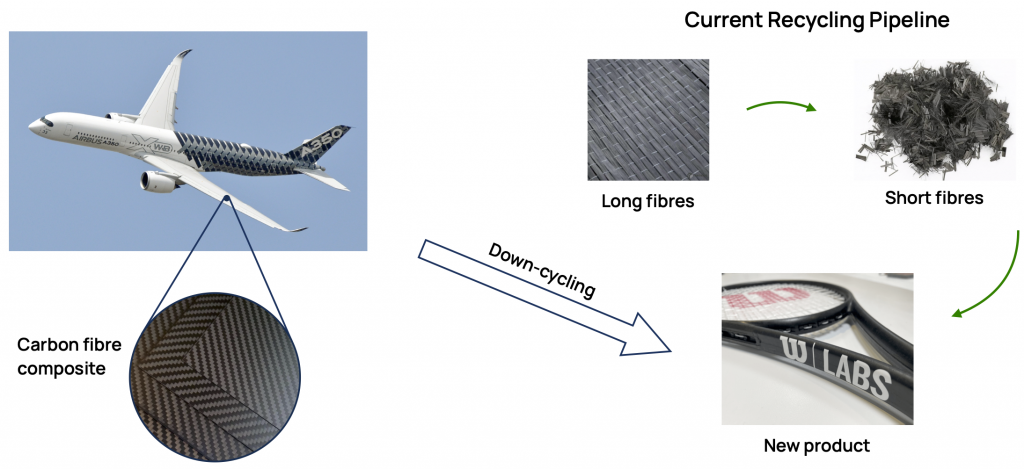
    Current composites recycling value chain

    The vision of my fellowship is to develop high-performance composite structures that are manufactured from recycled carbon fibre. This will be achieved by taking advantage of the unique processing benefits of short-fibre composites; in particular, the ability to form defect-free doubly curved shapes and the ability to easily steer the material along curvilinear trajectories. Using both computational design and automated manufacturing, my goal is to create ultra-lightweight structures that optimally combine geometry and material anisotropy.
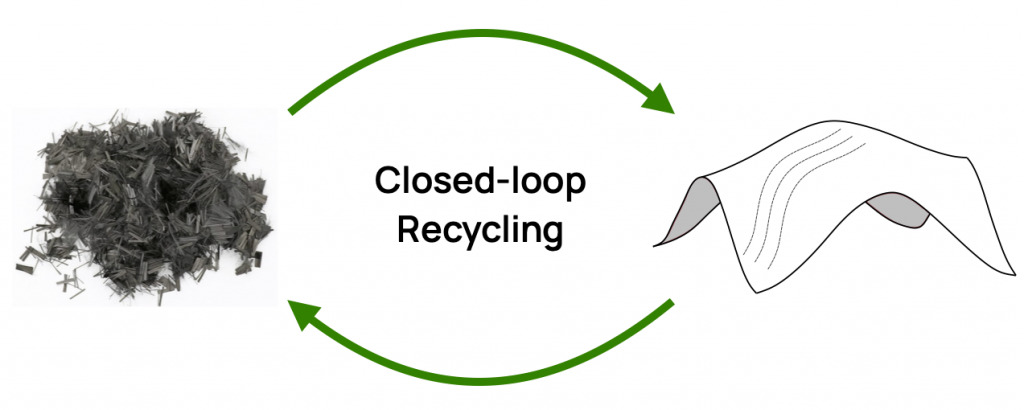
    Several composite mega-structures are coming to the end of their planned service life. The current recycling approach is to either downcycle the embodied material into lower value applications or to bury the material in landfill. To prevent this terrible waste, new recycling approaches are acutely needed.

    By the end of the fellowship, my ambition is to have demonstrated the feasibility of an end-to-end value chain, ranging from material sourcing to a manufactured and tested structure with applications in high-value added industries such as aviation.
  • BladeUp: an EPSRC Prosperity Partnership

    BladeUp: an EPSRC Prosperity Partnership

    Led by Alberto Pirrera at the Bristol Composites Institute, we’ve been awarded a Prosperity Partnership grant in collaboration with Vestas Wind Systems and LMAT.

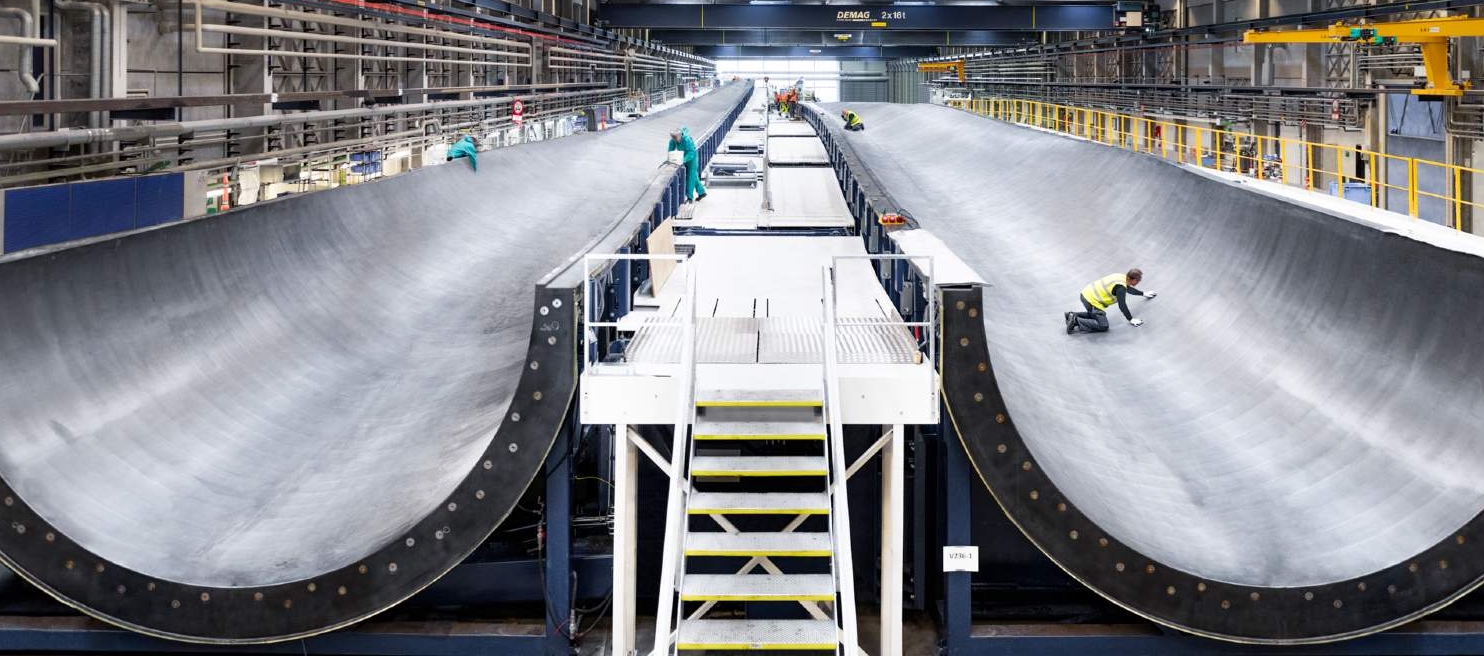
    The BladeUp project will secure the upscaling of wind turbine blade production capacity to meet growing demand in clean wind energy.

    The project will transform the design and manufacture of wind turbine blades using advanced computer modelling and machine learning, thereby cutting costs, reducing waste and speeding up production to make wind energy more affordable and reliable.


    The push towards sustainable energy has increased the need for renewable sources likes wind power. Meeting this rising demand requires a scale-up in wind turbine production capacity while maintaining manufacturing quality. Some estimate a required tripling in global renewable capacity by 2030 to meet net-zero emission targets.

    Straight-forward approaches like building more factories to raise production are very expensive. In addition, quality production relies on a skilled workforce which is not abundant in the short term. Finally, increasing production speed is likely to lead to more defects with downstream effects on turbine lifespan and in-service repairs.

    A new approach is clearly needed to increase production while maintaining quality.

    The BladeUp partnership between the University of Bristol, Vestas and LMAT aims to develop a different approach based on the following objectives:

    • new turbine blade designs that are optimised for ease and speed of manufacturing
    • new turbine blade designs that are inherently tolerant to manufacturing imperfections and design uncertainty
    • devising new streamlined processes for “right-first-time” manufacturing at speed and scale

    We anticipate that addressing these goals will also have spillover effects into other industry sectors where composite materials are used at scale.