Kirigami is the sister of the more well-known origami. While origami focuses on creating art out of folding paper, kirigami extends this to allow for cuts to be introduced. Both origami and kirigami have been researched extensively over the last decade to explore potential applications in structural engineering.
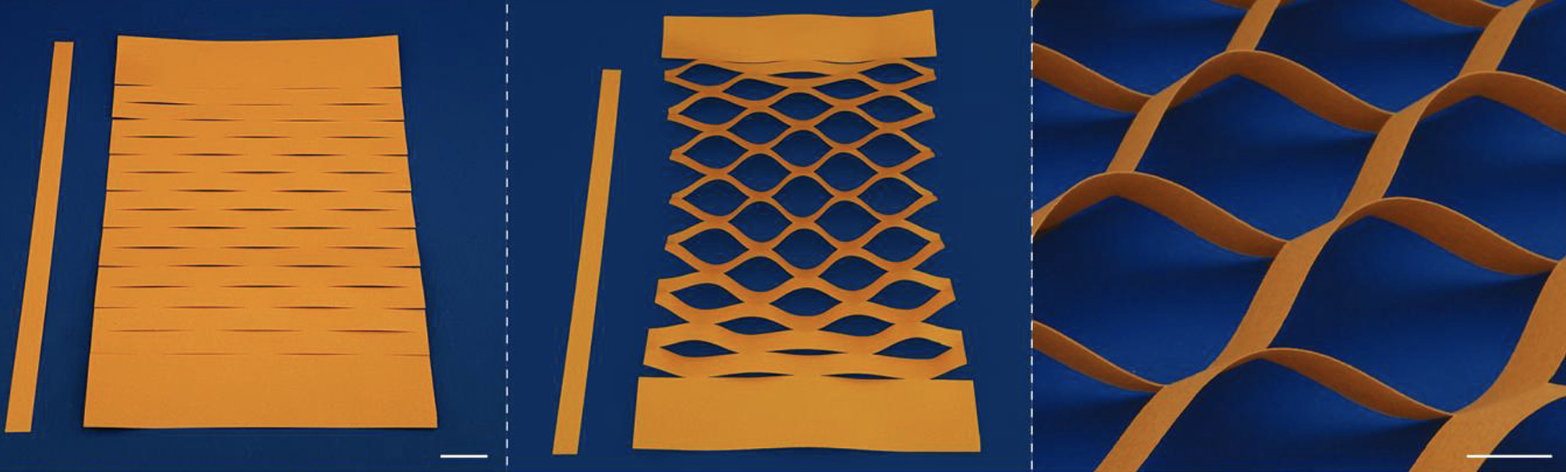
For example, when a parallel matrix of cuts is introduced into a sheet of paper and that sheet is then tensioned, the cells between the cuts buckle out-of-the-plane to form a pattern. This effect is currently being used for expandable packaging but also to create lightweight tension springs for space applications.
What is interesting is that depending on the ratio of cut length to vertical and horizontal cut spacing, different patterns can form. The cells either buckling anti-symmetrically, symmetrically or into a mixture of these two motifs (co-existence). These three behaviours lead to significantly varying tensional stiffness, which means that design approaches are needed to predict the buckling onset and stiffness correctly.

To date, the three regimes have largely been explored using computational methods, e.g. finite element analysis. These methods are very accurate but tend to be slower than analytical methods and require designers to have access to sophisticated modelling software. In a recent publication, one of my PhD students (Yuwen Du) and I have introduced an analytical model that correctly predicts buckling loads as well as the buckling modes into the three possible configurations.
With such a model it is now possible to rapidly design with this particular kirigami structure. In addition, the model has allowed us to delineate the energetic contributions that force the kirigami sheet to buckle into the anti-symmetric or the symmetric mode.